Quick Answer
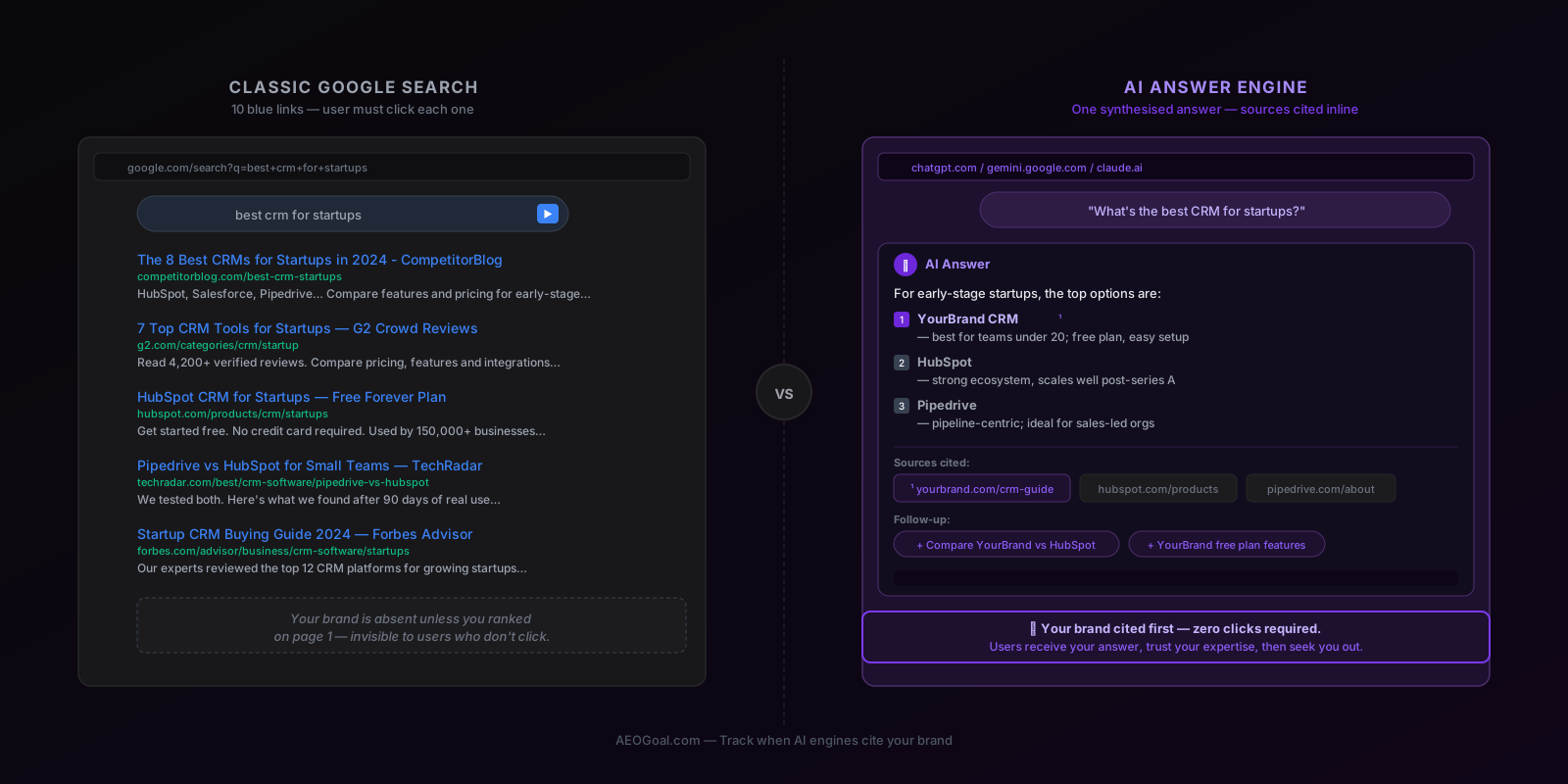
SEO rank tracking tools such as AccuRanker, Advanced Web Ranking, SE Ranking, and Mangools report where pages rank in search results, by keyword, market, and device. What they cannot see is the growing share of research that ends inside a generated answer: whether ChatGPT, Claude, Gemini, or Perplexity mention or cite the brand. AEO Goal includes daily Google rank tracking and adds that AI answer layer, with every gap turned into a concrete fix and re-checked.
What a rank tracker actually measures
A rank tracker answers one question with precision: for keyword K, in market M, on device D, what position does this URL hold today, and how has that moved? Around that core, mature trackers add SERP-feature detection, share-of-voice estimates across a keyword set, competitor position overlays, and scheduled client reporting. It is a well-solved problem, which is exactly why the category competes on update frequency, data accuracy, market coverage, and price rather than on what is measured.
That precision has a boundary. The measurement unit is a position in a list of links. When the buyer’s question is answered by a generated response instead of a click on that list, position data has nothing to say about whether the brand appeared, because the answer engine composed its response from sources it chose, cited a handful of URLs, and named a handful of brands. Ranking well makes citation more likely; it does not make it happen, and the gap between the two is invisible to every tool in this category.
The established rank tracking tools, honestly summarized
These notes cover well-known public positioning as of early 2026, deliberately without pricing figures, because rank-tracker pricing and limits change frequently. Verify current packaging with each vendor.
- AccuRanker. A dedicated rank tracker, widely regarded as one of the fastest in the category, with daily updates and on-demand refreshes. It does one job deeply rather than bundling a suite. See our direct comparison: AEO Goal vs AccuRanker.
- Advanced Web Ranking. One of the longest-running rank trackers, known for flexible update scheduling, broad search-engine and market coverage, and strong white-label reporting for agencies.
- SE Ranking. An all-in-one suite anchored by its rank tracker, adding keyword research, audits, and backlink data at a mid-market price point. Compared directly in AEO Goal vs SE Ranking.
- Mangools (SERPWatcher). A budget-friendly toolkit whose rank tracker favors simplicity over configurability, popular with freelancers and small teams. Compared directly in AEO Goal vs Mangools.
- Wincher and Nightwatch. Smaller dedicated trackers, respectively known for affordability and for agency-oriented tracking and reporting flexibility.
All of these are competent at the ranking question. None of them reads AI answers as a measurement surface, which is not a criticism, it is a category boundary.
| Evaluation area | Rank tracking question | AEO question |
|---|---|---|
| Measurement unit | What position does a page hold for a keyword? | Is the brand mentioned or cited in the generated answer? |
| Competitive view | Which domains rank above us? | Which competitors do engines recommend, prompt by prompt? |
| Source detail | Which SERP features or URLs appear? | Which source URLs did the engine actually cite, and do they verify? |
| Reporting | Are rankings improving by market and device? | Is Share of Model improving across prompts and engines? |
| Actionability | Which pages need SEO work? | Which prompt was lost, to which competitor page, and what fix closes it? |
Where AEO Goal fits
AEO Goal is not a rank-tracker replacement pitch; it ships the rank tracker. Daily Google position tracking, keyword research, and backlink analysis with a DR-weighted Domain Score are part of the platform, so the classic question keeps getting answered. What changes is the second layer in the same workspace: AI visibility tracking runs your buyer prompts across ChatGPT, Claude, Gemini, and Perplexity on a schedule, and AI citation tracking records which source URLs each engine cited, verifying every cited URL in two stages before it counts, per the published methodology.
The differentiator to test in a trial is the agent loop. A tracker, rank or AI, reports a number. AEO Goal names the prompt you lost, shows the competitor URL the engine cited, explains why your page was skipped, generates the brief or technical fix, and re-checks on the next scan whether the number moved. If your team’s real bottleneck is “we know the number, we do not know the next action,” that loop is worth more than a faster refresh interval.
The honest boundary: if your entire requirement is deep classic rank tracking, with exotic market matrices, minute-level refreshes, or white-label reporting as the core deliverable, a dedicated tracker like AccuRanker or Advanced Web Ranking is the specialist for that single job. AEO Goal’s daily tracking covers the mainstream need; its reason to exist is the layer the specialists do not measure.
How to run the evaluation
- Write down the questions you actually report on. If every stakeholder question is about positions and traffic, you need a rank tracker. If any question is “why does ChatGPT recommend the competitor,” you need the AI layer too.
- Test the AI layer on your own brand. Run your top twenty buyer prompts through the engines your market uses and check: were you mentioned, was your page cited, who won instead? AEO Goal’s free scan from the homepage does a first pass without signup.
- Check the unit economics of running two tools versus one. A dedicated tracker plus a separate AI visibility tool means two subscriptions, two prompt/keyword sets, and stitched reporting. One platform with both layers means one backlog, which is the argument for consolidation - and consolidation is only honest when the bundled tracker actually covers your ranking needs, so verify that first.
- Demand methodology, not vibes. Any AI visibility vendor should publish how prompts are run, what is excluded, and how citations are verified. If the method is not written down, the numbers are not auditable.
When rank tracking alone still suffices
- Your buyers demonstrably search and click; AI answers are marginal in your category so far.
- Reporting obligations are position-and-traffic contracts, especially agency deliverables.
- You need location- or device-specific position evidence at fine granularity.
When you need the AI answer layer
- Buyers ask ChatGPT, Claude, Gemini, or Perplexity before or instead of clicking results.
- Competitors appear in generated answers even where your pages outrank them.
- Leadership wants Share of Model, citation trends, and answer sentiment on the same report as rankings.
- The content team needs to know which pages engines can extract and cite, and what to fix when they cannot.
For the broader tool landscape, see best AI SEO tools; for the conceptual split, see AEO vs traditional SEO; and if the category is new to you, start with what is AEO.