Quick Answer
AccuRanker and AEO Goal measure different surfaces, which is why this comparison is worth five minutes even if you already own one of them. AccuRanker is a dedicated, specialist rank tracker known for the speed and scale of its position tracking: it tells you, with precision, where a URL stands in the ranked list of results. AEO Goal reads the generated answer itself - whether ChatGPT, Claude, Gemini, Perplexity, or Google AI Overviews mention and cite your brand, at what citation rate, share of model, and sentiment - and then does what no tracker does: it ships the fix and re-checks it on the next scan. The uncomfortable fact that connects them: a page can hold position 1 and still be absent from the AI answer that intercepted the click. If your team needs specialist-grade, high-frequency position tracking at scale, keep the specialist. If your team needs to see and win the answer layer, that is AEO Goal’s core job, and many teams run both.
Are these tools even in the same category?
No, and pretending otherwise would insult the buyer this page is written for. If you are evaluating AccuRanker seriously, you are probably an in-house or enterprise SERP team that cares about measurement rigor: clean position data, granular market and device splits, defensible share-of-voice math. That rigor deserves respect, not a bait-and-switch pitch.
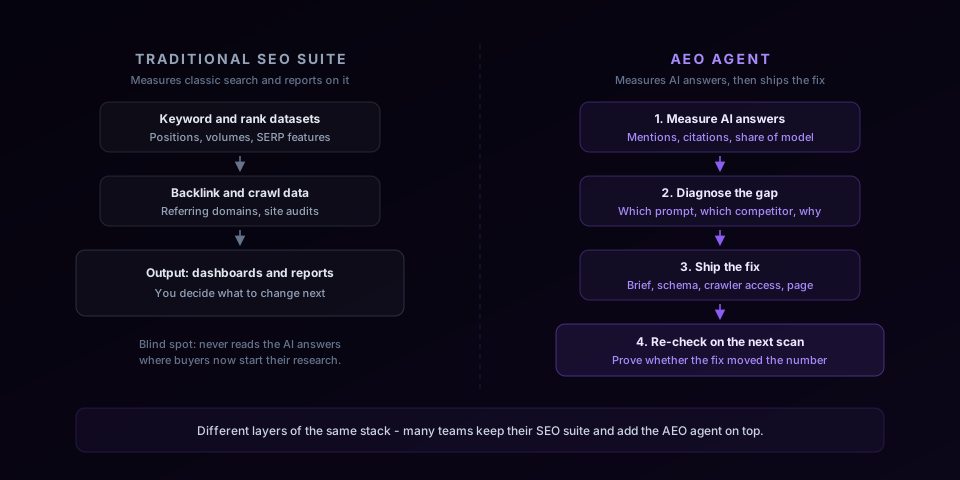
So here is the honest category split. AccuRanker sits in the dedicated rank tracking category: one job, done deeply, which is exactly how our rank tracking tools comparison describes it. AEO Goal is an answer engine optimization platform and, more precisely, an AEO agent: it measures AI answers directly, diagnoses why a brand was skipped, generates the fix, and verifies the result - while also carrying a classic SEO layer (keyword research, daily Google rank tracking, backlinks) so its findings land in one backlog instead of two tools. The comparison is not “which tracker is better.” It is “which surfaces does your measurement program actually cover?”
What is AccuRanker built for?
Described by its broadly known category role, and deliberately without claims about current pricing, packaging, refresh rates, or database sizes (verify those with the vendor): AccuRanker is a specialist position tracker, widely regarded as one of the fastest in its category, built for teams that treat rankings as a first-class dataset rather than a side widget in a suite. The buyer it serves wants position evidence they can defend in a meeting: by keyword, by market, by device, over time, with competitor overlays.
That is a real and durable job. Rankings still drive real traffic, agencies still sign position-and-traffic contracts, and a specialist that does one thing deeply is often the right procurement call. Nothing on this page argues otherwise.
What is AEO Goal built for?
AEO Goal is built for the question position data cannot answer: when a buyer asks an AI engine about your category, are you in the answer? Concretely, the platform runs as a loop:
- Measure. Your priority prompts run across ChatGPT, Claude, Gemini, and Perplexity on a schedule. Each generated answer is parsed for brand mentions, cited source URLs, position within the answer, and sentiment - producing citation rate, share of model, and competitor overlap per engine. The method is published in the AI citation tracking methodology, because unauditable numbers are worthless to a team that cares about rigor.
- Diagnose. A free scan checks the mechanical prerequisites of being cited: robots.txt access across 16 AI agents, llms.txt, sitemap, JSON-LD structured data, metadata, and entity salience.
- Fix. Every gap ships with a concrete action - an answer-first brief, a schema change, a crawler-access fix - ranked by impact in one prioritized backlog.
- Re-check. The next scan shows whether the fix moved citations, share of model, or rankings. That closed loop is what makes it an agent rather than another dashboard; the full argument is in AI SEO software.
Alongside that, AEO Goal carries keyword research, daily Google rank tracking, and backlink analysis with a DR-weighted Domain Score and an AEO Rank, so SEO findings and AEO findings live on the same list.
Position tracked vs answer cited
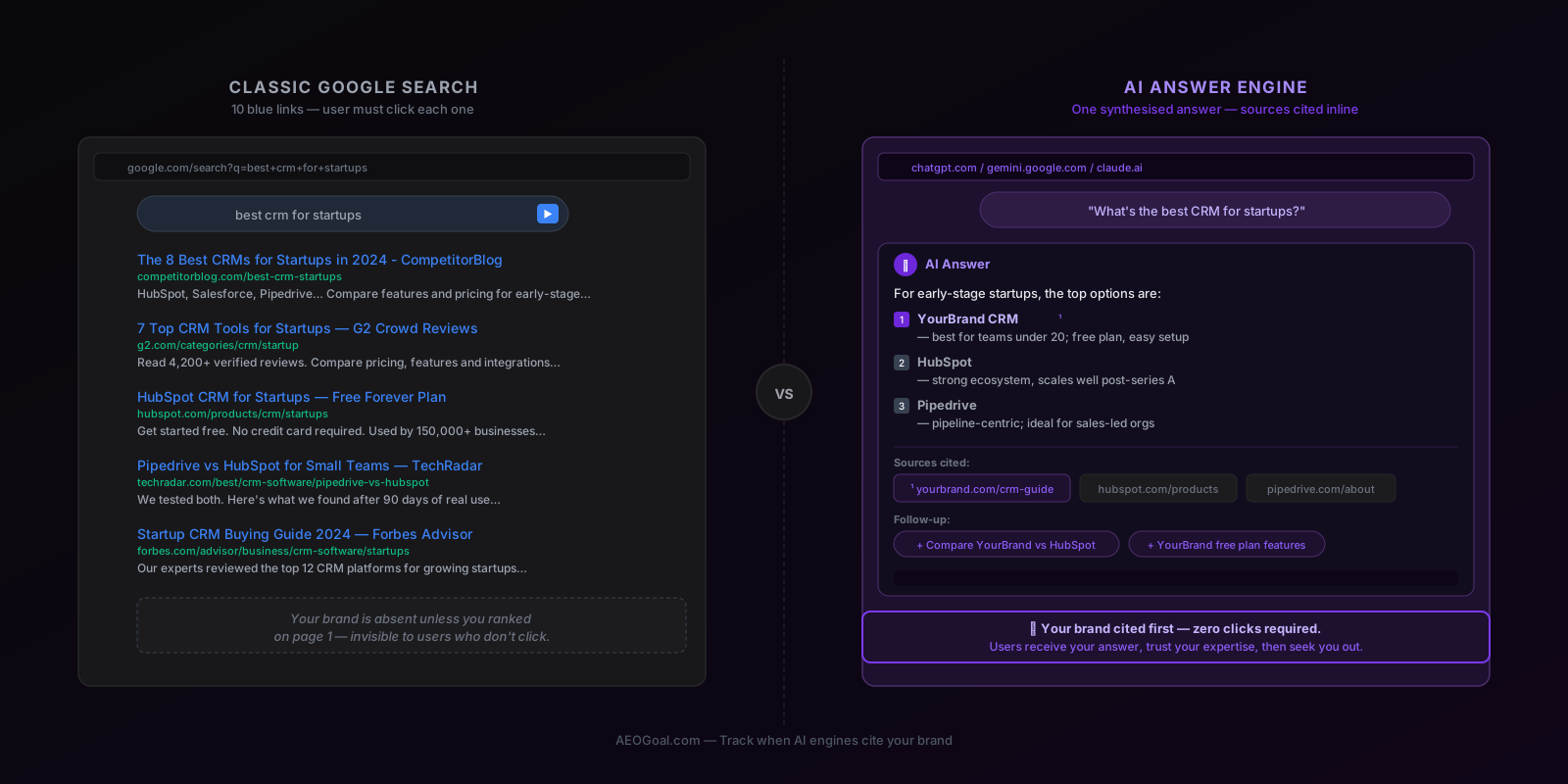
This is the crux, so treat it with the precision a measurement buyer expects. A rank tracker’s measurement unit is a position in a list of links. That unit is well defined, comparable over time, and - this is the limitation, not a flaw - silent about what happens inside a generated answer. The answer engine selects its own sources, cites a handful of URLs, and names a handful of brands. Ranking well correlates with being cited; it does not cause it.
The failure mode this creates is invisible by construction: you hold position 1, your tracker shows a flat green line, and the AI answer sitting above the results (or in the chat where the search never happened) recommends your competitor. Traffic softens, the ranking report says nothing changed, and the team debugs the wrong surface. AEO Goal exists to instrument that second surface with the same seriousness you already apply to the first: per-prompt, per-engine, mention vs cited-source distinction, trend lines, and verified citation URLs via AI citation tracking and AI visibility tracking.
AEO Goal vs AccuRanker: the decision table
| Question you are buying an answer to | Specialist rank tracker | AEO Goal |
|---|---|---|
| What position does URL X hold for keyword K, by market and device? | Core job, specialist depth | Daily Google tracking for priority keywords |
| Did ChatGPT, Claude, Gemini, or Perplexity mention us for buyer prompt P? | Not in the data model | Core job, per prompt and per engine |
| Which source URLs did the engine actually cite? | Not measured | Measured and verified per the published methodology |
| Which competitor wins the prompts we lose? | Position overlays only | Competitor AI visibility, prompt by prompt |
| Why were we skipped, and what do we change? | Out of scope | Diagnosis plus a concrete fix per gap |
| Did last month’s fix work? | Position delta only | Re-checked citations, share of model, and rankings |
| One backlog across SEO and AEO findings? | No, tracking only | Yes, one prioritized queue |
Read the table honestly and the shape of the decision is obvious: rows one and two are different surfaces, and a mature program in 2026 wants both instrumented.
When to keep or choose AccuRanker
- Your reporting obligations are position contracts: fine-grained market, device, and location evidence, at a scale and frequency a bundled tracker should not pretend to match.
- Rankings are still where your budget decisions get made, and AI answers are demonstrably marginal in your category so far.
- You are an agency whose deliverable is the ranking report itself.
In those cases the specialist is the right tool, and AEO Goal’s daily tracking of priority keywords is a complement, not a substitute. We would rather say that plainly than win a comparison page and lose the renewal.
When to run both
Most teams that take measurement seriously end up here. The specialist keeps answering the position question with full depth; AEO Goal instruments the answer layer and turns its findings into shipped fixes. The two never contradict each other because they never measure the same thing - which is also why “our rank tracker has AI features” is worth interrogating in a demo: ask whether it parses generated answers into citations, share of model, and sentiment, or whether it tracks the presence of an AI box as one more SERP feature. Those are different products. The conceptual split is laid out in AEO vs traditional SEO.
A worked example for the SERP-rigor buyer
Say you manage search for a B2B data platform. Your tracker shows position 1 to 3 for “customer data platform comparison” across your core markets - a defensible, well-measured win. Now run the same buying question as a prompt: “what is the best customer data platform for a mid-market team?” across ChatGPT and Perplexity. A plausible result: two competitors named, one analyst roundup cited, your brand absent - not because you rank poorly, but because your comparison page buries the direct answer, your entity signals are weak, and one AI crawler is blocked in robots.txt.
AEO Goal surfaces exactly that: the lost prompt, the competitor URL the engine cited, the diagnosis, an answer-first brief plus the crawler fix, and - on the next scan - whether your citation rate on that prompt moved. Your tracker was never wrong. It was measuring a different surface, and the gap between the two surfaces is where the pipeline was quietly leaking.
What to verify with each vendor before buying
House policy: this page makes no claims about AccuRanker’s current pricing, packaging, feature matrix, refresh rates, or database sizes, and you should not trust any comparison page that does. Verify directly:
- With AccuRanker: current plans and limits, update frequency, market and device coverage, share-of-voice methodology, API access, and how (or whether) AI answer surfaces appear in its data.
- With AEO Goal: which engines and prompts your plan covers, how citations are verified (the methodology is public), how findings become briefs and tasks, and current pricing.
- With both: data retention, SSO, subprocessors, API limits, and cancellation terms - the boring diligence that outlasts any feature chart.
The bottom line
If the question is “where do we rank,” a specialist tracker answers it with a rigor AEO Goal does not pretend to out-specialize. If the question is “are we in the AI answer, and if not, what do we ship this week to change that,” no rank tracker can answer it at all - and AEO Goal was built to answer it end to end, measurement through fix through re-check. You can see your own answer-layer standing in minutes: run the free AI visibility scan and find out which engines cite you, which skip you, and what to fix first. For the wider field, see best AI SEO tools.