What is local SEO?
Local SEO is the process of helping a business appear when people search for a product or service in a specific area. It covers Google Maps, the local pack, ordinary organic results, and the AI assistants people use to ask for recommendations.
For example, a dentist may want to appear for “dentist near me,” “emergency dentist in Madrid,” and “family dentist in Salamanca.” A plumber may target “boiler repair [city]” or “emergency plumber near me.” These searches have strong local intent because the searcher is looking for a nearby provider.
How to read a “dentist near me” result
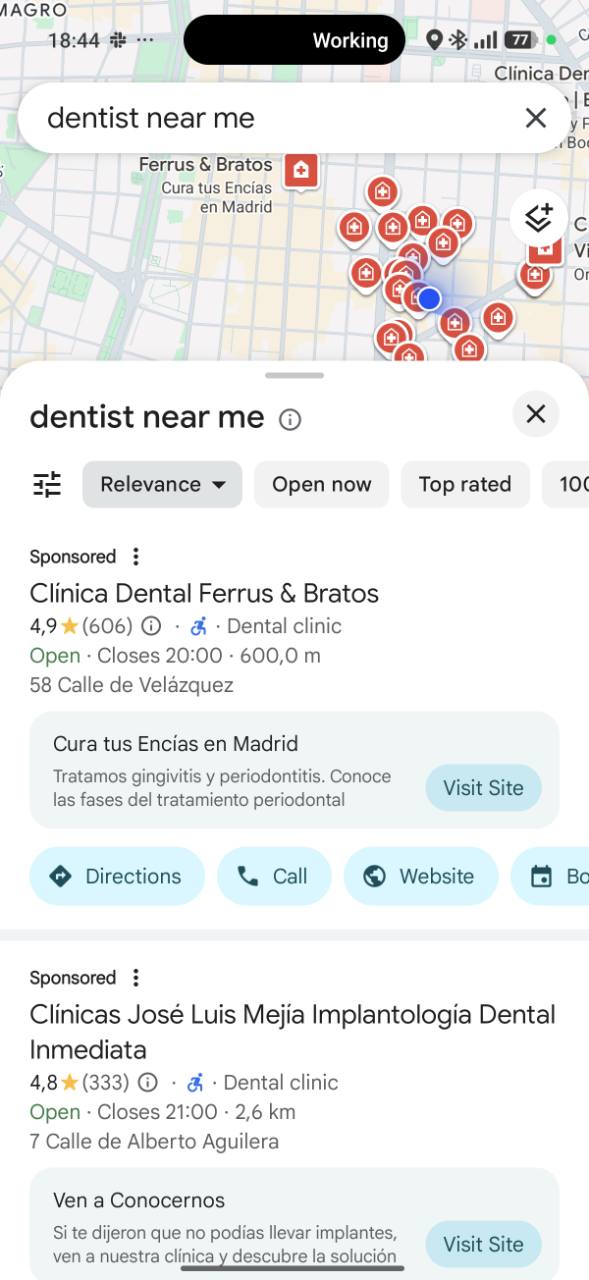
Google places ads and unpaid business listings in the same flow. The markers show which position was bought, which positions were earned, and what information a patient uses to choose a dentist.
Sponsored placements at the top
Unsponsored local results below
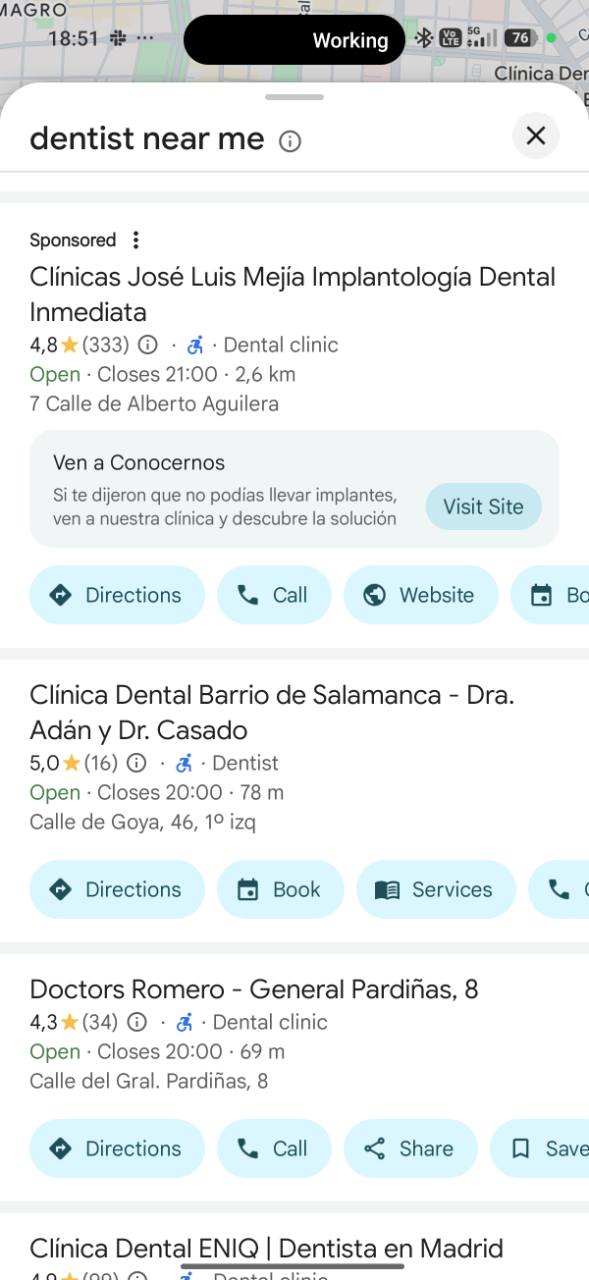
- 1Search query. “Near me” tells Google to use the searcher’s location and return nearby providers.
- 2Map and proximity. Pins show the available businesses around the searcher, making distance part of the choice.
- 3Sponsored result. The “Sponsored” label means this position is an ad, not an organic local ranking.
- 4Organic local listing. These businesses appear without paying for the placement.
- 5Decision signals. Rating, review count, category, opening status, distance, and address help people compare options.
- 6Conversion actions. Directions, booking, services, and calling turn the search result into a customer action.
Local SEO combines five things: an accurate business profile, useful service pages, genuine reviews, consistent business information, and measurement tied to calls and enquiries.
AEO Goal helps you measure this before deciding what to change. Add the searches and questions customers use, select the city or country you serve, and record the starting result. The platform shows where your business ranks in Google, whether AI assistants mention it, and which competitors appear instead. That evidence tells you whether the next job is a missing service page, weak business information, too few reviews, or a technical problem. After the change is published, run the same searches and prompts again to see whether visibility improved.
Here is how a plumbing business would run that process inside AEO Goal:
- Use Keyword Research to expand “plumbers near me” into “24/7 emergency plumber,” “boiler repair [city],” and question searches such as “how much does an emergency plumber cost?”
- Send the strongest terms to Rank Tracking, with the city or country selected so you can see the actual market you serve.
- Add the question versions as tracked prompts. In Citations, check two separate outcomes: whether an assistant names your company and whether it links a page on your domain as a source. The same result also records competitors named in the answer.
- Use Competitors to compare the businesses winning the same searches and prompts.
- Turn technical and content findings into assigned work through Site Audit, Quality Gate, and Tickets.
That is local SEO management in practice: discover the searches, check the baseline, improve the business signals, and keep the next action visible.
Keyword Research
Plumbing demand · Madrid
Google: 11 · People Also Ask: 5 · Trends: 2
What this tells you: volume estimates demand, difficulty helps prioritise the opportunity, and intent separates people researching a problem from people ready to hire. Select a phrase, then send it to Rank Tracking or turn it into a tracked AI prompt. Swipe the table to see every metric and action.
SEO Presence
Rank Tracking
Tracked keywords
18
+4 this week
Average position
8.3
↓ 2.1
Top 3 positions
4
of 16 ranking
Cited by AI
7/12
tracked overlap
What this tells you: each keyword is measured in the selected market and device, so a national average cannot hide weak visibility in Madrid. The citation column shows whether the same topic also earns an AI source link.
AI visibility
Citations Overview
Where LLMs name your brand and cite your site as a source.
Cited as a source
7
Pages on your domain linked by an AI answer
Brand mentions
12
Answers that named the business
Prompt × LLM · last 30d
All statusesEach cell is this prompt’s most recent answer per LLM. Swipe the matrix to see every LLM.
How to read it: a mention never counts as a citation. “Cited as a source” means the LLM linked your own domain. “Brand mentioned” means it named the business without citing your site. “Competitor only” and “Not present” are visibility gaps; “Untested” means no answer was collected in this window.
Competitive visibility
Who wins the same searches and prompts?
What this tells you: compare the businesses appearing for the same tracked prompts, then investigate the pages and sources behind the leader instead of copying an unrelated national competitor.
Act
Site Audit finding → assigned ticket
Emergency service page missing LocalBusiness details
Opening hours and service area are absent from visible content and structured data.
Open · 2
Add local business details to emergency page
SEO-142 · HIGH
In progress · 1
Update Madrid service-area copy
SEO-139 · LS
Done · 3
Correct holiday opening hours
SEO-131 · VERIFIED
What this tells you: the audit finding becomes assigned work with a status and verification step, so the visibility gap does not end as an observation in a report.
Use the tabs to follow one local query from research through rankings, AI answers, competitor analysis, and assigned work.
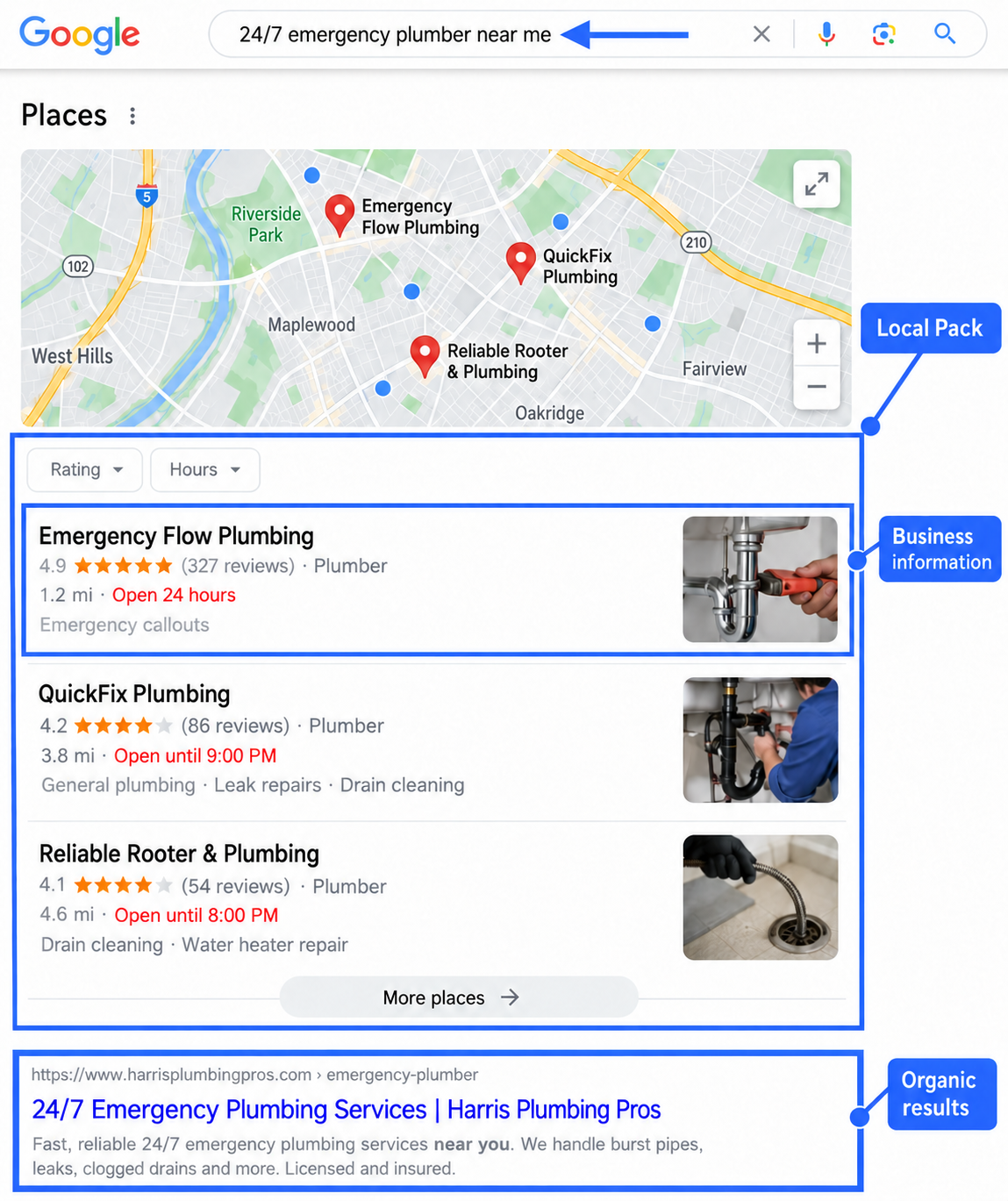
Read this example from top to bottom: the map pack creates the shortlist, the business card gives the customer a reason to choose, and the organic result gives the website another chance to earn the click. Local SEO is the work of improving each of those layers.
Why local SEO is valuable
Local searches often happen close to the moment someone chooses a business. A person searching for an open restaurant, a nearby clinic, or an emergency repair service usually needs a practical answer, not a general explanation.
Visibility in local search can lead to:
- Calls and appointment requests from Google Business Profile.
- Visits to a shop, clinic, restaurant, or office.
- Enquiries from service pages and location pages.
- Discovery through Google Maps, local results, and AI recommendations.
The goal is not to rank for every search. It is to become visible for the searches that bring the right customers to the right location.
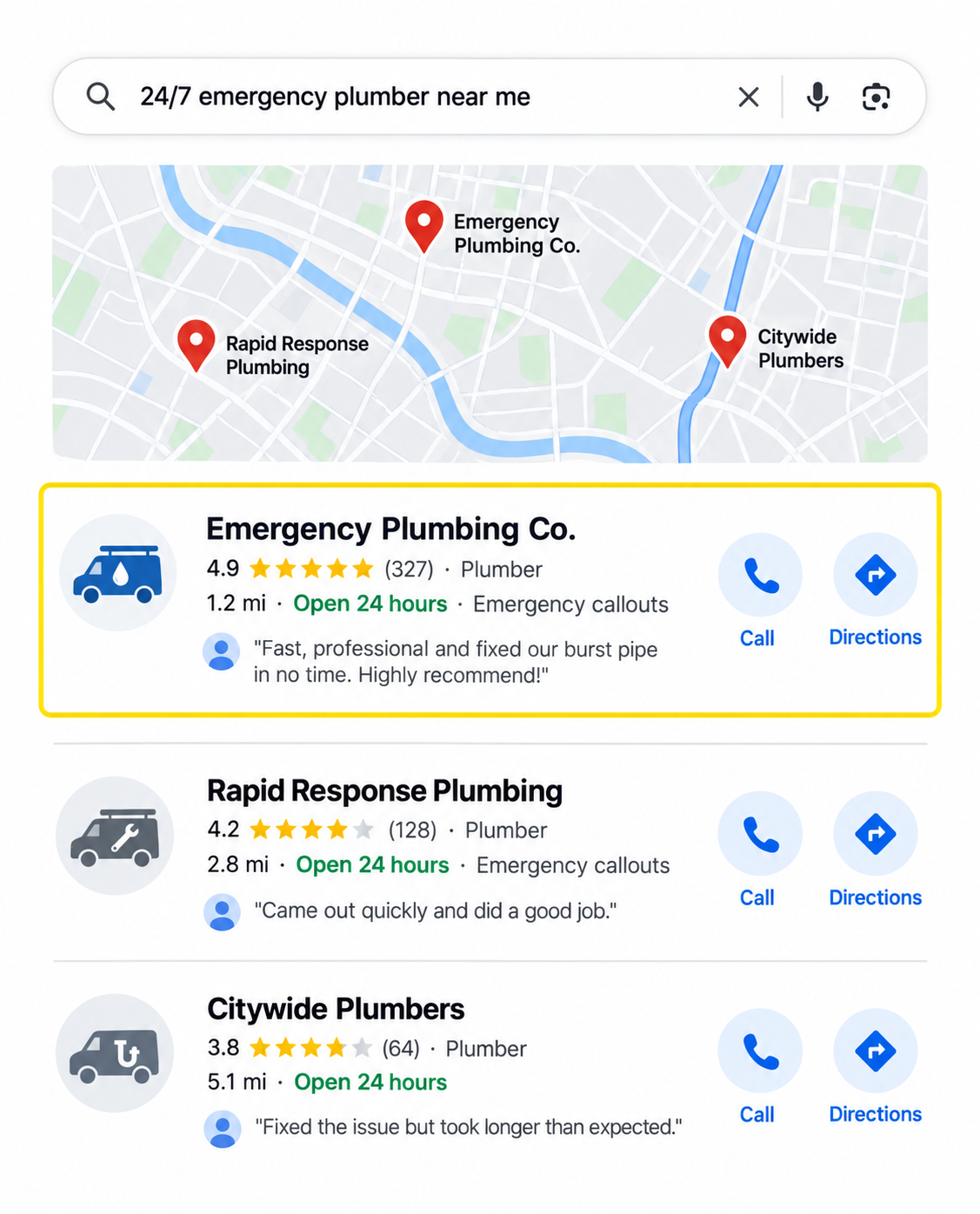
For an emergency plumber, the path is short: a customer searches, compares availability and distance, then calls. Your profile and landing page should answer those questions without making the customer hunt for them.
How Google local search works
Google says local results are primarily shaped by relevance, distance, and prominence. In practice, that means:
- Your profile and pages must clearly match what the searcher wants.
- Your location and service area must make sense for the query.
- Your business needs evidence of trust and recognition: reviews, links, mentions, and real-world activity.
Google explains local visibility through three broad signals:
- Relevance: how closely the business matches the search.
- Distance: how close the business is to the searcher or the location in the query.
- Prominence: how well-known and trusted the business appears to be.
Local results usually contain two parts:
- The local pack: the map and business listings shown for a local search.
- Organic results: the regular web pages below or around the map results.
A business can appear in one, both, or neither. A strong Google Business Profile does not replace a useful website, and a well-optimised website does not replace accurate business details.
AI assistants do not publish a complete local ranking formula, so no tool can promise a citation or recommendation. They can surface businesses using information available on the web. Accurate profiles, genuine reviews, accessible pages, and clear service information give assistants better evidence to work with.
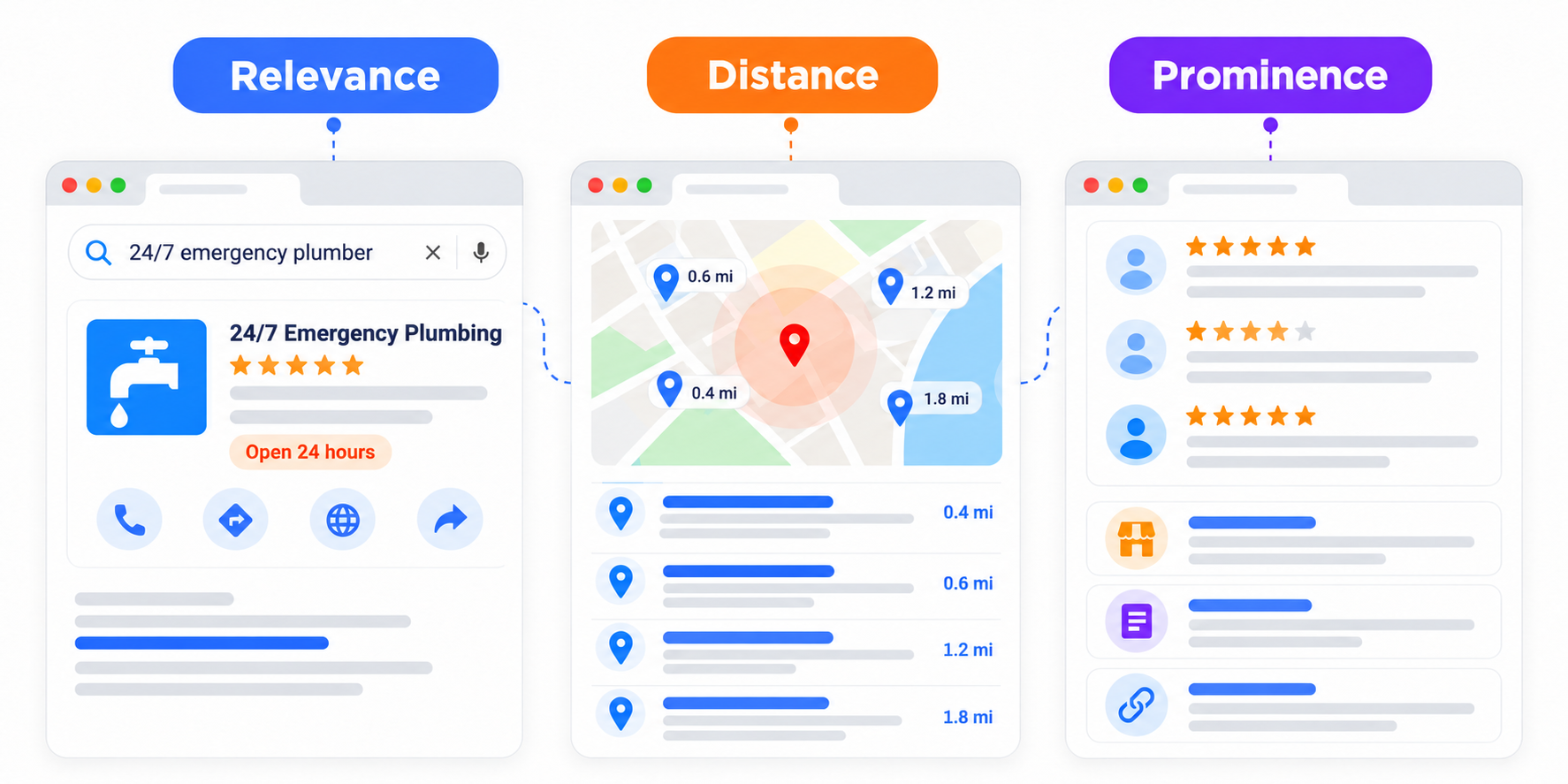
Use the three signals as a diagnostic. If the service does not match the query, fix relevance. If the business is too far away, improve the service-area strategy or target a closer market. If competitors look more trusted, build prominence through genuine reviews, useful local proof, and relevant mentions.
The main local SEO signals
Google Business Profile
Choose the most specific primary category. Add accurate hours, holiday hours, phone number, service area, services, products, photos, and appointment links. Keep the listing current: an incorrect opening time can lose a customer even when the listing ranks well.
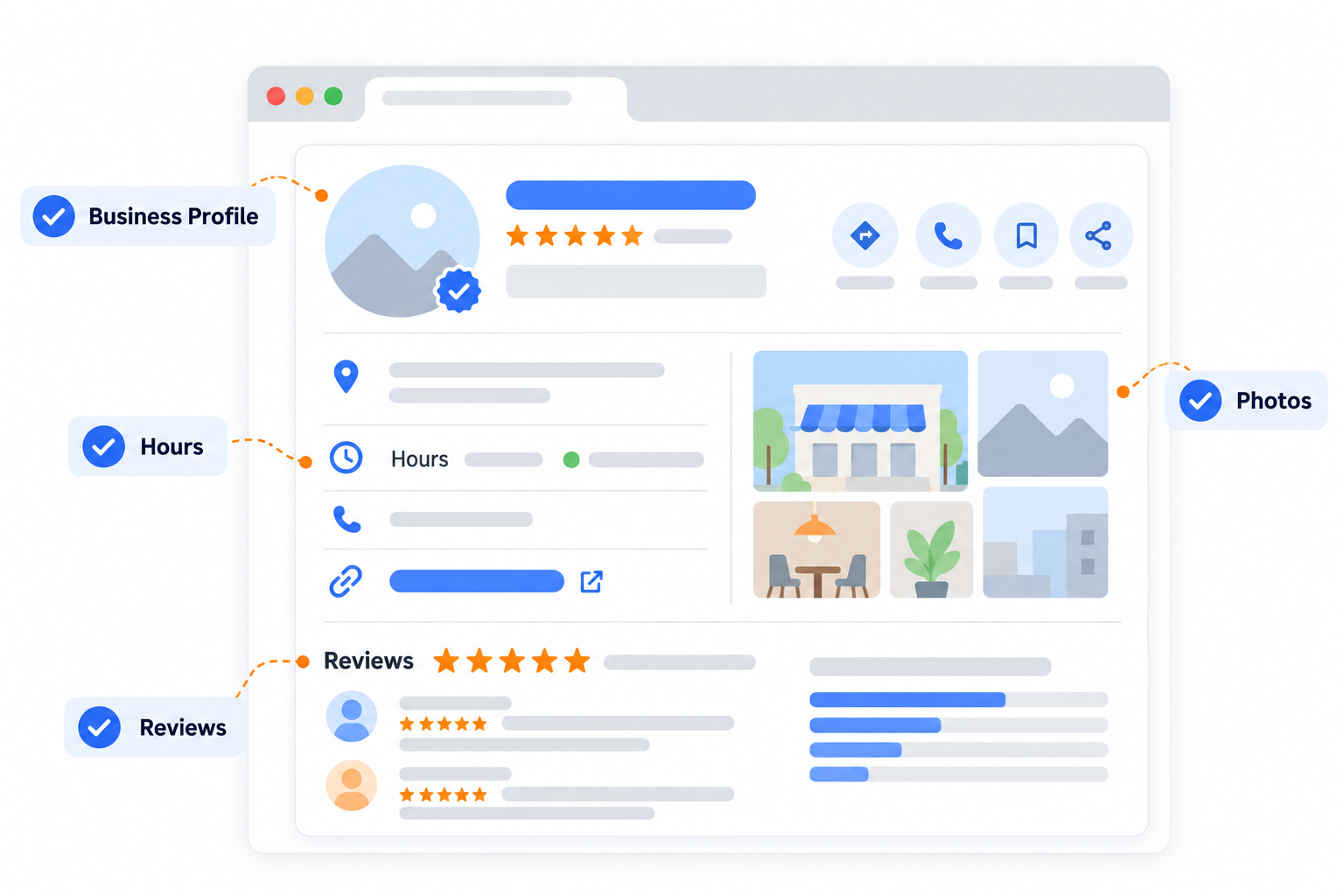
A complete profile answers the practical questions a customer has before calling: what you do, where you work, whether you are open, and how to reach you. For a 24/7 plumber, the hours and emergency-service details should be impossible to miss.
Reviews
Ask customers for honest feedback after a completed job. Respond to positive and negative reviews professionally. Do not buy reviews, offer incentives for positive reviews, or try to suppress criticism.
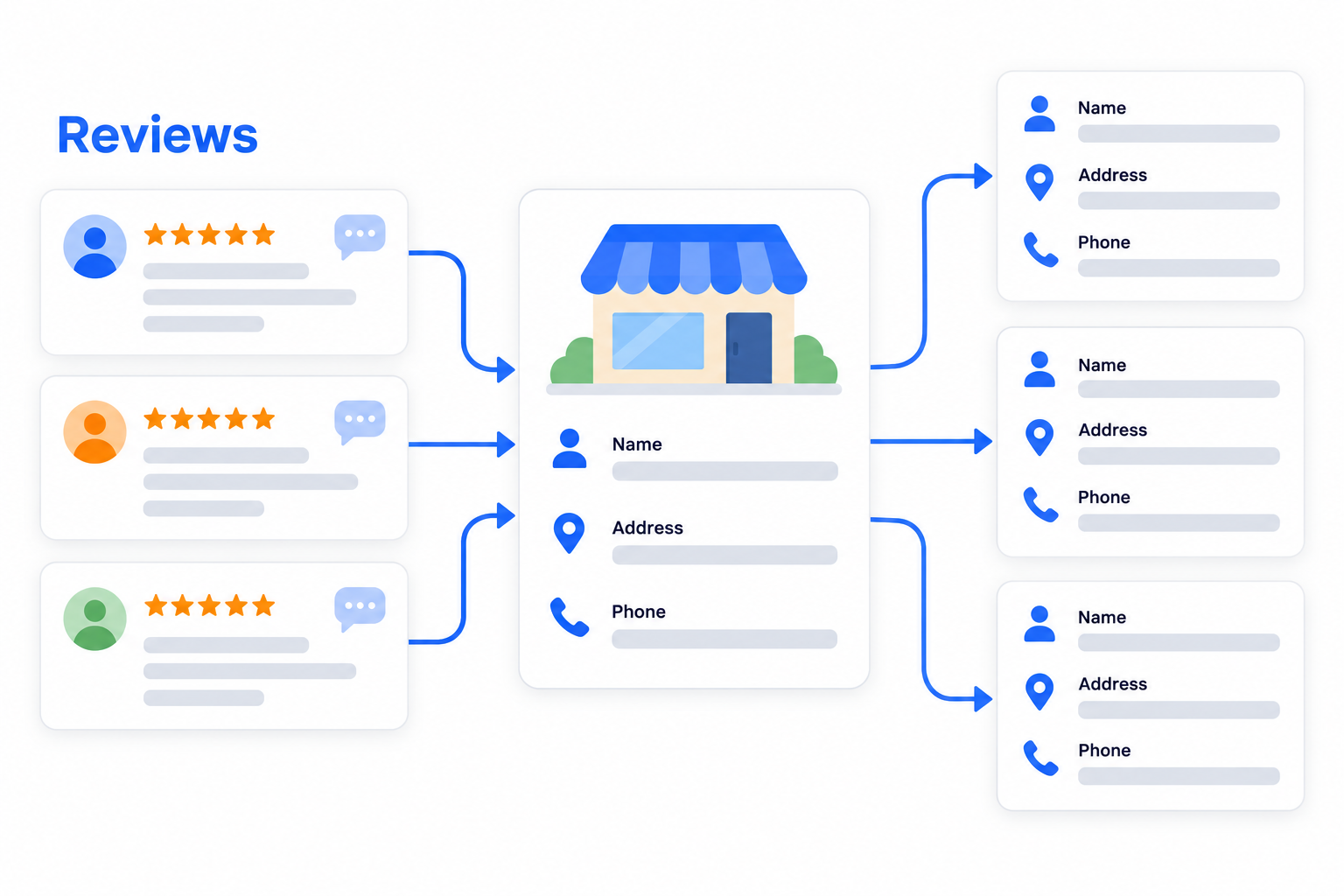
Reviews create trust; consistent business details reduce doubt. If your phone number, hours, or service area changes across sites, update the important sources first and then ask for new customer feedback after completed jobs.
Service and location pages
Create one strong page for each real service. Explain who the service is for, what is included, where you provide it, what the process involves, and how to contact you. Create location pages only for locations you genuinely serve, with real local details.
Business information
Keep your name, address, phone number, hours, and website consistent across important directories, industry sites, social profiles, and local organisations. Prioritise sources customers actually use instead of submitting to every directory.
Local reputation and links
Show completed work, service areas, team expertise, local partnerships, case studies, and useful customer questions. Look for legitimate mentions from suppliers, trade associations, chambers of commerce, local publications, and community organisations.
How to do local SEO: a practical workflow
Start with the result page, not a generic checklist. Circle the businesses winning the query, record what their listings show, and compare those details with your own profile and service page.
1. Find your priority searches
List your services, locations, and urgent or high-value questions. A plumber might track “emergency plumber near me,” “boiler repair [city],” and “water heater installation [neighborhood].” Check each query in Google: if the results show a map pack or local businesses, it has local intent.
In AEO Goal, these become the tracked searches for the next cycle. Add the city, neighbourhood, or postcode instead of relying on one national position. The point is to see whether the business is visible where the customer is standing.
Inside AEO Goal: Use Keyword Research to expand the seed terms, review search volume, difficulty, intent, SERP features, and AI answer frequency. Save the strongest keywords to Rank Tracking and convert question keywords into tracked prompts.
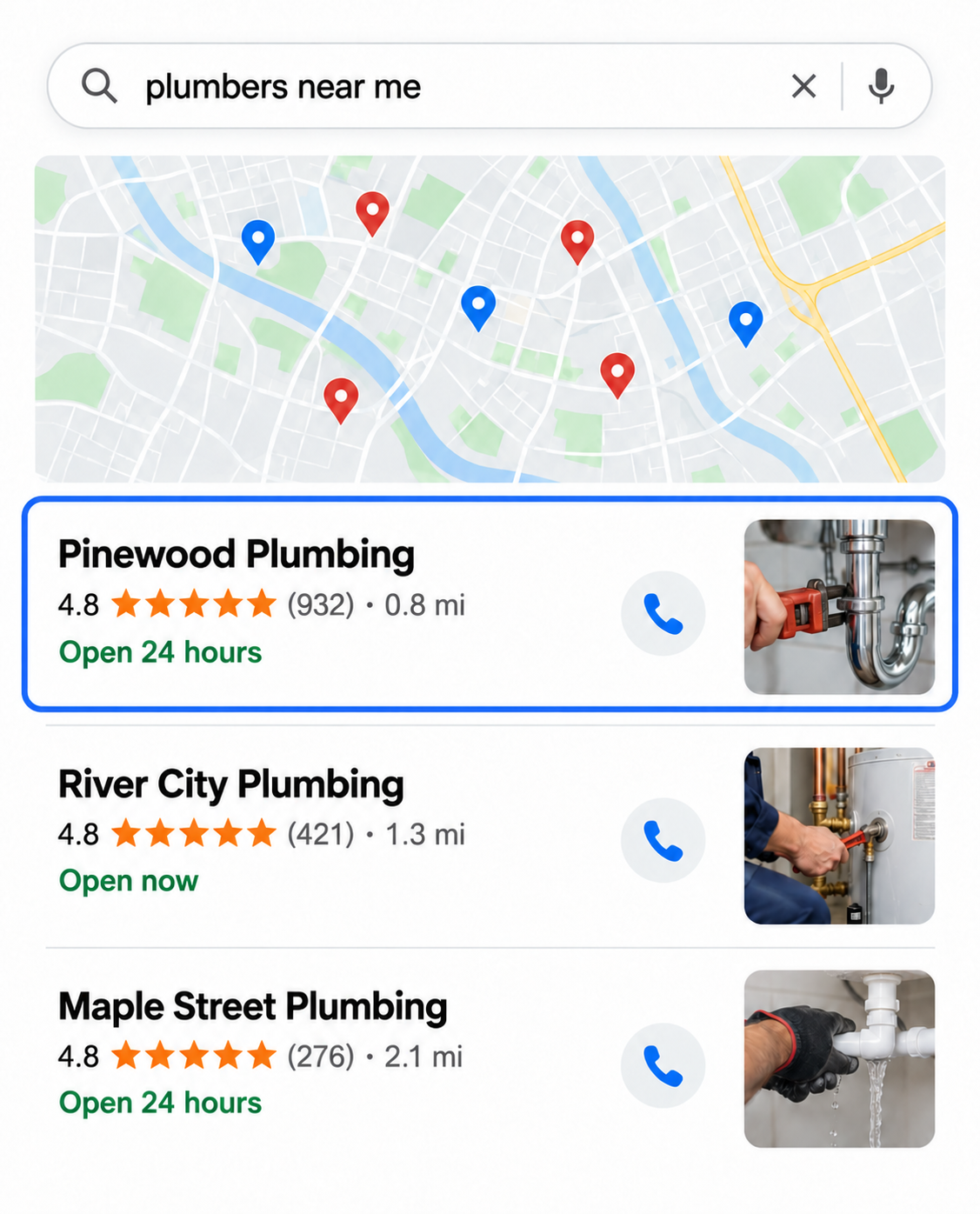
For “plumbers near me,” record the fields customers can compare in seconds: rating, review count, distance, opening status, service description, photos, and the path to call. These observations become your first optimisation brief.
2. Improve your Google Business Profile
Use the most specific primary category available. Add accurate hours, holiday hours, phone number, service area, services, products, photos, and appointment links. Keep the information current; an incorrect opening time can lose a customer even when the listing ranks well.
Inside AEO Goal: Create a baseline ticket for missing or inconsistent profile information. Record the current category, hours, service area, review count, and profile URL so the next review has something concrete to compare.
3. Build useful service pages
Do not create thin pages for every wording variation. A service page should explain who the service is for, what is included, where you provide it, how much the process usually involves, and how to contact you. Add location detail only when you genuinely serve that location.
Inside AEO Goal: Use the site crawler and Quality Gate to inspect the emergency plumbing page. Check whether the page is crawlable, answers the service question directly, has clear entity information, links to the relevant location, and gives an assistant a passage worth citing.
4. Make each location page unique
Multi-location businesses should give each location its own address, hours, phone number, staff or service details, map, and locally relevant proof. Copying the same paragraph across fifty location pages creates a larger site, not a stronger one.
Inside AEO Goal: Crawl each location page, create tickets for duplicated or thin content, and compare the pages that rank against the pages that do not. Track one keyword set per service area instead of averaging all locations together.
5. Build a reliable review process
Ask customers for honest feedback after a completed job. Respond to positive and negative reviews professionally, without offering incentives or trying to suppress criticism. Reviews help customers judge whether you are credible; they are not a shortcut for relevance or distance.
Inside AEO Goal: Record review count, rating, and recency as part of the local baseline. Use competitor comparison to identify whether the businesses winning “24/7 emergency plumber near me” have stronger or more recent review evidence, then assign the review-process task to the right owner.
6. Clean up business information
Check your name, address, phone number, hours, and website across important directories, industry sites, social profiles, and local organisations. Prioritise the sources customers actually use rather than submitting to every directory on the internet.
Inside AEO Goal: Add citation and business-information inconsistencies as tickets. Keep the source URL, incorrect field, corrected value, owner, and completion date together so the fix can be audited later.
7. Publish proof from your local work
Show completed work, service areas, team expertise, local partnerships, case studies, and answers to questions customers ask. Specific evidence is more useful than repeating a city name in every paragraph.
Inside AEO Goal: Use prompt research and AI citation results to find questions where a competitor is cited and your site is absent. Turn the gap into a brief for a case study, service explanation, FAQ, or local proof page.
8. Earn relevant local mentions and links
Look for legitimate opportunities from suppliers, trade associations, chambers of commerce, local publications, sponsorships, and community organisations. A relevant local mention is usually more valuable than a large list of unrelated directory links.
Inside AEO Goal: Review Backlinks and competitor referring domains to find realistic local link opportunities. Separate relevant prospects from low-quality directories, then track outreach or reclamation work as tickets.
9. Check technical access
Make sure important pages are indexable, internally linked, canonicalised correctly, and represented accurately in structured data. Use Google Search Console to check indexing and performance. Structured data can clarify a page, but it cannot make unsupported claims true.
Inside AEO Goal: Run Site Audit and the site crawler. Prioritise blocked pages, broken links, missing canonicals, incorrect schema, slow templates, and pages that cannot be reached through internal links.
10. Measure and improve
Track rankings by location, Google Business Profile actions, calls, direction requests, enquiries, and conversions. If you also care about AI discovery, record the exact prompt, engine, date, answer position, mention, and cited source. Re-test after meaningful changes instead of treating one answer as a permanent score.
AEO Goal can keep the search baseline, competitor comparison, AI prompt results, and open fixes together. Use it to answer practical questions: did the emergency page begin ranking, did the business appear more often for “plumbers near me,” and did an assistant cite the page after the update? The value is in the before-and-after record, not in a score displayed without context.
Inside AEO Goal: Review Rank Tracking, Citations, Competitors, and Tickets on a fixed weekly or fortnightly cadence. Close a ticket only when the fix is live and the next measurement confirms what changed.
Local SEO checklist: the first 30 days
Use this as a simple implementation sequence for a plumbing business:
Week 1: establish the baseline
- Add “plumbers near me,” “24/7 emergency plumber near me,” “boiler repair [city],” and the main service-area searches to Keyword Research.
- Save the priority terms to Rank Tracking with the correct market and location.
- Add the top three local competitors by domain.
- Add five to ten question prompts for AI visibility tracking.
- Record current profile rating, review count, hours, category, calls, and primary landing pages.
Week 2: fix the business signals
- Correct the Google Business Profile category, hours, service area, phone number, services, and appointment link.
- Standardise name, address, phone, hours, and website on the most important directories.
- Create a genuine review-request process after completed jobs.
- Add real work photos, emergency-service details, response-area information, and clear contact options.
Week 3: improve the website
- Publish or improve the emergency plumbing service page.
- Add separate pages only for real services and locations.
- Link the homepage, service pages, location pages, and contact page together.
- Run Site Audit and Quality Gate, then turn the highest-impact findings into Tickets.
- Add accurate LocalBusiness or relevant service structured data where it matches visible content.
Week 4: compare and re-measure
- Check ranking movement for the priority searches.
- Compare your map-pack and organic visibility with the tracked competitors.
- Review which AI prompts mention or cite the business and which cite a competitor.
- Check calls, enquiries, direction requests, and booked jobs against the baseline.
- Keep the fixes that produced movement, revise the ones that did not, and start the next cycle.
Keyword maps by local business type
Do not use one generic keyword list for every local business. Start with the service, the location, and the customer’s decision stage. Then give each group one page that can answer it fully.
Plumbers and emergency plumbing
| Keyword group | Example searches | Page to build or improve |
|---|---|---|
| Immediate need | “plumber near me”, “24/7 emergency plumber near me”, “emergency plumber [city]” | Emergency plumbing page with phone, hours, response area, and callout process |
| Problem | “burst pipe repair [city]”, “blocked drain plumber [city]”, “water leak detection near me” | One page per real problem or service |
| Installation | “boiler installation [city]”, “water heater replacement [city]”, “central heating repair [city]” | Service page with brands, eligibility, process, and quote route |
| Trust | “licensed plumber [city]”, “best plumber for landlords [city]” | Proof section, credentials, reviews, case studies, and service-area pages |
Inside AEO Goal: Research the keyword groups, track each location, add prompts such as “Who is a reliable 24/7 emergency plumber in [city]?”, add the three businesses appearing most often, and create tickets for missing service pages, unclear hours, or weak proof.
Dentists and dental clinics
| Keyword group | Example searches | Page to build or improve |
|---|---|---|
| Core service | “dentist near me”, “family dentist [city]”, “private dentist [neighbourhood]” | Location or practice page with treatments, access, hours, and booking |
| High-intent treatment | “emergency dentist [city]”, “same day tooth extraction [city]”, “root canal dentist near me” | Treatment page with suitability, process, aftercare, and appointment route |
| Cosmetic | “Invisalign [city]”, “teeth whitening near me”, “dental implants [city]” | Treatment page with clinician credentials, candidacy, timeline, and costs where allowed |
| Trust and access | “dentist accepting new patients [city]”, “wheelchair accessible dentist [city]” | Location page with staff, accessibility, insurance, parking, and patient information |
Inside AEO Goal: Add treatment and location keywords to Rank Tracking, track prompts such as “Which family dentist near [neighbourhood] accepts new patients?”, compare the practices named by search and answer engines, and create content tickets where a treatment page does not answer the patient’s next question.
Real estate agents and property professionals
| Keyword group | Example searches | Page to build or improve |
|---|---|---|
| Buy | “estate agents [city]”, “homes for sale [neighbourhood]”, “buy apartment [city]” | Area guide and buying-service page with current inventory and local expertise |
| Sell | “best estate agent to sell my house [city]”, “house valuation [city]”, “sell my flat [neighbourhood]” | Seller page with valuation process, fees, market evidence, and case studies |
| Rent and manage | “letting agent [city]”, “property management [city]”, “rental management near me” | Lettings or property-management page with tenant and owner workflows |
| Property type | “commercial property agent [city]”, “luxury homes [city]”, “new build homes [city]” | Dedicated property-type page with inventory, expertise, and eligibility |
Inside AEO Goal: Track buyer and seller keywords separately, add prompts such as “Who are the best estate agents for selling a flat in [area]?”, monitor competitor domains and cited listing pages, and use the site crawler to find expired listings, broken property links, or duplicate area pages.
Lawyers and local professional services
| Keyword group | Example searches | Page to build or improve |
|---|---|---|
| Practice area | “family lawyer [city]”, “personal injury solicitor near me”, “employment lawyer [city]” | Practice-area page with jurisdiction, process, evidence, and consultation route |
| Urgent problem | “criminal defence lawyer open now”, “emergency immigration lawyer [city]”, “lawyer for eviction [city]” | Urgent-help page with availability, scope, and first steps |
| Client type | “business solicitor for startups [city]”, “divorce lawyer for parents [city]” | Client-specific page with relevant experience and clear boundaries |
| Trust | “law firm reviews [city]”, “regulated solicitor [city]” | About, credentials, case outcomes where permitted, reviews, and professional memberships |
Inside AEO Goal: Separate practice-area, urgency, and client-type prompts; compare which firms are cited; use Quality Gate to check whether pages state jurisdiction and service scope clearly; and assign review, content, or technical fixes through Tickets.
Automate the niche workflow with the API
For one business, the app is enough. For an agency, franchise, or multi-location operator, automate the repeated setup with a scoped API key or the AEO Goal MCP connector.
- Create one brand for each business or controlled location set.
- Use
add_tracked_keywordsto load the niche keyword map with a location and device. - Use
add_tracked_promptsto load decision-stage questions, with a persona or funnel stage when useful. - Use
set_brand_competitorsto keep the local competitor set current. - Read rankings, citations, competitor comparisons, and prompt status on a schedule.
- Use
generate_contentonly for measured keyword or citation gaps; drafts remain unpublished for review. - Send completed work back through the normal publishing process, then re-run the same keywords and prompts.
The REST API authentication guide covers Bearer tokens and scoped keys. The MCP tools reference covers the tools for adding keywords and prompts, setting competitors, reading rankings, and queuing drafts. Use the MCP connector for Claude or Cursor; use the REST API for scripts, dashboards, and agency workflows. Keep keys in a secret manager, grant only the scopes required, and respect plan caps and rate limits.
Example automation request for a plumbing client:
Add these keywords for Northside Plumbing in Manchester: “plumber near me”, “24/7 emergency plumber near me”, “boiler repair Manchester”, and “blocked drain repair Manchester”. Track them on mobile in Manchester, add three local competitors, and create prompts for “Who is a reliable emergency plumber in Manchester?” and “Who offers boiler repair in Manchester?”
Local SEO example: a 24/7 emergency plumber
Suppose an emergency plumbing company wants more calls for “24/7 emergency plumber near me.” It appears in the local pack, but below competitors with stronger review signals and clearer availability information.
The diagnosis might show that the company has no dedicated emergency-callout page, its profile does not clearly say “open 24 hours,” and its review profile has not been updated recently. The fix is to:
- Create a useful emergency plumbing page explaining response times, service area, callout process, and supported problems.
- Update the Business Profile with accurate 24-hour availability and emergency services.
- Add real job photos, service-area details, and a prominent phone number.
- Continue requesting honest reviews from customers after completed jobs.
- Re-check “plumbers near me” and “24/7 emergency plumber near me” by location.
This is the difference between producing more content and improving the evidence available about the business.
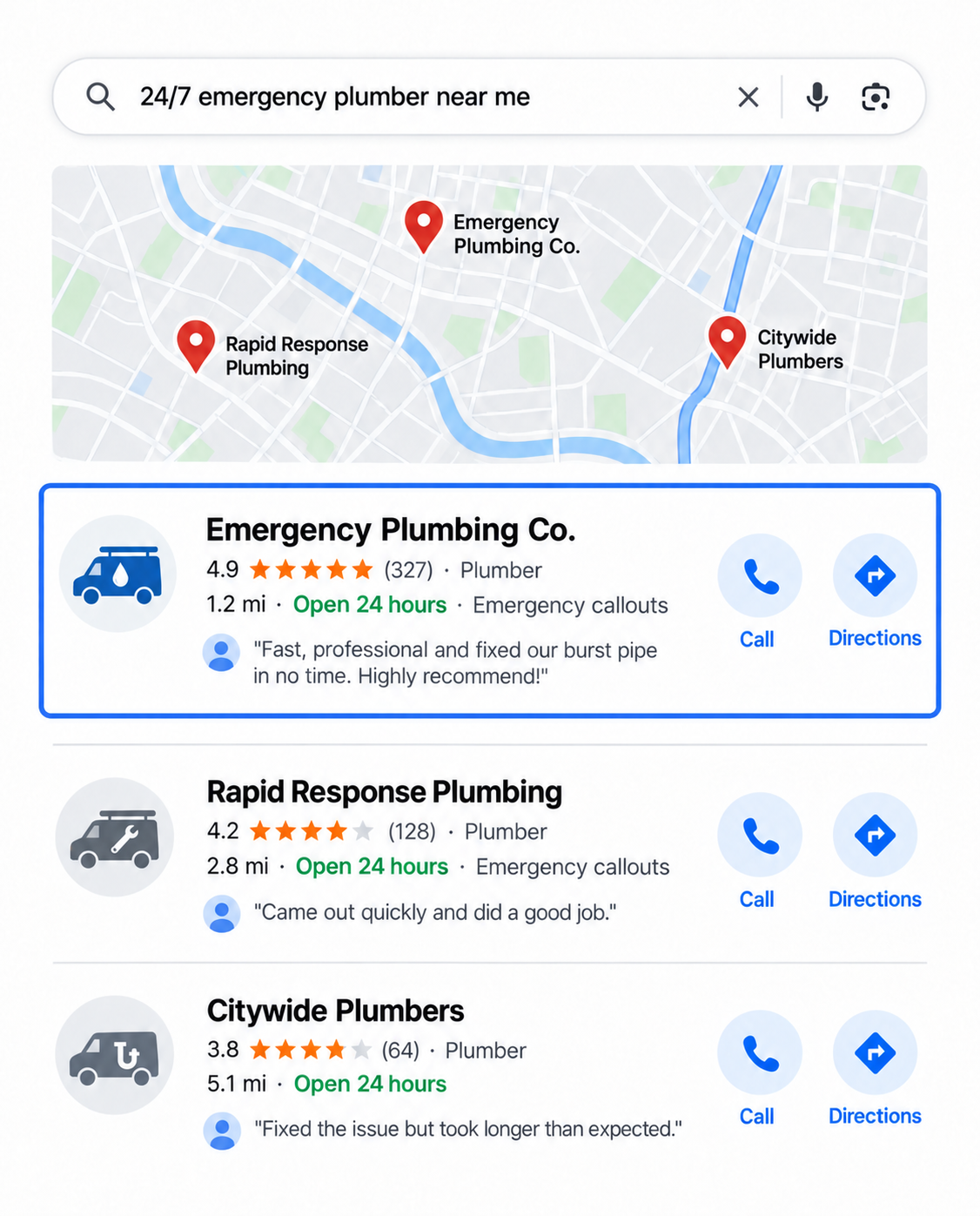
The target is not an attractive listing by itself. It is a listing that makes the next action obvious: the customer can see that the business is open, close enough to help, experienced, and easy to call.
How to measure local SEO
Track more than a single ranking number. A useful local SEO report includes:
- Rankings for priority searches by city, neighbourhood, or postcode.
- Google Business Profile calls, website visits, direction requests, and appointment actions.
- Organic clicks and enquiries from Search Console and analytics.
- Review volume, rating, recency, and response rate.
- AI prompts where the business is mentioned, omitted, or cited.
Record the search, location, date, ranking surface, competitor, and landing page. This makes changes easier to explain and prevents a single personalised search from becoming a misleading success story.
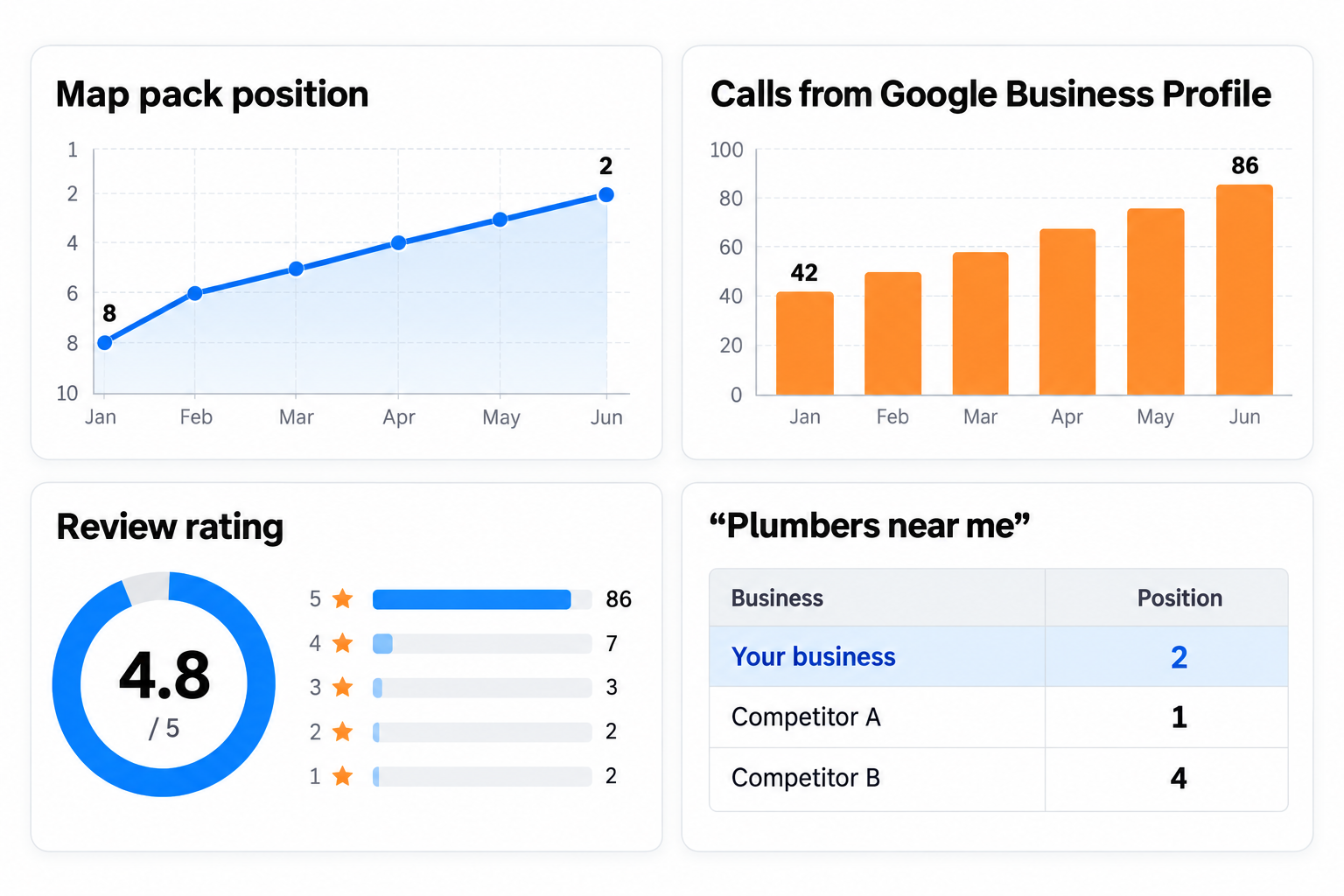
A useful report connects visibility to business outcomes. Position 2 is informative, but the stronger question is whether the change produced more calls, enquiries, or booked jobs from the target area.
Where AEO Goal fits
AEO Goal is the measurement and prioritisation layer for this workflow. It can track priority local searches, compare competitors, identify technical and content gaps, and test whether AI engines mention the business or cite its pages. It does not replace the plumber’s Business Profile, review process, website, or judgement. It helps organise the work and show whether the work produced a measurable change.
The platform is useful at different points in the process, not just at the reporting stage:
- Research: find local keyword variations, intent, search volume, difficulty, SERP features, and AI answer frequency.
- Baseline: track Google positions, the ranking URL, movement over time, and competitor positions.
- Diagnosis: find crawl, metadata, internal-link, structured-data, and page-quality issues that can hold a service or location page back.
- Content planning: turn a missing answer or thin emergency-service page into a brief with a clear page purpose and supporting questions.
- AI visibility: record which prompts mention the plumber, which pages are cited, and which competitor receives the source link instead.
- Operations: assign findings, track their status, and re-check the result after the page or profile work is complete.
For example, if “24/7 emergency plumber near me” is missing from the map pack and an AI answer cites a competitor’s emergency-service page, the useful response is not to publish several generic articles. Research the query family, inspect the competing page, improve the one service page and its supporting business information, assign the technical checks, then re-run the ranking and citation measurements.
Use Keyword Research to expand “plumbers near me” into “24/7 emergency plumber,” “boiler repair [city],” and question searches such as “how much does an emergency plumber cost?”
Send the strongest terms to Rank Tracking, with the city or country selected so you can see the actual market you serve. Add the question versions as tracked prompts. In Citations, check brand mentions and links to your domain as separate outcomes, then inspect which competitors were named or cited instead. Use Competitors to compare the businesses winning the same searches and prompts. Turn technical and content findings into assigned work through Site Audit, Quality Gate, and Tickets.
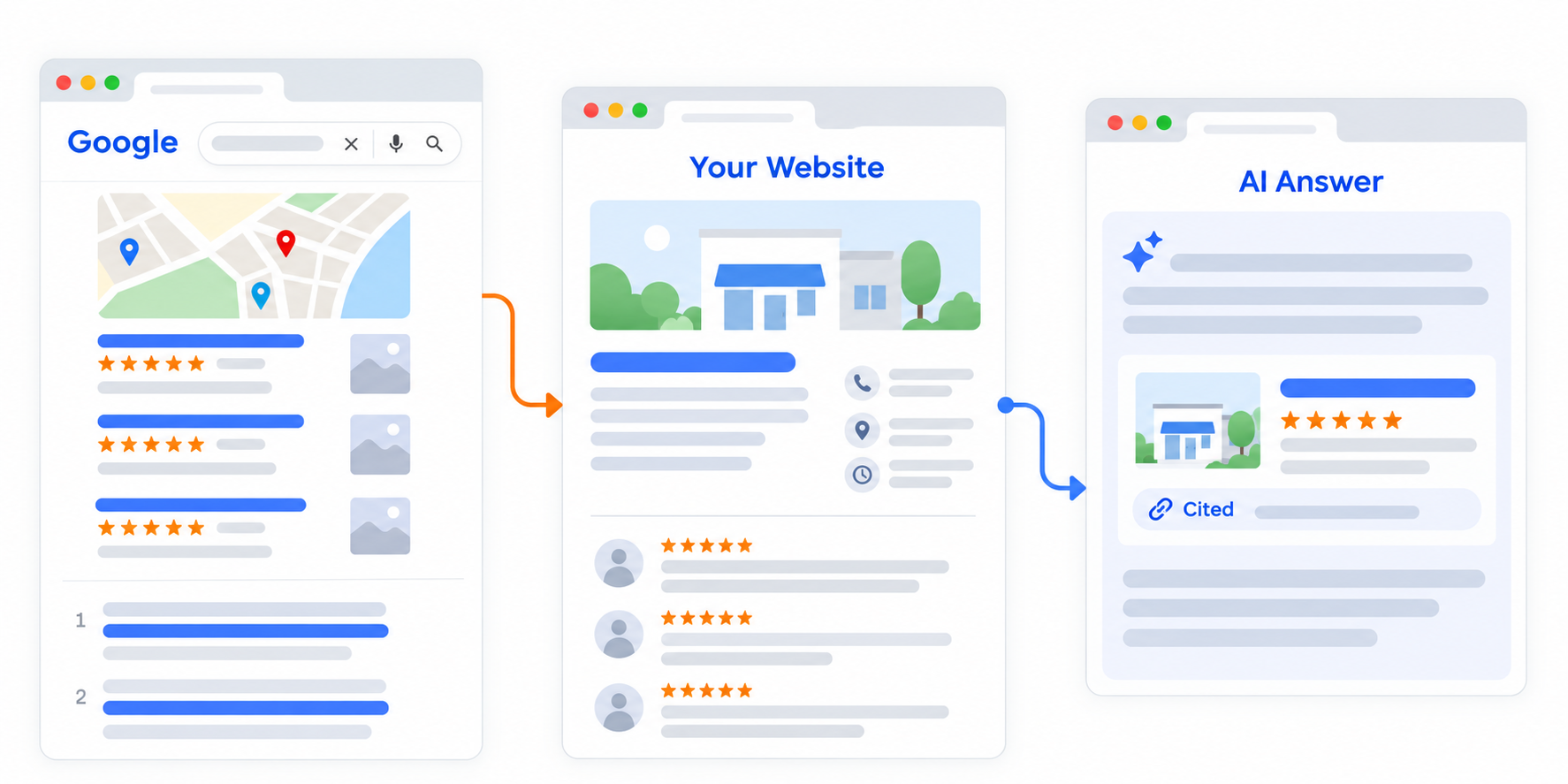
The website is the shared evidence layer. Clear service information, accurate business details, reviews, and local proof can support both traditional search visibility and the pages an AI assistant chooses to cite.
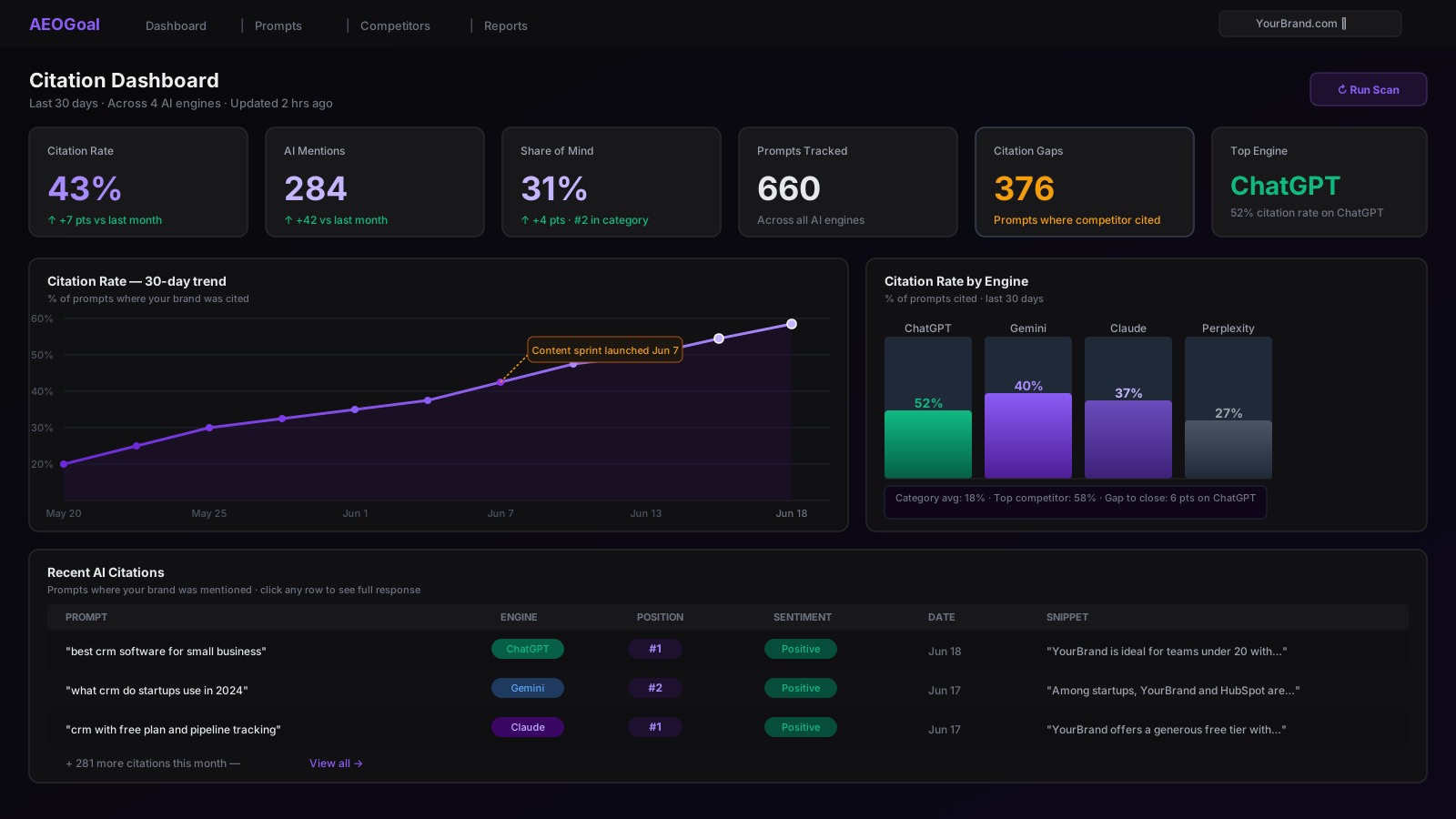
The useful part is the connection between the finding and the next action. A crawl issue can become a technical task. A thin service page can become a content brief. A competitor cited for a query can become a prompt and source gap to investigate. The next scheduled run shows whether the change moved visibility.
What no local SEO tool can promise
No software controls Google rankings, reviews, or AI answers. A platform can measure the surfaces, find gaps, and help you prioritise work; it cannot guarantee a position or citation. Treat AI visibility as a sampled measurement that varies by prompt, location, language, engine, and date.
Who this is for
- Local businesses - plumbers, electricians, HVAC companies, roofers, builders, locksmiths, pest-control companies, landscapers, cleaners, movers, auto-repair shops, dentists, doctors, clinics, veterinarians, pharmacies, salons, spas, gyms, restaurants, retailers, hotels, and other businesses that depend on nearby customers.
- Real estate professionals - estate agents, property managers, mortgage brokers, and local developers competing for location-based property searches.
- Professional services - lawyers, accountants, insurance brokers, financial advisers, architects, consultants, and other firms whose customers search by city, neighbourhood, or service area.
- Multi-location teams that need visibility by location rather than one national average.
- Agencies and consultants that need a repeatable baseline, action plan, and re-measurement loop for every client.
Run a free AI visibility scan to see whether assistants can currently find and cite your business, then use AEO versus traditional SEO to understand how the two surfaces fit together.