Quick Answer
Ahrefs is an SEO suite best known for its backlink index and Site Explorer: the reference tool for auditing and building link authority at scale. AEO Goal is an AEO agent for the surface a link index does not read: it runs your prompts across ChatGPT, Claude, Gemini, Perplexity, and Google AI Overviews, measures citation rate and share of model per engine, ships the fix, and re-checks it on the next scan. Its AEO Rank scores authority among the domains AI engines actually cite. Link-heavy teams typically run both; AEO Goal also carries keyword research, daily rank tracking, and backlinks with a DR-weighted Domain Score for teams that consolidate.
Two different maps of the same territory
If you are the kind of buyer comparing these two tools, you probably think in links. You know your referring domains, you know which competitor picked up a passive-authority page that keeps earning, and you treat the link graph as the closest thing SEO has to ground truth. That instinct does not become wrong in AI search. It becomes incomplete.
Here is the mechanical reality. When ChatGPT, Perplexity, or Google AI Overviews composes an answer, it retrieves and cites a small set of source pages, and those engines demonstrably lean toward sources they treat as authoritative. Authority still gates the outcome. But the outcome itself changed: instead of ten ranked links, there is one generated paragraph citing perhaps three or four domains. A link index maps who has authority in general. It does not tell you which domains a given engine cites for your buyers’ prompts, whether yours is among them, or why a competitor with a thinner link profile keeps getting quoted while you do not.
That last case is the one that breaks link-led intuition, and it happens constantly: the engine cannot cleanly retrieve or extract your page, so it cites a weaker domain that answers the question directly. Authority you cannot get cited is authority the buyer never sees.
What Ahrefs is built for
Described by its broadly known category role, without guessing at its current feature matrix: Ahrefs is an SEO suite best known for its backlink index and Site Explorer, the tools an entire generation of SEOs uses to audit link profiles, research competitors’ links, and prospect for new ones, alongside classic keyword and ranking workflows. For teams whose growth engine is link acquisition and whose audits run across very large datasets, that index is the job, and a specialist index at that scale is genuinely hard to replace.
If that is your daily work, keep it. This page is not going to pretend a citation tracker substitutes for a large-scale link database, because it does not.
Why backlinks still matter in AI search (and what changes)
The honest version of the story has two halves.
What stays true: authoritative domains get cited. Engines pull evidence from sources they trust, and the trust graph correlates heavily with the link graph. A brand with no authority has an AI-visibility problem that no amount of prompt tracking will fix, and link work remains one of the levers.
What changes: the population you are competing in shrinks and shifts. The domains that matter for your AI visibility are not “every domain with high DR.” They are the specific domains engines cite for your category’s prompts - a much smaller set, and one no link index enumerates. This is exactly what AEO Goal’s AEO Rank measures: your authority standing among the domains AI engines actually cite, computed alongside a DR-weighted Domain Score so you can see both the classic view and the citation-population view of the same profile. When the two diverge - strong Domain Score, weak AEO Rank - you have found the gap this comparison exists to name: your authority is real, but it is not registering where answers get assembled.
The remaining levers are not link levers. Whether an engine can retrieve your page (AI-crawler access, llms.txt), extract your answer (structure, JSON-LD, entity salience), and trust it as a citable source (direct claims, proof) decides who gets quoted among authoritative candidates. See the AI citation tracking methodology for how those signals are measured.
What AEO Goal is built for: from citation gap to shipped fix
AEO Goal is an agent, not a dashboard. The distinction is more important to a link-led team than most, because you already know what it is like to own a dataset and still have to invent the workflow on top of it.
- It reads the answers. Your priority prompts run against ChatGPT, Claude, Gemini, Perplexity, and Google AI Overviews on a schedule; every generated answer is parsed for brand mentions, cited source URLs, position, and sentiment.
- It attributes the loss. Per engine, you see which prompts cite a competitor and skip you, and which competitor page won the citation - the AI-answer equivalent of finding the exact page that earned the link you wanted.
- It ships the fix. Blocked AI crawler, missing structured data, weak entity salience, no citable answer page: each finding maps to a concrete action, from a robots.txt or llms.txt fix to an answer-first brief, in one prioritized backlog.
- It re-checks. The next scan shows whether citations and share of model moved. Proof, not vibes.
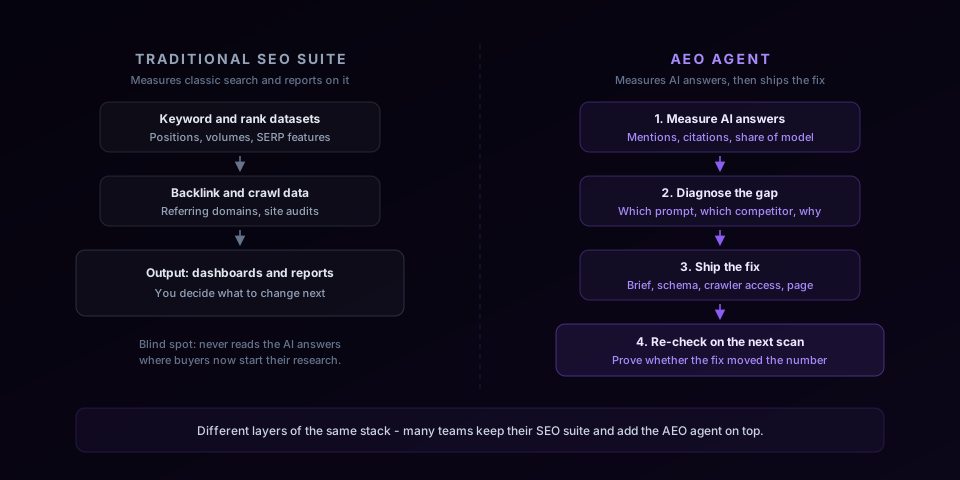
It also carries the classic core - keyword research, daily rank tracking, and backlink analysis - so consolidating teams get one workspace, and link-led teams get a second opinion on their profile scored for the AI-citation era.
The jobs, side by side
| The job to be done | Backlink-index suite | AEO Goal |
|---|---|---|
| Audit a backlink profile at very large scale | Its defining strength | Core backlink analysis, not an index replacement |
| Prospect link targets from competitors’ profiles | Built for this | Not the product |
| Know which prompts cite competitors instead of you, per engine | Not designed to read answers | Built for this |
| See which competitor page an engine cited, and why yours was skipped | No | Yes, with the fix attached |
| Score authority among domains AI engines actually cite | No | AEO Rank, alongside DR-weighted Domain Score |
| Track share of model and sentiment across five answer engines | No | Yes, per engine, as a trend |
| Turn a visibility gap into a brief or technical fix, then re-verify | You build that workflow | Fix-and-recheck loop, one backlog |
| Daily rank tracking and keyword research | Yes | Yes |
When to keep Ahrefs
Keep it - without hedging - if link auditing and link acquisition at dataset scale are core weekly work, if your agency deliverables are built on deep link exports, or if your team’s competitive edge is out-researching rivals in the link graph. AEO Goal’s backlink module covers monitoring and authority scoring; it is not a substitute for a specialist index when the index itself is the job. Pretending otherwise would violate the one rule this site’s comparisons follow: match the tool to the job.
Both tools, one budget: how the split works
The pairing is unusually clean because the overlap is small. The link index answers “where does authority come from and where can we get more.” AEO Goal answers “is that authority turning into citations, where is it failing to, and what do we ship this week to fix it.” Teams that run both typically leave prospecting and profile audits in the index and move all answer-engine measurement, competitor citation analysis, and fix workflow into AEO Goal, using AEO Rank as the bridge metric: it tells you when accumulated link equity is or is not registering in the citation population.
Consolidation onto AEO Goal alone fits teams whose link work is monitoring rather than acquisition - they need to know the profile is healthy and see Domain Score trend, not export a million rows.
A worked example: the link-led content team
Picture a content lead at a developer-tools company who has done everything the link playbook asks: years of original research pages, a referring-domain graph competitors envy, top-three rankings on the head terms. Then a champion at a prospect mentions that Perplexity’s answer for “best [category] for CI pipelines” cites two competitors and a Reddit thread. Not them.
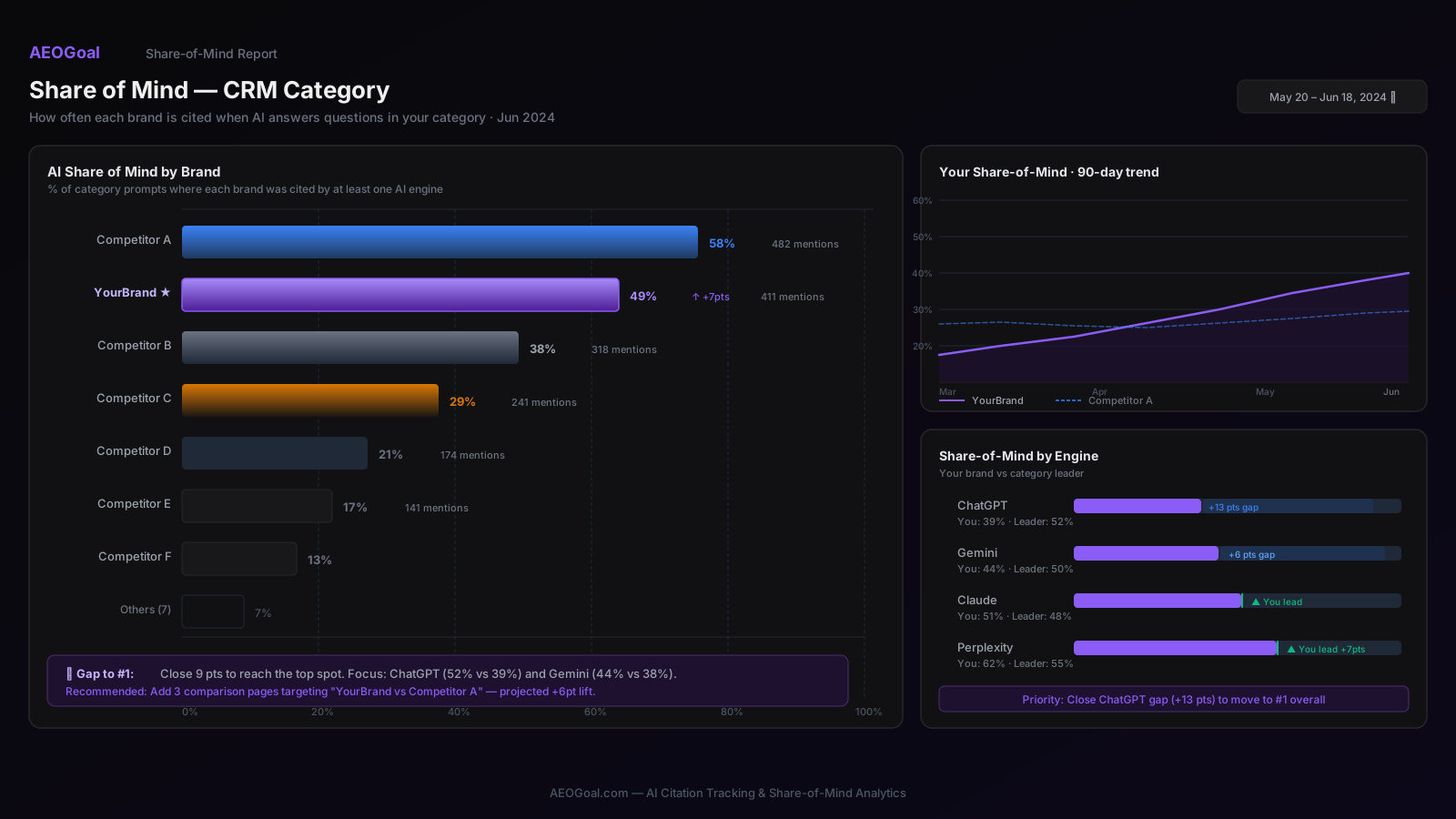
AEO Goal’s scan and first prompt runs explain it in a week. Two AI crawlers are blocked by a years-old robots.txt rule; there is no llms.txt; and the brand’s best research page buries its answer under a 400-word narrative intro that engines never extract. Domain Score: strong. AEO Rank: mediocre, because among the domains engines cite for these prompts, the brand barely registers. The fixes are unglamorous - crawler access opened, an answer-first rewrite of the research page’s opening section from the generated brief, JSON-LD added - and the re-checks over the following scans show the page starting to appear as a cited source on Perplexity and Gemini, with share of model ticking up on exactly the prompts that were lost. The link equity was always there. It just needed a path into the answers.
What to verify with each vendor
A comparison page is a shortlist input, not diligence. Before buying:
- With Ahrefs: current pricing and plan limits, index freshness and coverage for your market, export and API limits, any AI-visibility features it now offers and precisely how they measure, and contract terms.
- With AEO Goal: engines and prompt counts per plan, scan cadence, how AEO Rank and Domain Score are computed, how fixes are generated and re-checked, pricing, and data handling. Then test against your own domain, not a demo.
- With both: SSO, access control, data retention, subprocessors, rate limits, and cancellation terms.
For the broader landscape, see best AI SEO tools and AEO vs traditional SEO.
Baseline your citation authority in five minutes
You already measure your authority one way. Measure it the second way before you decide anything: the free AI visibility scan checks AI-crawler access across 16 agents, llms.txt, sitemap, JSON-LD, metadata, and entity salience against your live domain. If your link equity is flowing into citations, the scan and your first prompt runs will show it. If it is not, you will get the exact list of what is in the way - and AI citation tracking will prove whether each fix worked.