What Competitor SEO Analysis Means Now
Competitor SEO analysis used to answer one question: which keywords do they rank for that we do not? That question still counts, but it now covers only half the battlefield. When a buyer asks ChatGPT, Claude, Gemini, or Perplexity which product to choose, the engine composes an answer that names a handful of brands and cites a handful of sources, and that selection is not a copy of the Google results page. A competitor can trail you in rankings and still be the default recommendation inside AI answers, or the reverse.
Complete analysis therefore compares brands across four layers: the keywords each domain ranks for, the brands engines mention when answering buyer prompts, the URLs engines cite as sources, and each site’s technical readiness to be crawled and parsed at all. Each layer fails independently, and each has a different fix.
A note on what this page is: a working method, not an embedded analyzer. The interactive pieces are the free AI visibility scan, which works on any domain with no signup, and the tracking views inside the AEO Goal app. Both are described below exactly as they behave.
The Free Comparison You Can Run Today
The free scan takes a domain, fetches its homepage, robots.txt, llms.txt, and sitemap live, and reports measured signals with zero AI queries involved. Because it accepts any domain, the cheapest competitor analysis available is to scan your site and a competitor’s back to back and compare the panels.
What you get per domain: an AI visibility score, entity coverage, and a signal checklist covering AI crawler access (how many AI user agents robots.txt allows), indexability, sitemap presence, llms.txt, JSON-LD structured data with the detected types, whether an Organization entity resolves and how many sameAs corroboration links it carries, canonical, H1 discipline, Open Graph, and title and meta description length. It also flags concrete issues, each mapped to a fix.
Reading the comparison: if a competitor allows the AI crawlers you block, they are in training and retrieval corpora you are absent from, which is an invisibility problem no content work can compensate for. If their Organization markup carries a sameAs cluster and yours does not, engines can disambiguate them more confidently than you. These are structural advantages that compound quietly, and they are also the cheapest gaps to close, which is why they are worth checking before any content investment. The deeper crawl-level version of this comparison is a technical SEO audit.
The Gap Map: Where Analysis Becomes Decisions
The productive way to organize findings is to plot every shared topic on two axes: who ranks in classic search, and who gets cited in AI answers. Every topic lands in one of four quadrants, and each quadrant has one correct move.
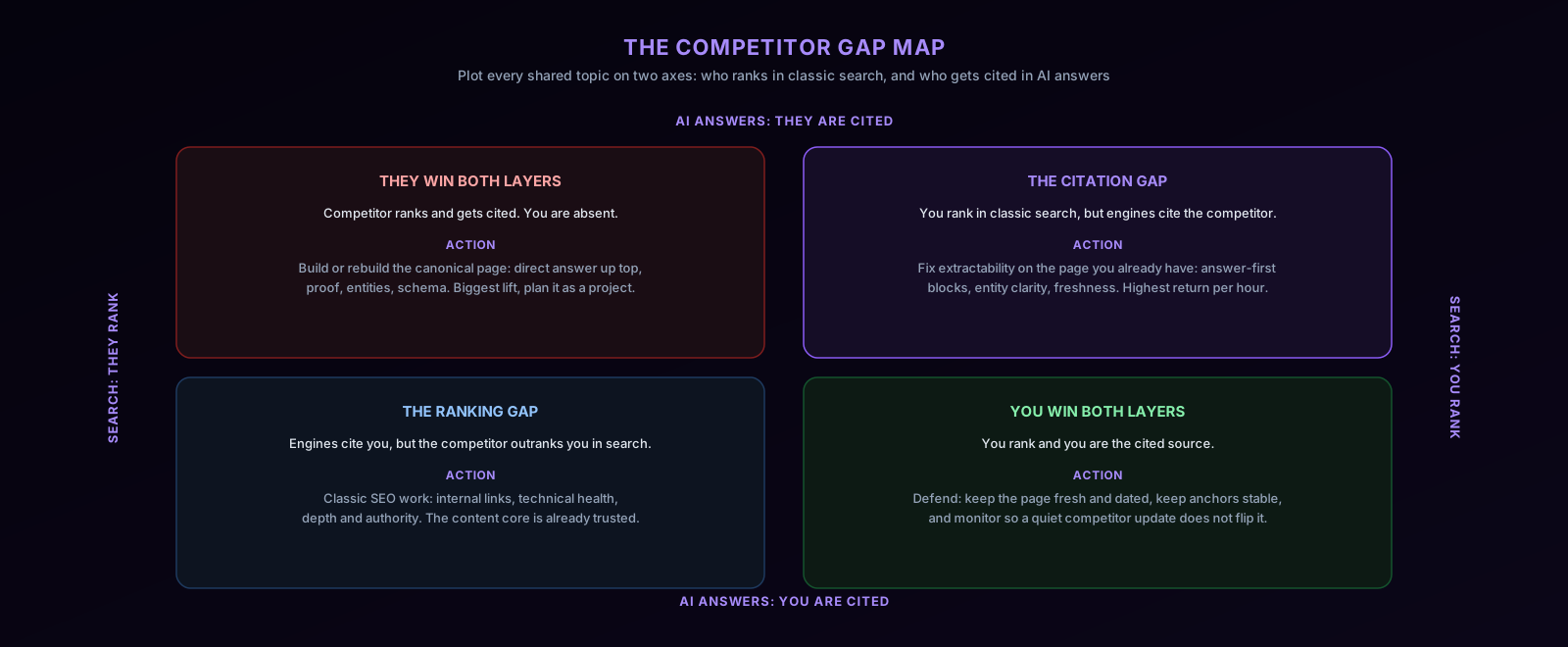
They win both layers. The competitor ranks and gets cited; you are absent. This is the expensive quadrant: it usually means you lack a credible canonical page for the topic. Building one is a project, not a tweak, so these gaps go through prioritization rather than straight to the backlog.
The citation gap: you rank, they get cited. The highest-return quadrant per hour invested. Your page already has the authority to rank, but engines quote the competitor, which typically points at extractability: answers buried mid-paragraph, missing entity clarity, no freshness signals. Fixing the structure of a page you already own is much cheaper than building new authority.
The ranking gap: they rank, you get cited. Engines already trust your content; classic search does not surface it as well. The work is traditional SEO: internal linking, technical health, depth, and authority.
You win both. Defend it. Keep the page fresh and honestly dated, keep heading anchors stable so earned citations do not rot, and keep monitoring, because a quiet competitor rewrite can flip a quadrant without any alarm going off.
Tracking The Gap Over Time
A one-time analysis is a snapshot that starts aging immediately, and AI answers add a complication rankings never had: the same engine can answer the same prompt differently on consecutive runs. Single observations are weak evidence in this system; trends are the signal.
In the AEO Goal app, the Competitors view makes the trend the primary object. You add a competitor by domain, and every tracked prompt is scored as a head-to-head: you win, the competitor wins, both appear, or neither does. Above that sits side-by-side Share of Model, the percentage of tracked answers mentioning each brand, plus a win/loss breakdown and the direction the gap is moving. Prompt-level detail shows exactly which buyer questions you are losing, which turns “we are behind on AI visibility” into “these eleven prompts recommend them and not us.”
The same longitudinal logic applies to rankings: rank tracking overlays competitor positions on your keyword history, and keyword research surfaces terms with high AI answer frequency, where the answer layer, not the results page, is deciding winners. For the source-level view of who engines actually quote, see AI citation tracking and the competitor AI visibility product page.
From Finding To Fix: Decision Rules
Analysis that ends in a spreadsheet is a cost center. Three rules keep it attached to outcomes.
Every persistent gap becomes an owned-page decision. The output of analysis is never “competitor X is strong”; it is “this specific page of ours needs to change, in this specific way” or “we need a page that does not exist.” If a finding cannot be phrased that way, it is not actionable yet.
Sequence by cost, not by annoyance. Citation gaps on pages that already rank are usually the cheapest wins. Technical gaps from the free scan are nearly free to close. Both-layer losses are the most expensive and should be taken on deliberately, when the topic’s value justifies a real project.
Re-check after every ship. A fix is a hypothesis until the next measurement cycle confirms the quadrant changed. This is the loop AEO Goal runs as an agent: find the gap, ship the concrete fix, re-check whether citations, Share of Model, or position moved. Fixes that did not move anything go back for rediagnosis instead of being counted as done.
Common Mistakes
Copying the winner. Covered above, and worth repeating because it is the default instinct: imitation gives the engine a redundant source. Contribute something the incumbent lacks or pick a different gap.
One page per keyword. Competitor keyword lists tempt teams into generating a thin page for every term. Engines consolidate around canonical sources; a strong page serving a topic cluster beats twenty near-duplicates serving keywords.
Treating traffic estimates as measurements. Third-party traffic figures are modeled from panels and clickstream samples. They rank topics by relative size usefully; as absolute numbers in a report, they are a credibility risk. Label them as estimates or leave them out.
Analyzing only your named rivals. The brands AI engines actually recommend are frequently not your internal shortlist. Let tracked answers tell you who the field is, and add the names that keep appearing.
Confusing mentions with citations. A competitor being named in answers and a competitor’s URL being cited as a source are different advantages with different causes. Measure both.
What Is Free And What Is Paid
Free, no signup: the AI visibility scan on any domain, including competitors’, with the full signal panel and issue list described above. Paid, in the app: scheduled prompt runs across engines, Share of Model trends, prompt-level head-to-heads, rank tracking with competitor overlays, and keyword research, because ongoing tracking consumes real engine queries on a schedule. The scan tells you where both sides stand structurally today; the app tells you who is winning the answers and whether your fixes are working. For the strategic background, see AEO vs traditional SEO.
Frequently Asked Questions
How many competitors should I track? The handful that actually appear in your category’s AI answers and rankings, typically three to six. Past that, review time per competitor drops below the threshold where anyone acts on the data.
Can I analyze a competitor without knowing their brand name variations? Yes. In AEO Goal you add a competitor by domain, and mentions of both the domain and the associated brand name are detected across tracked prompt results automatically.
How often should the comparison refresh? Tracking runs on a schedule in the app; your review cadence is the real variable. Weekly review of movements and a monthly decision pass on the gap map is a sustainable rhythm for most teams.