Quick Answer
AEO Goal is a complete AI SEO platform, not an add-on to one. It covers the classic search stack - keyword research, daily Google rank tracking, backlink analysis with a DR-weighted Domain Score, and technical site audits including measured Core Web Vitals - and the AI-answer layer a suite does not read: your buyers’ prompts run across ChatGPT, Claude, Gemini, Perplexity, and Google AI Overviews, and every answer is parsed for citation rate, share of model, and sentiment, then turned into a fix that the next scan re-checks.
Semrush is a broader all-in-one marketing suite. Its additional reach sits mainly outside organic search: ads and paid research, very large-scale competitive datasets, and multi-channel campaign work.
If you can only run one and your job is organic search plus AI visibility, AEO Goal covers both surfaces on its own. Choose Semrush when paid media and multi-channel breadth are the actual requirement. Run both when the suite is genuinely earning its seat across channels.
Same job, different coverage
Both tools are bought to answer one question: are buyers finding us, and what do we fix next? They differ in which surfaces they can see while answering it.
Where they overlap is organic search. Keyword research, rank tracking, backlinks, and technical audits are core to both, and this page is not going to pretend a suite does them badly. Where they diverge is at the edges, in opposite directions. Semrush reaches sideways into channels beyond organic search. AEO Goal reaches into the answer layer that sits on top of search.
That layer is not a niche. When a buyer asks ChatGPT or Perplexity “what is the best [your category] for mid-sized teams,” the answer is a generated paragraph with a handful of cited sources, not a results page with ten ranked links. Keyword databases, position tracking, and traffic estimates describe the old surface with real depth; none of them opens the new one. A brand can hold strong rankings and still be absent from the answers a growing share of buyers reads first, and a ranking dashboard will look healthy the entire time.
One misreading worth correcting, because it comes up constantly: AEO Goal is not a tool you bolt on once your technical SEO is finished. It ships the tools that fix technical SEO. Teams with real crawl or indexation debt use it to work both problems at once, which is the efficient order, because the page failing an audit is usually the same page AI engines decline to cite.
What Semrush is built for
Stated plainly and without pretending to know its current feature matrix: Semrush is widely known as a broad, all-in-one digital-marketing platform built around classic search and competitive datasets - keyword research, rank tracking, competitive analysis, content tooling, and advertising research under one login. For a marketing team that owns many channels, that breadth is the product. One workspace, one bill, one place where a demand-gen manager can move from keyword clusters to a competitor’s paid strategy to a content calendar.
If those are your jobs, a suite of that shape earns its seat. Nothing on this page argues otherwise, and we would rather say that clearly than manufacture a feature-by-feature fight we could not honestly source. Verify its current packaging and capabilities with the vendor; the category role is not in dispute.
What AEO Goal is built for: an agent, not another dashboard
AEO Goal is built for the surface the suite does not read, and it is built to act, not just report. The loop looks like this:
- Measure the answers. Your priority prompts run against ChatGPT, Claude, Gemini, Perplexity, and Google AI Overviews on a schedule. Every generated answer is parsed for brand mentions, cited source URLs, position, and sentiment.
- Find the gap. Citation rate, share of model, and competitor overlap per engine show exactly which prompts cite a competitor and skip you, and where.
- Ship the fix. Each gap comes with a concrete action: an answer-first content brief, a schema change, a crawler-access fix (robots.txt for AI agents, llms.txt), or a specific page to publish - ranked into one prioritized backlog.
- Re-check. The next scan shows whether the fix moved citations, share of model, or rankings. You are not buying another chart; you are buying the work that changes the chart.
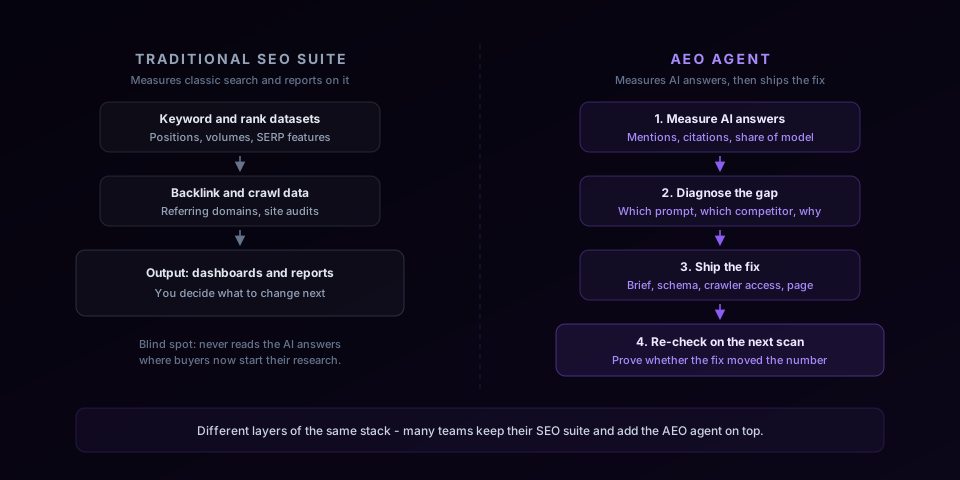
And because buyers do not split their research between “AI search” and “Google,” AEO Goal carries the full classic stack in the same workspace: keyword research with volume and difficulty, daily rank tracking, backlink analysis with a DR-weighted Domain Score plus AEO Rank (which measures authority among the domains AI engines actually cite), and technical site audits covering broken links, indexation, crawlability, and Core Web Vitals measured from CrUX field data. Findings from both surfaces land in one backlog, so a suite buyer’s favorite property - one place to work - survives the switch rather than being traded away for it.
Which tool does which job?
Compare by job, not by feature-list length. Here is how the split usually falls for a suite-owning team:
| The job to be done | Broad SEO suite | AEO Goal |
|---|---|---|
| Research keyword clusters and competitive gaps across many channels | Built for this | Covers the core (volume, difficulty, clusters) |
| Manage paid-search and ads research alongside organic | Its home turf | Not the product |
| Know which prompts cite competitors and skip you, per AI engine | Not designed to read generated answers | Built for this |
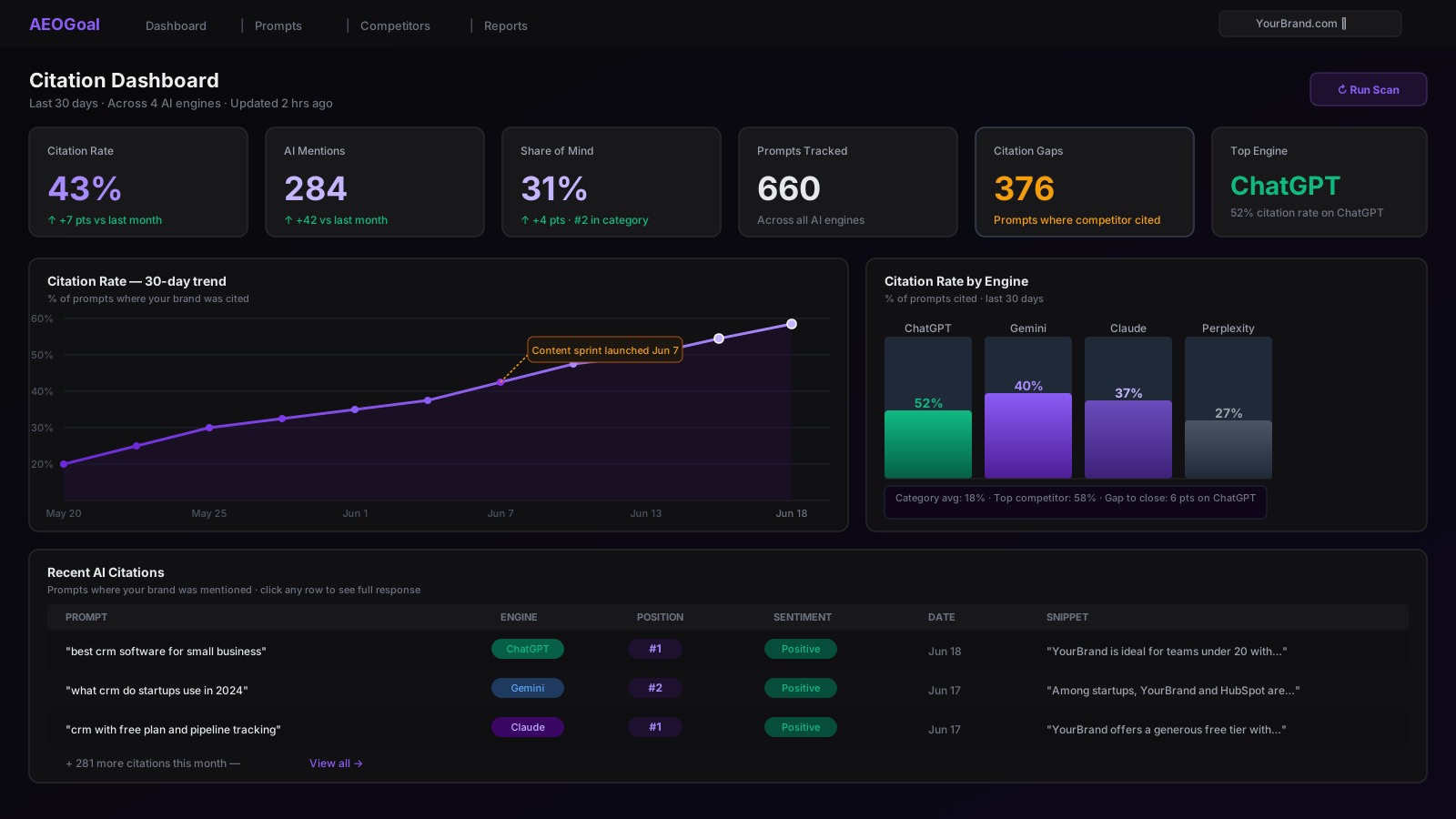
| Track share of model and sentiment across ChatGPT, Claude, Gemini, Perplexity | No | Yes, per engine, as a trend |
| Turn an AI-answer gap into a brief, schema fix, or crawler-access fix | You translate charts into tasks yourself | Every finding ships with a fix path |
| Prove last month’s fix moved the number | Manual before-and-after analysis | Fix-and-recheck loop on every scan |
| Daily Google rank tracking and backlink monitoring | Yes | Yes (Domain Score, AEO Rank) |
| Technical site audits: broken links, indexation, Core Web Vitals | Yes | Yes, in the same backlog as AI findings |
| One prioritized backlog across AEO and SEO findings | Dashboards per module | Yes - one queue |
When Semrush is the right call
Honesty is house style, so here it is: if your team’s daily work depends on suite breadth - ads and paid research next to organic, competitive datasets at very large scale, channels beyond search entirely - keep the suite. AEO Goal is a search and AI-answer platform, not an all-in-one marketing platform, and it does not pretend to be one. A team whose bottleneck is paid media or multi-channel coordination should not swap that away.
Note the shape of that boundary, though, because it is narrower than it is often reported. It is about channels beyond organic search, not about depth within it. “Use AEO Goal only once your traditional SEO is already flawless” is simply wrong: rank tracking, keyword research, backlinks, and technical audits are in the product, so an unfinished classic stack is a reason to use it, not a reason to wait.
Run both, or consolidate?
Two honest paths, and team shape decides between them:
Run both when the suite is earning its keep across channels. AEO Goal layers on as the AI-answer system: it reads the answers, attributes wins and losses per engine, and ships the fixes. The classic-SEO overlap (keywords, ranks, backlinks) becomes a budget question you can settle at renewal time, not a conflict. This is the common pattern for mid-sized and larger marketing teams.
Consolidate when you audit what you actually use and find it is keyword research, rank tracking, backlinks, technical audits, and content briefs - the core, not the breadth. AEO Goal carries exactly that core plus the entire AI-answer layer the suite lacks, on one backlog. This is not a downgrade to a point tool: it is the same search work in one place, with a surface added that the suite cannot see at all. Teams take this path because unused breadth is the most expensive line item in the stack.
The wrong path is the quiet third one: keeping only the classic suite and assuming rankings are a proxy for AI-answer presence. They are not, and the gap between the two is invisible from inside a ranking dashboard. See AEO vs traditional SEO for why the disciplines diverge.
A worked example: the channel owner with a full stack
Picture a demand-gen lead at a B2B software company who owns the suite and runs it well: rankings are stable in the top five for the money keywords, the content calendar is fed, and the competitive reports go out monthly. Then sales starts hearing the same line on calls: “ChatGPT recommended two of your competitors.” Nothing in the suite explains it, because nothing in the suite reads answers.
Week one with AEO Goal: the free scan finds two AI crawlers blocked in robots.txt and no llms.txt; prompt tracking shows a 9 percent citation rate on 40 category prompts while the two named competitors sit far higher, and the engines are citing a comparison page the team never considered strategic. Weeks two and three: unblock the crawlers, publish an answer-first comparison page from the generated brief, add JSON-LD to the three most-cited-adjacent pages. The following scans show citation rate climbing and share of model moving on ChatGPT and Perplexity specifically - measured, not assumed. The suite kept doing its job the whole time; it just was never going to do this one.
What to verify with each vendor before you buy
Public comparison pages, this one included, should inform a shortlist, never replace diligence. Before committing money:
- With Semrush: current pricing and plan limits, which modules your team will actually use, any AI-visibility capabilities it now offers and how they measure (real answer parsing or estimates), data freshness, seat costs, and contract terms.
- With AEO Goal: which engines and how many prompts your plan covers, scan cadence, how fixes are generated and re-checked, pricing, and data-handling terms. Then confirm all of it against your own domain with the free scan rather than a demo dataset.
- With both: SSO and access controls, API limits, data retention, subprocessors, and cancellation terms - the procurement layer that feature pages skip.
For how citation metrics are derived, see the AI citation tracking methodology.
See your AI-answer baseline first
The cheapest way to settle this comparison is evidence from your own domain. Run the free AI visibility scan - it checks AI-crawler access across 16 agents, llms.txt, sitemap, structured data, metadata, and entity salience, and shows where AI engines stand on your brand today. If the scan comes back clean and buyers in your category are not asking AI engines anything, keep the suite and move on. If it does not, you have found the layer your stack is missing, and AEO Goal is built to close it.