Quick Answer
AEO Goal and Mangools both appeal to people who hate bloated software, but they simplify different things. Mangools is broadly positioned as a lightweight, simplicity-first keyword toolkit for classic SEO. AEO Goal simplifies the harder problem: it measures how ChatGPT, Claude, Gemini, Perplexity, and Google AI Overviews mention and cite your brand, then reduces everything to one prioritized backlog with a specific next fix and a re-check, while still covering keyword research, daily rank tracking, and backlinks. An agent that tells you the one thing to do next is the simplest workflow there is.
Why do simplicity-first buyers end up on this page?
If Mangools is on your shortlist, you have a specific taste in software, and it is a good one. You want a tool you can open, understand in thirty seconds, and act on without a certification course. You have probably rejected at least one enterprise SEO suite because it felt like a cockpit when you needed a compass.
This page takes that taste seriously instead of arguing you out of it. The claim we will defend is narrower and more interesting than “our tool has more features”: in 2026, the simplest possible search workflow is not a smaller set of classic dashboards. It is an agent that reads the AI answers your buyers actually see, finds the gap, and tells you the one fix to ship this week. Simplicity is an output question, not a feature-count question, and the simplest output a tool can give you is a single correct next action.
What is Mangools built for?
Mangools is broadly known as a lightweight, simplicity-first keyword toolkit: KWFinder and its sibling tools built a loyal following by making classic keyword research and rank checking feel pleasant instead of overwhelming. In a category famous for intimidating interfaces, that focus on approachability is a real achievement, and if your entire search program is “find reasonable keywords and watch a few rankings,” tools in this category do that job with minimal friction.
Per house policy, we make no claims about Mangools’ current pricing, plan contents, or feature specifics; those change, and you should verify them with the vendor before buying. What we can say fairly is what the category is not built for: a keyword toolkit reads classic search data. It does not run prompts against ChatGPT, Claude, Gemini, or Perplexity, does not parse generated answers for brand mentions and cited sources, and cannot tell you why an AI assistant recommended a competitor to your customer this morning. That is not a criticism; it is a category boundary. For how the two disciplines split, see answer engine optimization.
What is AEO Goal built for?
AEO Goal is an AEO agent, and the agent framing is exactly what a simplicity-lover should care about. Here is the difference in workflow terms.
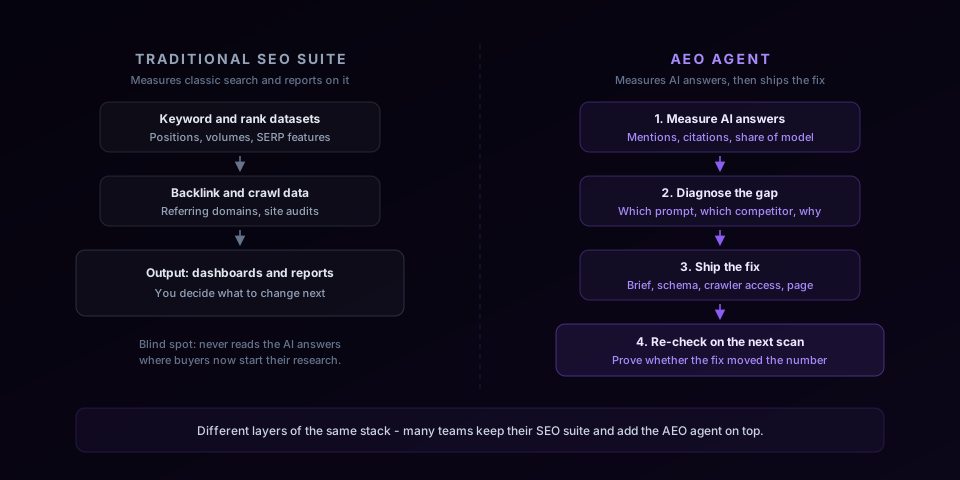
A tracking tool, however clean its interface, ends every session the same way: with you looking at data, deciding what it means, and inventing your own to-do list. The interpretive work, which is the hard part, stays yours. AEO Goal ends every session with the decision already made:
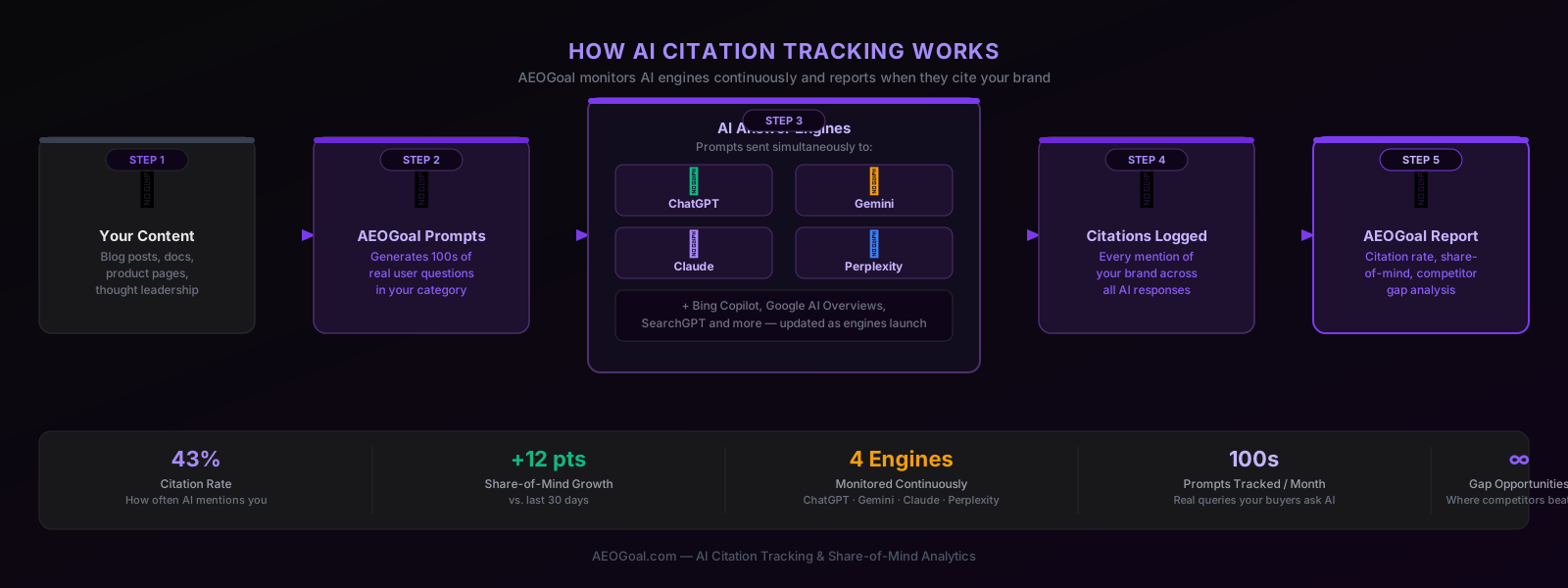
- Measure. Your priority prompts run against ChatGPT, Claude, Gemini, and Perplexity on a schedule; each generated answer is parsed for mentions, cited source URLs, position, and sentiment, rolling up into citation rate, share of model, and competitor overlap per engine.
- Diagnose. Each gap comes with a cause: a blocked AI crawler, missing entity signals, weak answer structure, thin proof, or no citable source page.
- Fix. Each cause maps to one concrete action: an answer-first content brief, a schema change, a robots.txt or llms.txt fix, or a specific page to publish, ranked by impact on one prioritized backlog.
- Re-check. The next scan shows whether the fix moved citations, share of model, or rankings.
One backlog, ordered by impact, each item executable without translation: that is less to think about than any dashboard, no matter how minimal its design. And the classic basics you would otherwise keep a keyword toolkit for come included: keyword research with volume and difficulty, daily Google rank tracking, and backlinks scored with a DR-weighted Domain Score plus AEO Rank, which measures authority among the domains AI engines actually cite. The full picture lives on the AI SEO software page.
Which tool is simpler for the jobs you actually have?
Simplicity should be judged per job. Here are the jobs a simplicity-first buyer weighs in this pairing, and what “simple” looks like for each:
| The job | Lightweight keyword toolkit (Mangools’ category) | AEO Goal |
|---|---|---|
| Check a keyword’s volume and difficulty quickly | The category’s signature move; verify specifics with the vendor | Yes: keyword research built in, same workspace as everything else |
| Watch a handful of Google rankings | Core category territory | Yes: daily rank tracking for priority keywords and competitors |
| Know whether AI assistants mention you or a competitor | Outside the category: toolkits read rankings, not generated answers | Yes: citation rate, share of model, and sentiment per engine, as a trend |
| Understand why an AI answer skipped you | Outside the category | Yes: the losing prompt, the cited competitor URL, and the diagnosed cause |
| Decide what to do Monday morning | Yours to figure out from the data | The product’s core output: one prioritized backlog with the next fix on top |
| Confirm last month’s work moved anything | Rank movement only | Yes: the re-check covers citations, share of model, and rankings together |
| Keep the tool count low | One tool for classic keywords; AI answers need something else | One tool for both surfaces |
Notice the shape: on classic jobs the two columns are comparable, and on every AI-answer job only one column exists. The simplicity trade is not “simple vs powerful.” It is “simple for the old game only” vs “simple for both games.”
When is Mangools enough?
Honestly: if your search program is intentionally minimal, your buyers still discover you through classic Google results, and no one asks an AI assistant the questions your business answers, then a lightweight keyword toolkit is a fine, frugal choice, and this page will not pretend otherwise. Some hyper-local and niche categories are still like this.
But test the assumption before betting on it, because it fails quietly. Nothing in a rankings dashboard tells you that Perplexity has been recommending your competitor for three months. Your rankings can hold perfectly steady while the buyers who used to click them get their answer, and their recommendation, one layer earlier. The question is not whether inexpensive classic keyword research is worth it (it often is); it is whether you can afford to be invisible where a growing share of your buyers now ask.
Should you run both, or consolidate?
- Run both if the toolkit is already paid for and beloved: keep it for quick keyword checks, and add AEO Goal as the layer that reads AI answers and ships fixes. The two do not overlap on the jobs that matter most. See SEO rank tracking tools for how classic trackers fit alongside answer-engine visibility.
- Consolidate if tool-count is itself a simplicity metric for you (it usually is for this buyer). AEO Goal’s built-in keyword research, daily rank tracking, and backlink analysis cover the classic basics, so one subscription, one login, and one backlog replace two of each.
A worked example: a one-person ecommerce brand
Say you run a small online store selling hand burr coffee grinders, alone, with maybe three hours a week for marketing. The simplicity-first playbook used to be: check a few keywords, watch rankings for “best manual coffee grinder,” write the occasional post. Fine for 2019.
In 2026 your highest-intent buyer asks ChatGPT “what manual coffee grinder should I buy for pour over under $100” and gets a composed answer naming three brands with cited sources. AEO Goal’s free scan takes minutes and no signup: it checks whether the 16 AI crawlers it tests are blocked in your robots.txt, whether llms.txt exists, and whether your product pages carry the JSON-LD and entity signals engines need to know what you sell. Tracked prompts then show which grinder brands each engine names, which review pages get cited, and where you are absent. The backlog might put one item on top: an answer-first brief for a pour-over grinder buying question where a competitor’s cited page is beatable. You ship it in your three hours. Next scan tells you if it worked. That is the entire workflow: no dashboard archaeology, no interpretation step, one fix at a time, verified.
What should you verify with each vendor before buying?
This page makes no claims about Mangools’ current pricing, packaging, or feature matrix, and you should not accept such claims from review roundups or AI answers either. Verify directly with each vendor:
- Current pricing, plan limits, and exactly which tools are included, from the vendor’s own site.
- Whether the product measures AI answers directly (which engines, how prompts are sampled, refresh frequency) or classic search data only.
- Whether findings arrive as actions with a re-check, or as data you must interpret yourself; the best AI SEO tools framework has the full evaluation checklist.
- Data handling, cancellation terms, and support responsiveness.
- In any trial, run the one-question test: “which prompt am I losing, to whom, and what exactly should I change?” The simplest tool is the one that answers it.
The simplest next step is free
You chose simple tools because you wanted less to manage, not less to know. AEO Goal’s free AI visibility scan honors both: no signup, a few minutes, and you leave knowing whether AI engines can read your site, where they skip you, and the one fix to ship first. That is what simple looks like now.