Free SEO analyzer with AI visibility scoring
Run the free scan now - type any domain and get your AEO readiness score in seconds, no signup required.
AEO Goal’s SEO analyzer checks the signals that decide whether AI answer engines can crawl, understand, and cite your pages - not just classic search signals. It reads your actual files live from your server, so every result is a measured fact, not an estimate. You see what is blocking you, in order of impact, with a clear path to fix it.
What makes this different from the average “free SEO checker” widget: it specifically checks AI readiness - robots.txt access for 16 AI crawler user agents, llms.txt presence and quality, JSON-LD entity structure, and how clearly your page establishes what your brand is. Most SEO analyzers were built before AI answers existed. This one was built to score both.

What happens when you run the scan
The scan runs six steps against your live site in under ten seconds:
- Fetch the homepage. Confirms the page responds, is indexable, and can be parsed.
- Check robots.txt for 16 AI crawler agents. Reads your actual rules and reports how many AI user agents - the crawlers used by ChatGPT, Claude, Gemini, Perplexity, and others - are allowed in.
- Check llms.txt. Reports whether the file exists and whether it actually links to your key pages or is an empty stub.
- Parse JSON-LD structured data. Lists the schema types found, and specifically whether an Organization entity with a sameAs cluster and FAQ markup are present.
- Compute entity salience. Measures how central your brand entity is on the scanned page - a page about everything is a weak retrieval source for anything.
- Score AEO readiness. Combines crawler access, structured data, llms.txt, and metadata into a single 0 to 100 score with a ranked issue list.
You see the score and your top three issues immediately with no email. Entering an email sends the full report. Fix details for every issue unlock when you create a free account - that is the entire gate.
How to read each signal
| Signal | What a bad result means | What to do |
|---|---|---|
| AI crawler access (n of 16 allowed) | Blocked agents cannot fetch your pages, so those engines cannot cite you | Decide your crawler policy deliberately; see the robots.txt guide |
| Indexable | A noindex directive removes the page from search and from most retrieval | Remove the directive unless the exclusion is intentional |
| robots.txt / Sitemap | Missing files make discovery slower and less reliable | Publish both; reference the sitemap from robots.txt |
| llms.txt | Missing or link-free llms.txt gives AI systems no curated map of your citable pages | Generate one; see llms.txt support |
| Schema (JSON-LD) | No Organization entity leaves engines guessing what your brand is | Add Organization schema with a sameAs cluster; validate it matches visible content |
| Canonical | Missing canonical invites duplicate-URL confusion | Add a self-referencing canonical to every indexable page |
| H1 heading | Zero or multiple H1s blur the page topic | Exactly one H1 that states what the page answers |
| Title / meta description | Missing, truncated, or padded metadata weakens snippets and retrieval context | Rewrite to the reported length verdict |
| Open Graph | Missing OG tags degrade link previews and some parsers | Add og:title, og:description, og:image |
| Freshness | No dateModified signal makes the page look stale to retrieval systems | Publish and maintain real modification dates |
Decision rules for acting on results
Work by what blocks what, not top to bottom:
- Fix access before content. If AI crawler access reads “blocked” or indexability reads “No”, nothing else on the report counts yet. An engine that cannot fetch the page cannot evaluate it.
- Fix identity before volume. Missing Organization schema and weak entity salience mean engines cannot confidently connect your pages to your brand. Fix that before publishing more content.
- Treat metadata verdicts as fast wins. Title length, meta description, H1 count, and canonical tags are usually one-file fixes. Ship them the same day.
- Re-scan after every batch of fixes. The scan is free and repeatable on any domain. The score only becomes useful as a trend: fix, re-run, confirm the line moved.
Common mistakes
Chasing the score instead of the blockers. An 85 with blocked AI crawlers is worse than a 70 with clean access. Read the lines, not the number.
Assuming the homepage represents the site. The free scan reads one page. Your key service and product pages may have different templates, different schema, and different problems.
Adding schema that the page does not support. Structured data that contradicts visible content is a credibility risk. See the structured data glossary entry for what engines actually consume.
Blocking AI crawlers by default. Many CDN and WAF presets block AI user agents silently. If your business wants to appear in AI answers, that default is quietly excluding you.
Fixing once and never re-checking. Deploys, plugin updates, and CDN changes routinely reintroduce blockers. Fix, re-scan, schedule.
From scan to continuous monitoring
The free scan gives you your technical baseline for today. AEO Goal’s paid tiers keep that baseline current and connect it to citation outcomes:
- Site-wide coverage. The site crawler follows internal links across your whole site, not just the homepage.
- Scheduled audits. Technical checks re-run weekly or monthly, automatically surfacing regressions before they cost you rankings.
- AI citation tracking. Your real prompts run across up to nine AI answer engines - ChatGPT, Claude, Gemini, Perplexity, Google AI Overviews, Microsoft Copilot, Grok, Meta AI, and DeepSeek - reporting citation rate, share of model, and sentiment per engine.
- Agent layer. Every gap gets a diagnosis and a concrete fix - not just a score to interpret.
That is the loop the product is built around: find the gap, ship the fix, re-check whether it moved citations or rankings. The analyzer is step one of that loop, offered free. Pricing covers what each tier adds.
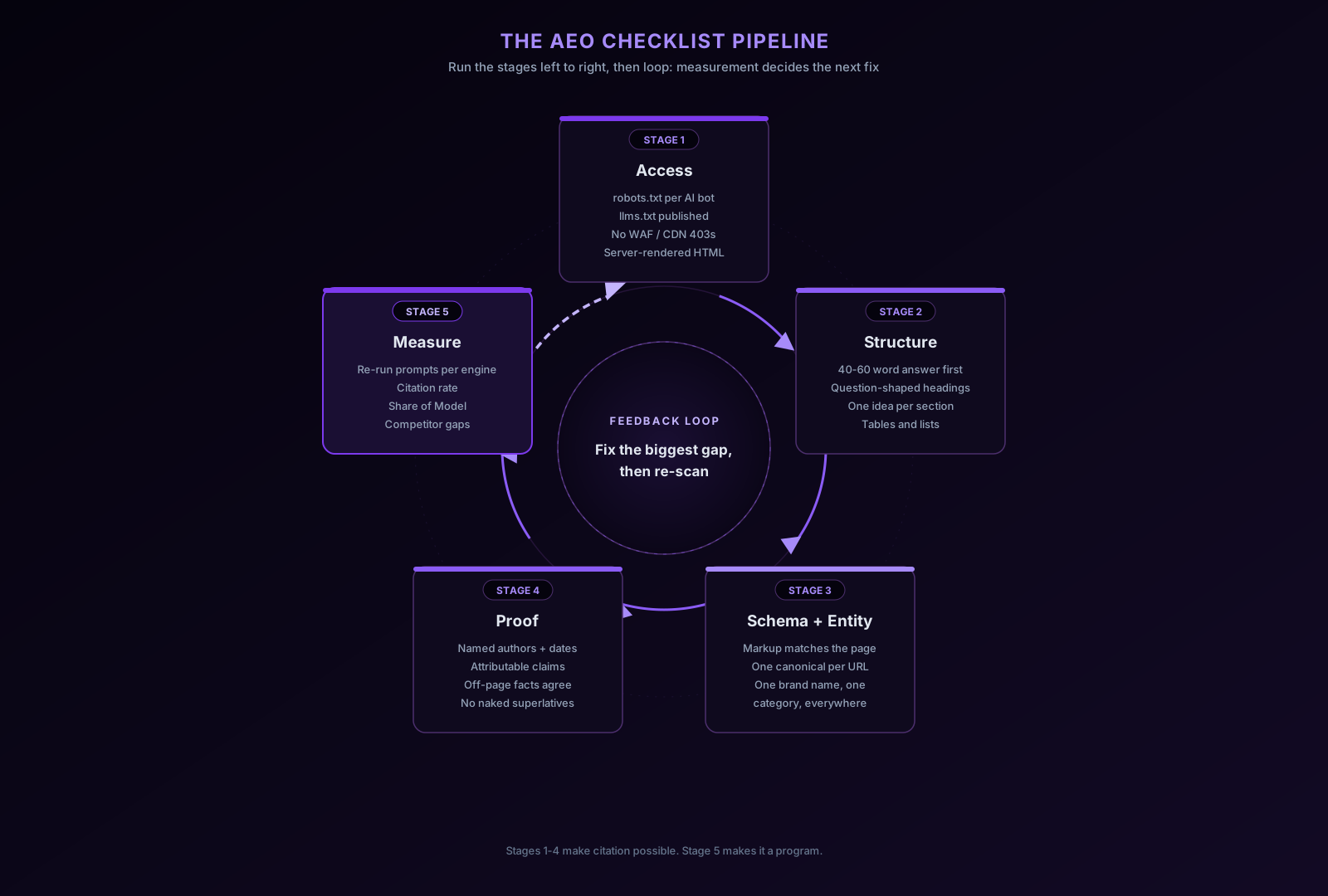
Where the scan fits in a program
Run the scan first, ship the access and identity fixes it surfaces, then move to the layers it does not cover: keyword and prompt targeting with the keyword research workflow, site-wide checks with the technical SEO audit, page quality with the content optimizer, and authority with the backlink checker.
New to Answer Engine Optimization? The free AEO and SEO course walks the whole sequence.