Quick Answer
ChatGPT SEO is the practice of structuring your website so ChatGPT can find, understand, and cite your brand in generated answers. It requires four things: pages that OpenAI’s crawlers (OAI-SearchBot, GPTBot, ChatGPT-User) are allowed to fetch, clear entity signals, answer-first formatting, and structured data that matches visible content. Success is measured at the prompt level - mentions, citations, and cited URLs - not with rank positions.
This is the full program guide. If your question is specifically “how do we rank or get cited in ChatGPT, and how do we measure it,” the companion piece on ChatGPT SEO ranking goes deeper on crawler verification, source eligibility layers, and prompt-level measurement.
Why ChatGPT Belongs in Your SEO Program
A growing share of product research now ends inside a generated answer instead of on a results page. When someone asks ChatGPT “what is the best [your category] for a small team,” the response is a synthesized recommendation with a handful of cited sources - not ten blue links. If your brand is absent from that answer, you are invisible at the exact moment a buyer is choosing a shortlist, and no amount of page-two Google ranking compensates for it.
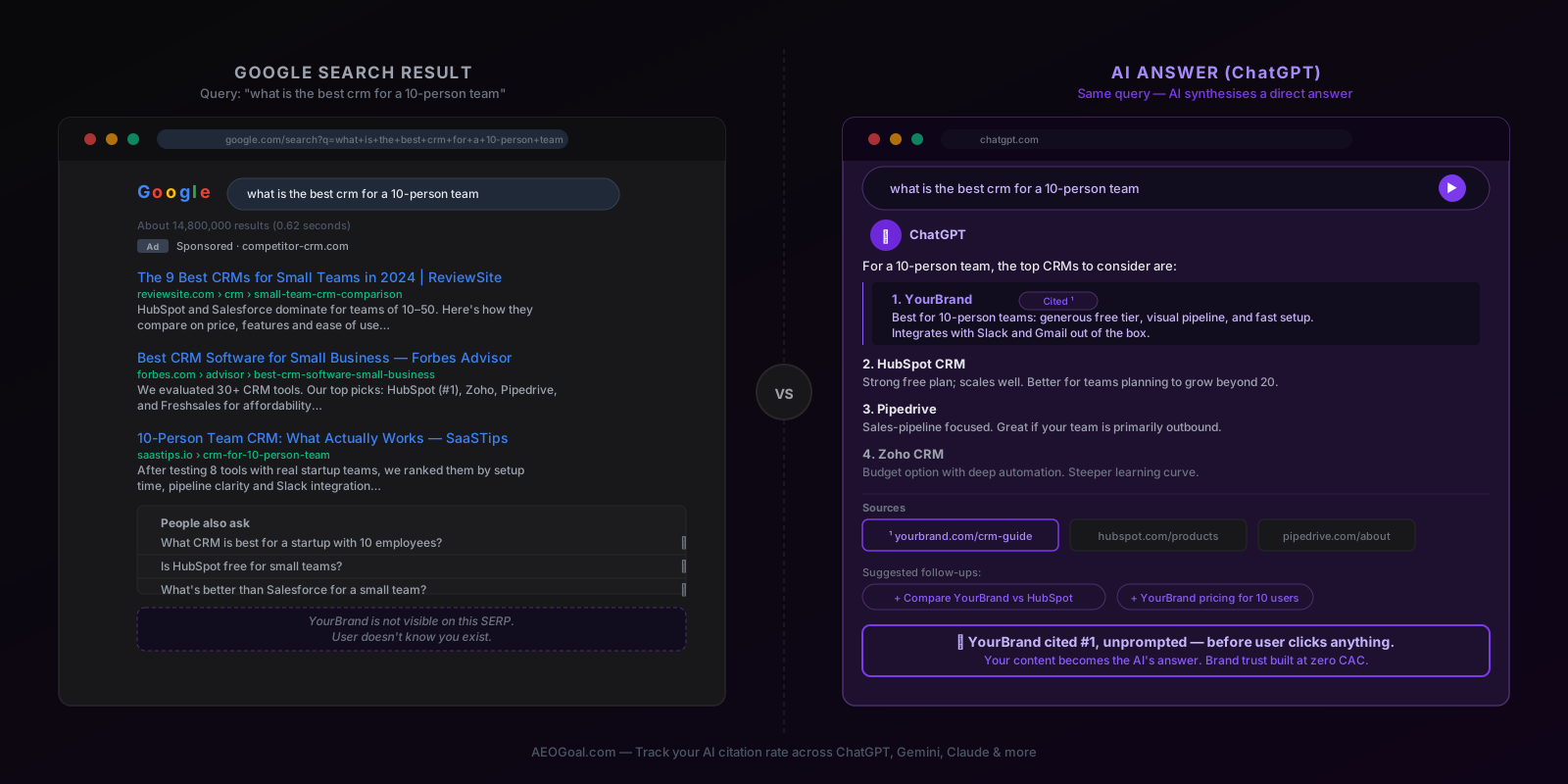
This does not replace traditional SEO. It extends it. The same crawlability, content quality, and entity clarity that earn Google rankings also make pages retrievable by ChatGPT - but AI answers add new requirements (crawler permissions specific to OpenAI, answer-first structure, extractable sections) and a completely different measurement model (citations and share of model instead of rank positions). ChatGPT SEO is the discipline of handling both.
How ChatGPT Builds an Answer
ChatGPT can draw on two different sources, and the distinction determines what you can influence:
- Training data. What the model learned before its knowledge cutoff. You influence this slowly, through consistent public descriptions of your brand across the web over time.
- Live web retrieval. ChatGPT search fetches current pages when a question benefits from up-to-date information, then synthesizes an answer and attributes the sources it used. OpenAI describes this behavior in its ChatGPT search help article. This is where most ChatGPT SEO work pays off, because retrieval responds to changes you ship this quarter, not changes the next model absorbs.
For a live-retrieval answer, the sequence is broadly: the user submits a prompt, ChatGPT decides whether to search, relevant pages are retrieved, and the model composes an answer citing some of those sources. Your job is to be eligible at every stage: accessible to the crawler, relevant to the prompt, useful enough to be quoted, and clear enough to be attributed.
The Three OpenAI Crawlers and What Each Controls
OpenAI documents its bots and their user agents at developers.openai.com/api/docs/bots. Each one gates a different thing, and each gets its own robots.txt decision:
| User agent | What it does | If you block it |
|---|---|---|
| OAI-SearchBot | Crawls sites to surface them in ChatGPT search features | Your pages drop out of live ChatGPT search citations |
| GPTBot | Fetches content that may be used to train OpenAI’s models | Future models learn less about you from your own site |
| ChatGPT-User | Fetches pages for certain user-initiated actions inside ChatGPT | Users’ direct page requests from ChatGPT fail |
Most brands that want AI visibility should allow all three for public marketing content while blocking application, admin, and API paths. A deliberate, least-privilege configuration looks like:
User-agent: OAI-SearchBot
Allow: /
Disallow: /app
Disallow: /admin
Disallow: /api

User-agent: GPTBot
Allow: /
Disallow: /app
Disallow: /admin
Disallow: /api
Two failure modes are worth calling out because they are common and silent. First, a legacy Disallow: / rule for GPTBot added during the 2023 wave of AI-crawler blocking, never revisited after ChatGPT search launched. Second, robots.txt that allows the crawlers while a WAF or bot-protection layer returns 403s, CAPTCHAs, or JavaScript challenges to them anyway. The robots file says yes; the infrastructure says no; the citation never happens. Verifying actual crawler access in server logs is covered step by step in the ChatGPT SEO ranking guide.
Beyond robots.txt, an llms.txt file gives AI systems a curated map of your most citable pages. It is an emerging convention rather than a documented OpenAI requirement, but it costs little and clarifies intent - see llms.txt support for how to generate one.
Choose the Prompts That Matter
Traditional SEO starts with keyword research. ChatGPT SEO starts with prompt research, and the two feed each other. Build a set of 10 to 50 prompts that represent real buyer questions in your category:
- Category prompts: “best [category] software for [segment]”
- Comparison prompts: “[you] vs [competitor], which is better for [use case]”
- Problem prompts: “how do I [job your product does]”
- Validation prompts: “is [your brand] good for [use case]”
Your existing keyword research is the raw material: high-intent keywords convert into conversational prompts, and question-format keywords often are prompts already. The difference is that a prompt set is a fixed measurement instrument. You will run the same prompts on a schedule and track how answers change, so choose prompts a real buyer would ask, not vanity phrasings you expect to win.
Build Pages ChatGPT Can Cite
Retrieval favors pages that are easy to extract an answer from. Five properties matter most.
Answer-first structure. Put the direct answer in the first 60 to 80 words or in a clearly labeled summary section. If the answer is buried under a 500-word introduction, the page is harder to quote and something more direct gets cited instead.
Clear heading hierarchy. One H1 that names the topic. H2s that frame sections as real questions or descriptive phrases: “How Does ChatGPT Decide What to Cite?” beats “Overview.” Headings are the parse structure a retrieval system uses to map sections to intents.
Accurate structured data. Add FAQPage schema for question-and-answer sections, Article for guides, and Organization with logo and contact details. Structured data tells retrieval systems what the page is and who published it - but it must match visible content. Never add aggregateRating, reviews, or awards that do not appear on the page.
Consistent entity signals. Describe what you do in the same plain language everywhere: your homepage, your product pages, your about page, third-party profiles. If your site calls you a “revenue orchestration platform” in one place and a “sales CRM” in another, the model’s picture of you blurs, and blurry entities lose citations to sharp ones.
Freshness and internal links. Update lastmod in your sitemap when content genuinely changes, correct outdated claims, and link related pages to the canonical answer page with descriptive anchor text (“AI citation tracking,” not “click here”). Internal links concentrate retrieval on the page you want cited.
Keep the Traditional SEO Foundation Strong
ChatGPT SEO is not a silo, and treating it as one wastes the overlap. The connection runs in both directions:
- Classic SEO feeds AI retrieval. ChatGPT’s search features draw on web search infrastructure, so pages that are well indexed, well linked, and authoritative in classic search are better positioned for AI retrieval too. Crawlability fixes, sitemap hygiene, and backlink authority are dual-purpose investments.
- AI answers feed classic SEO. Prompt-level gaps reveal buyer questions your keyword research missed. A prompt where a competitor is cited and you are absent is simultaneously an AI-visibility gap and a content brief for a page that can also rank in Google.
Run one program with two measurement surfaces: rank tracking for Google positions, citation tracking for AI answers, and one shared backlog of fixes. The comparison page on AEO vs traditional SEO breaks down where the disciplines diverge.
What Does Not Work
- Thin “ChatGPT pages.” Pages created to target a phrase without real substance are not retrieved more often; they dilute entity signals and can cannibalize the page that should be cited.
- Keyword stuffing. Repeating “ChatGPT SEO” twenty times is not how retrieval works. Salience comes from clear, consistent descriptions, not term frequency.
- Hidden content. Text behind logins, or loaded by JavaScript after render, is typically invisible to AI crawlers. What the crawler cannot fetch, the answer cannot cite.
- Schema that lies. Structured data contradicting visible content is a trust liability on every surface, AI and Google alike.
- Flip-flopping crawler permissions. Blocking and unblocking OpenAI’s bots creates inconsistency in what has been indexed. Decide the policy once, deliberately.
Measure, Then Close the Loop
Manual testing - asking ChatGPT your prompts and eyeballing the answers - is fine for a first look and useless as a program. Answers vary by phrasing, context, and retrieval, so a single spot check tells you almost nothing durable. A real measurement loop looks like this:
- Run your fixed prompt set against ChatGPT on a schedule and record mentions, citations, and cited URLs.
- Compare cited URLs against your pages and competitors’ pages.
- Identify citation gaps: prompts where a competitor is cited and you are not.
- Diagnose each gap - blocked crawler, missing page, weak answer structure, thin entity signals.
- Ship the fix, then re-run the prompt set and confirm the change moved the number.
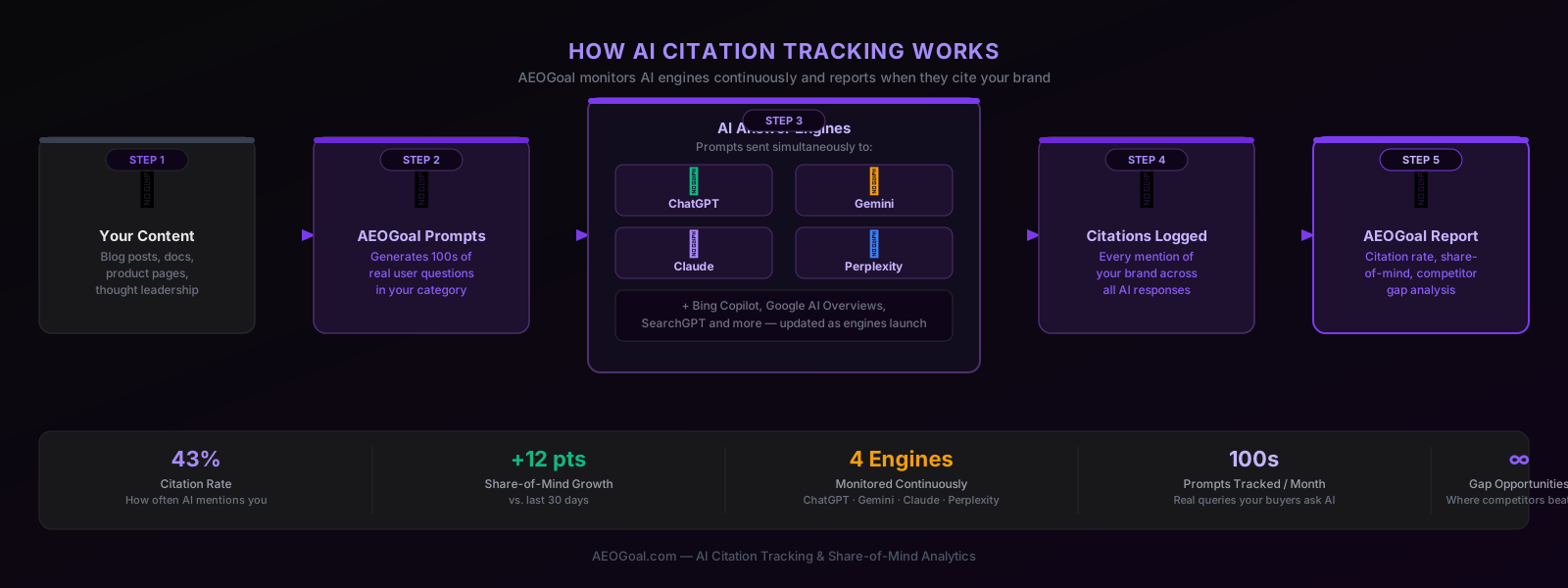
This loop is exactly what AEO Goal automates, and the part after step 3 is what separates it from tracking-only tools. AI citation tracking runs the prompts and logs every mention, cited URL, position, and sentiment per engine. When it finds a gap - say, a competitor cited across ChatGPT and Perplexity for a prompt you should own - it does not stop at the chart: it identifies the cause (a blocked crawler, a missing citable page, weak answer structure) and ships the fix, whether that is a robots.txt correction, a schema change, or an answer-first content brief for the page that should exist. On the next scan it re-checks whether the fix moved citations. AI visibility tracking extends the same loop across Claude, Gemini, and Perplexity, and the methodology documents exactly how citations are detected and scored, so the numbers you report are defensible.
ChatGPT SEO vs Traditional SEO
| Dimension | Traditional SEO | ChatGPT SEO |
|---|---|---|
| Crawler | Googlebot, Bingbot | OAI-SearchBot, GPTBot, ChatGPT-User |
| Unit of competition | Keyword | Prompt |
| Signal weight | Backlinks, authority, page speed | Entity clarity, answer-readiness, freshness |
| Measurement | Rank position, impressions, clicks | Citation rate, cited URL, share of model |
| Primary tool | Google Search Console | AI citation tracking |
| Key technical files | sitemap.xml, robots.txt | robots.txt (per-bot rules) + llms.txt |
The foundations are shared: crawlability, well-structured content, accurate metadata. What changes is the extra signals AI retrieval weights and how success is measured - prompt-level AI visibility and AI citations replace rank position as the headline metric.
A 30-Day ChatGPT SEO Program
- Week 1: Access. Audit robots.txt for OAI-SearchBot, GPTBot, and ChatGPT-User rules; check WAF and bot-protection logs for blocked OpenAI requests; publish or update llms.txt; fix broken canonicals.
- Week 2: Baseline. Define your prompt set, run it, and record mentions, citations, cited URLs, and competitor overlap per prompt. This is your before picture.
- Week 3: Fix. Take the three highest-value gaps and ship the fix for each: restructure an existing page answer-first, add matching schema, or publish the citable page the prompt deserves.
- Week 4: Re-measure. Re-run the prompt set, compare against baseline, and feed what you learned into next month’s fixes.
Run it once and you have an audit. Run it monthly and you have a compounding program, because each cycle turns last month’s fixes into this month’s proof.
For the wider discipline beyond ChatGPT, see What is Answer Engine Optimization and What is Generative Engine Optimization. For the measurement-heavy technical companion to this guide, continue to ChatGPT SEO ranking.