Quick Answer
ChatGPT SEO ranking is not a fixed position you can check the way you check a Google result. It is retrieval and citation performance: whether OAI-SearchBot can actually fetch your pages, whether those pages match and support the prompts that matter, whether the generated answer mentions your brand, and whether your URLs appear as cited sources. You improve it layer by layer - access, retrieval match, source quality, citation fit, consistency - and you measure it at the prompt level over repeated runs.
This page is the measurement and technical companion to the canonical ChatGPT SEO guide. The guide covers the full strategy and content program; this page covers the narrow question “how do we rank, get cited, and prove it in ChatGPT.”
Why There Is No ChatGPT Rank Position
OpenAI says ChatGPT can automatically search the web when a question benefits from current information; the behavior is described in the ChatGPT search help article. That creates a fundamentally different measurement problem from classic SEO, because a ChatGPT answer can vary run to run based on:
- The exact prompt wording
- Conversation context before the question
- Whether web search is invoked at all
- Which sources are retrieved for that specific run
- How the model synthesizes those sources
- Whether a retrieved source is surfaced to the user as a citation
- Page freshness and accessibility at retrieval time
A keyword has one rank position per engine per location per day. A prompt has a distribution of outcomes. So the useful question is never “what is our ChatGPT rank” - it is “across the prompts that matter, how often are we mentioned, how often are we cited, which of our URLs get cited, and who beats us.” Those are rates and trends, and they only become meaningful with repeated, scheduled measurement.
The Five Source Eligibility Layers
Every ChatGPT citation has to survive five layers. When you are not cited, the diagnosis is always a failure at one of them - which makes this the most useful debugging model in AI SEO.
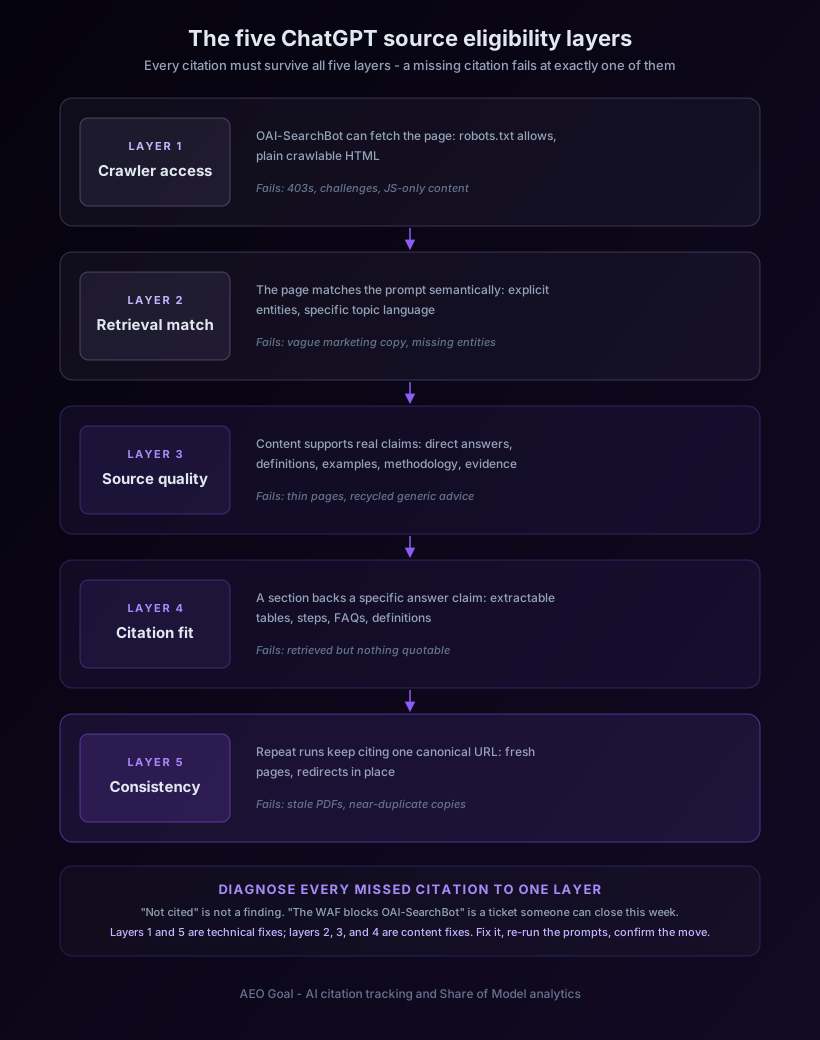
Layer 1: Crawler Access
OpenAI’s crawler documentation identifies OAI-SearchBot as the crawler for surfacing websites in ChatGPT search features, distinguishes GPTBot (content that may train foundation models) and ChatGPT-User (certain user-initiated actions), and publishes the user agent strings so you can find them in logs.
Robots.txt is only half the check. The other half is your infrastructure: WAF rules, bot-protection services, and rate limits routinely block AI crawlers that robots.txt allows. Verify with a log-file audit:
- Search your server or CDN logs for
OAI-SearchBot,GPTBot, andChatGPT-Useruser agent strings. - Check the response codes those requests received. You want stable
200s on public pages;403,429, CAPTCHA interstitials, or JavaScript challenges mean the crawler is being turned away regardless of robots.txt. - Confirm the pages you most want cited actually appear in those logs at all. A page no crawler visits is a page no answer cites.
- Check that main content is present in the initial HTML response, not injected client-side after render.
Layer 2: Retrieval Match
The page must match the prompt semantically. This is where entity work pays off: a page about “AI visibility tracking” should make the related entities explicit - AI citations, prompt monitoring, cited URLs, answer engines, competitor overlap, ChatGPT search, Google AI Overviews, Bing Copilot, Perplexity, share of model. Pages written in vague positioning language (“we empower modern teams”) are hard to retrieve for any specific prompt because they match nothing specific.
Layer 3: Source Quality
Retrieval finds candidates; synthesis needs usable material. A strong source page contains direct answers, specific examples, dated facts where relevant, clear definitions, methodology, and original evidence. A thin page restating generic advice gives the model nothing to quote, so even when it is retrieved, it contributes nothing citable.
Layer 4: Citation Fit
Not every retrieved source becomes a visible citation. A source earns the citation when it supports a specific claim in the answer. Build pages from clean, extractable sections: definitions, step-by-step workflows, comparison tables, metrics and methodology, FAQs, capability descriptions, and honest limitations. Each of those blocks is a potential claim-support unit.
Layer 5: Consistency
If your public footprint contradicts itself, ChatGPT may cite an old page, a third-party directory, or a competitor’s description of you. Keep canonical pages current, redirect retired pages, and purge stale claims from PDFs, microsites, and orphaned resources. One authoritative page per topic beats five near-duplicates competing for the same retrieval.
Technical Checklist
Run this audit before touching copy:
- Check
robots.txtfor OAI-SearchBot, GPTBot, and ChatGPT-User rules - each is a separate, deliberate decision. - Confirm public pages return stable
200responses to OpenAI user agents in server logs. - Review WAF, bot-protection, and rate-limit configurations and logs for blocks on those user agents.
- Confirm canonical tags point to the intended source page, so retrieval consolidates on one URL.
- Make sure important content is not hidden behind login, app state, or JavaScript-only rendering.
- Keep XML sitemaps current, with honest
lastmodvalues. - Use descriptive internal links to concentrate signals on canonical topic pages.
- Block sensitive paths explicitly:
/app,/admin,/api, billing, customer data, staging.
The enterprise posture is least-privilege crawler access: allow the public source pages that should be discoverable, explicitly protect private and regulated areas, and review the policy on a schedule instead of letting a 2023-era blanket block silently persist.
How to Measure ChatGPT SEO Ranking
Measure with a prompt set, not a keyword rank tracker. For each prompt in your set, on every scheduled run, record:
| Field | What to capture |
|---|---|
| Prompt | The exact question tested |
| Brand mention | Whether your brand appears in the answer |
| Citation | Whether an owned URL is cited as a source |
| Cited URL | Which specific page is used |
| Competitors | Which competitor brands or URLs appear |
| Answer framing | Whether the description is accurate, positive, neutral, or negative |
| Gap | The likely eligibility layer that failed |
| Next action | Fix crawl access, update page, consolidate content, or monitor |
Three measurement rules keep the data honest:
- Repeated runs, not single checks. Because answers vary, a single run is an anecdote. Rates over repeated scheduled runs are the metric: citation rate, mention rate, share of model versus named competitors.
- Fixed prompt set. Changing the prompts every month destroys the trend. Add prompts deliberately and keep the core set stable so before-and-after comparisons mean something.
- Diagnose to a layer. Every miss gets attributed to an eligibility layer. “Not cited” is not a finding; “not cited because OAI-SearchBot gets a 403 from the WAF” is a ticket someone can close this week.
From Measurement to Fixes: How AEO Goal Closes the Loop
Manual spot checks are useful for intuition, but a program needs automation - and measurement alone still leaves the hard part undone. This is where AEO Goal works differently from tracking-only tools. AI citation tracking runs your prompt set against ChatGPT on a schedule and logs mentions, citations, cited URLs, position, and sentiment per run. Then the agent layer takes over: each gap is diagnosed to its eligibility layer and shipped with the corresponding fix - a crawler-access correction when OAI-SearchBot is blocked, a schema or structure change when the page exists but is not extractable, or an answer-first content brief when the citable page is simply missing. The next scan re-checks whether the fix moved the citation rate, so every change is proven or reverted rather than assumed.
The same prompt set runs across Claude, Gemini, and Perplexity through AI visibility tracking, which is important because eligibility failures are often engine-specific: a WAF rule can block OpenAI’s crawler while Perplexity’s sails through, and only cross-engine comparison exposes that asymmetry. The citation tracking methodology documents how mentions and citations are detected and scored, so the trend you report to stakeholders is reproducible, not vibes.
Where Classic SEO Fits In
ChatGPT search draws on web search infrastructure - OpenAI’s help documentation has described the feature as using search providers to find current information - so your classic search footprint and your ChatGPT eligibility are linked. Practically:
- Pages that are well indexed and well linked in traditional search are stronger retrieval candidates.
- Sitemap hygiene, canonical discipline, and internal linking serve both surfaces at once.
- Keyword research seeds the prompt set: your high-intent keywords, rewritten as conversational questions, are usually the prompts worth measuring.
Treat the prompt-level data and your rank-tracking data as two views of one program, on one backlog. The ChatGPT SEO guide covers that combined program end to end.
What Not to Do
Avoid “ranking hacks” that create more risk than value:
- Publishing thin ChatGPT-only pages that fragment your entity signals
- Blocking OAI-SearchBot while expecting ChatGPT search citations
- Stuffing “ChatGPT SEO ranking” into every heading
- Adding FAQ schema for questions that do not appear on the page
- Letting old PDFs or microsites contradict canonical pages
- Measuring brand mentions without checking which URLs are actually cited
- Drawing conclusions from a single manual run instead of repeated scheduled measurement
The disciplined path is unglamorous and it works: verified crawler access, one canonical source page per topic, accurate extractable content, prompt-level measurement on a schedule, and a remediation workflow that attributes every miss to an eligibility layer and ships the fix.
For the full strategy and content program, return to the canonical ChatGPT SEO guide, and see how the same measurement extends across other AI search engines. If you want the program run for you, the ChatGPT SEO solution covers what that looks like in practice.