Quick Answer
Bing AI SEO ranking is the work of making pages eligible, useful, and source-worthy across Bing Search, Microsoft Copilot, and AI-generated summaries in Bing. It is not a separate trick from SEO - it is Bing SEO plus AI citation measurement. The path is layered: make the right pages accessible to bingbot, get them indexed through Bing Webmaster Tools and IndexNow, publish content that answers real grounding queries, then monitor the AI Performance report and prompt-level citations to find pages that match queries but are not yet cited - and fix them.
Why Bing Is More Important Than Its Search Share Suggests
Many SEO programs still treat Bing as Google’s smaller sibling and skip it. In an AI search environment that is a real gap, for three reasons:
- Microsoft distributes AI answers everywhere. Copilot (the successor to Bing Chat) surfaces AI-generated, source-cited answers through Bing, the Edge browser, and Windows. A brand invisible to Bing’s index is invisible to that entire distribution surface at once.
- Bing’s index has reached beyond Bing. When OpenAI first added live web browsing to ChatGPT, the feature was named “Browse with Bing,” and ChatGPT search has been described as drawing on third-party search providers. The exact supply relationships between engines and indexes shift and are not fully public, so treat this as directional rather than a guarantee - but historically, being well represented in Bing has counted outside Microsoft’s own products.
- Bing gives you citation data Google does not. Microsoft introduced AI Performance reporting in Bing Webmaster Tools as a public preview in 2026. The report is designed to show citation activity in AI-generated answers, including total citations, average cited pages, grounding query phrases, and page-level citation activity. See the Bing Webmaster Blog announcement. That is first-party evidence of which pages Microsoft’s AI systems actually use as sources - the same shift toward AI visibility and AI citation measurement we describe in AEO versus traditional SEO, except here the engine itself hands you the data.
How a Page Becomes a Copilot Citation
Bing does not publish a checklist that guarantees Copilot citations, and no honest AI SEO guide should claim one. What you can do is model the pipeline and diagnose where your pages drop out of it.
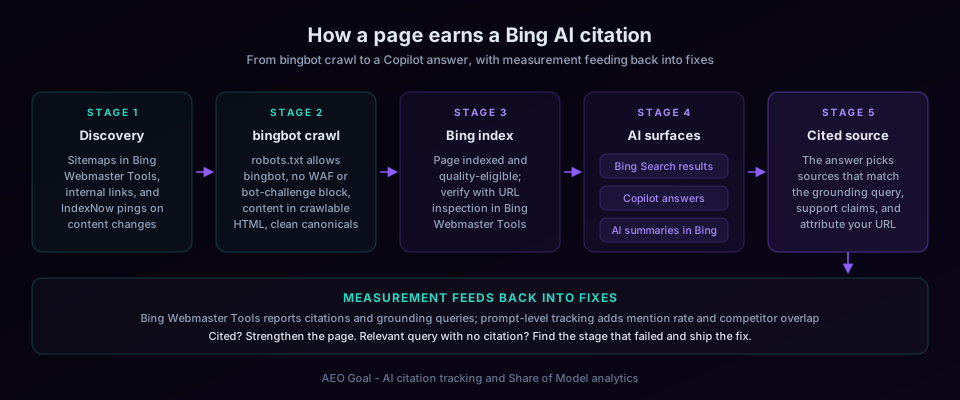
1. Discovery
Bing must find the URL. Submit and maintain XML sitemaps in Bing Webmaster Tools, link new pages from crawled pages, and consider IndexNow - the open protocol Microsoft supports for pinging Bing the moment a URL is added, updated, or deleted. For sites that publish or change content frequently, IndexNow shortens the gap between shipping a fix and the index seeing it, which counts when AI answers favor current sources.
2. Crawl and Render
The page must be accessible to bingbot, Bing’s crawler. The failure modes mirror the ones that block OpenAI’s crawlers: a robots.txt disallow, a WAF or bot-protection rule returning 403s or challenges, aggressive rate limits, redirect chains, or main content that only exists after JavaScript execution. Check server logs for bingbot user agent requests and the status codes they receive - robots.txt telling you bingbot is allowed means nothing if the infrastructure turns it away.
3. Index Eligibility
If a page is not in Bing’s index, it is very unlikely to be selected as a cited source. Use Bing Webmaster Tools URL inspection to confirm important pages are known, crawled, and indexed, and use site diagnostics to catch quality flags. Canonical consistency is important here: if Bing indexes a parameter variant or an old duplicate instead of your canonical URL, your signals split across URLs and the citation lands on the wrong one or nowhere.
4. Query Fit
AI answers are grounded in questions, not just keywords. A category page that ranks for “AI SEO software” may still be a poor source for the grounding query “which platforms track Copilot citations for enterprise teams,” because it never addresses that question directly. Build pages that answer actual buyer questions with clear definitions, comparisons, trade-offs, and evidence - and use the grounding query phrases from the AI Performance report as literal editorial input, since they show you the retrieval language real answers were built around.
5. Source Trust
Bing’s Webmaster Guidelines emphasize content quality, relevance, user value, technical health, and avoiding manipulative practices. For AI answers, add attribution-friendliness: accurate, current, specific content with a clear publisher identity. Schema helps the engine understand what it is citing - Article, FAQPage, Organization, Product, or SoftwareApplication where each genuinely matches the visible content. Schema that contradicts the page is a trust liability on every surface.
Bing AI SEO Checklist
Work through this in order; each item gates the ones after it.
- Verify the domain in Bing Webmaster Tools.
- Submit XML sitemaps and keep
lastmodhonest when content meaningfully changes. - Confirm bingbot is not blocked by robots.txt, WAF rules, bot protection, or geo logic - check the logs, not just the config.
- Review canonical tags so duplicates do not split signals across URLs.
- Confirm index coverage for priority pages with URL inspection.
- Add visible, direct answers to the questions that matter in your category.
- Name entities consistently: product names, category terms, supported markets, methodology.
- Add schema that matches visible content.
- Use descriptive internal links from related resources, product pages, and comparison pages to the canonical page for each topic.
- Monitor AI Performance, classic Bing performance, server logs, and cross-engine citation tracking together, not in separate silos.
Turning AI Performance Data into Editorial Decisions
The AI Performance report should feed your content backlog, not just a reporting deck:
| Signal | How to use it |
|---|---|
| Total citations | Establish whether the site participates in Microsoft AI answers at all - your baseline |
| Average cited pages | See whether visibility concentrates on one page or spreads across a topic cluster |
| Grounding queries | Convert real retrieval language into headings, definitions, and new sections |
| Page-level citation activity | Find pages that already earn trust (strengthen them) and pages that never do (diagnose them) |
| Citation changes over time | Detect content decay, technical regressions, or competitor displacement early |
The decision rule is simple. If a page is cited for a grounding query, invest in it: sharpen definitions, add comparison language, current examples, and internal links to the next-best page. If a grounding query is relevant but no owned page is cited, first ask whether an existing canonical page can be extended to answer it - only create a new page when the question is genuinely distinct, because thin near-duplicates split signals and rarely earn citations.
Where Traditional SEO and Bing AI Visibility Meet
Everything above sits on classic SEO foundations, and the overlap is the efficiency: crawlability, index coverage, canonical discipline, structured data, and internal linking serve Bing’s blue links and Bing’s AI answers simultaneously. The connection runs the other way too - grounding queries from the AI Performance report are keyword research you did not have to run, often exposing question-form demand your keyword tools missed. Treat Bing rankings, Google rankings, and AI citations as three views of one content program with one backlog, rather than three separate projects. The same page fix - an answer-first restructure with matching schema - typically moves more than one of them.
How AEO Goal Covers the Bing Side
Bing Webmaster Tools tells you what Microsoft’s AI systems cite; it does not tell you what ChatGPT, Claude, Gemini, or Perplexity say about you, and it does not turn its own findings into fixes. AEO Goal closes both gaps. Its Bing Webmaster Tools integration pulls your Bing search performance into the same workspace where AI visibility tracking runs your prompt set across up to nine AI answer engines (ChatGPT, Claude, Gemini, Perplexity, Google AI Overviews, Microsoft Copilot, Grok, Meta AI, and DeepSeek) - so you can see whether a page Microsoft cites is also earning citations elsewhere, or whether an eligibility failure is engine-specific. And when AI citation tracking finds a gap - a grounding query or prompt where a competitor is cited and you are not - it ships the fix rather than just charting the miss: a crawler-access correction, a schema change, or an answer-first content brief for the page that should exist, then re-checks the result on the next scan. The methodology documents how citations are detected and scored, so the trend you report is reproducible.
Bing AI SEO Mistakes to Avoid
- Treating Bing as a copy of Google with a smaller audience - Microsoft AI surfaces have their own distribution, crawler behavior, webmaster tooling, and reporting
- Creating thin Bing-only pages that duplicate existing topic pages
- Ignoring bingbot in server logs while auditing only Googlebot
- Publishing JavaScript-only content that is hard to extract
- Adding schema that does not match visible page content
- Treating an AI citation as a fixed ranking instead of a rate over repeated measurement
- Reporting Bing AI visibility without competitor overlap or answer framing, which hides whether you are winning or merely present
The Enterprise Operating Model
An enterprise program includes Bing in the same operating model as Google, ChatGPT, and Perplexity: crawler observability from real logs, scheduled prompt monitoring, page-level citation tracking, source quality reviews, and governance for regulated claims. The shortcut is to update a few titles and hope Bing follows. The enterprise-grade approach is a single Microsoft AI visibility view that combines Bing Webmaster Tools data, server logs, sitemap health, prompt tests, and competitor citations - so the team can defend, with evidence, where Bing and Copilot already use the brand, where competitors are cited instead, and which specific content changes are worth funding next quarter.
For how Bing fits into the broader engine landscape, see AI search engines and the companion guides to ChatGPT SEO and Google generative AI SEO. If you are comparing platforms for the measurement layer, start with the best AI SEO tools.