Quick Answer
Google generative AI SEO is the work of making your content eligible, useful, and source-worthy for Google Search experiences that include AI Overviews and AI Mode. It is not a separate ranking system that can be gamed with special markup, AI-only pages, or prompt-shaped keyword stuffing.
Google’s official guidance is direct on this point: foundational SEO still counts because generative AI features in Search are rooted in Google’s core ranking and quality systems, and a page must be indexed and eligible to appear in Search with a snippet to be shown as a supporting link in AI Overviews or AI Mode. There are no additional technical requirements beyond that. See Optimizing your website for generative AI features on Google Search and AI features and your website.
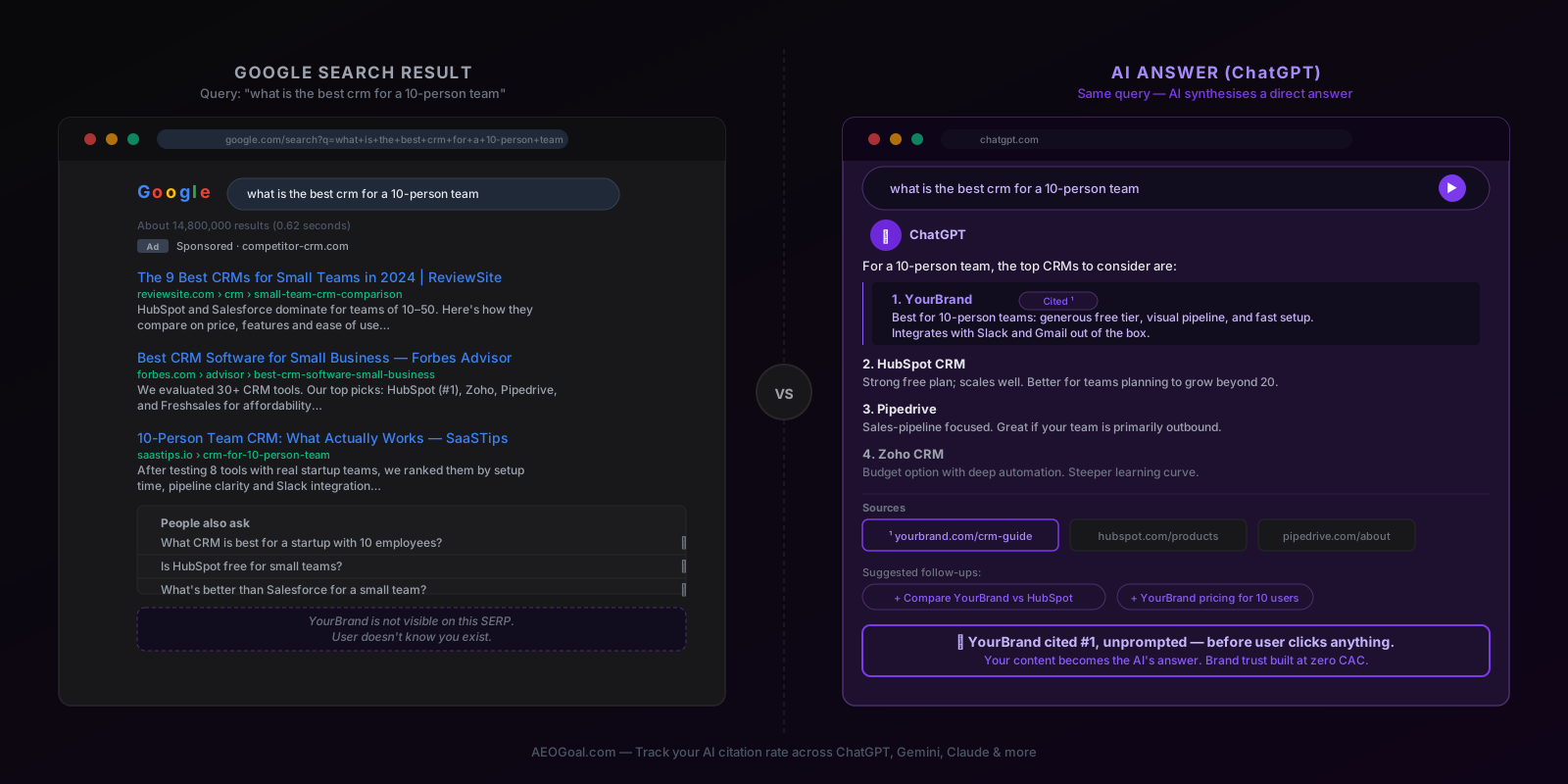
That sounds reassuring, and it is, but it hides the real shift: the same eligible page now competes to be one of a few cited sources inside a synthesized answer, not one of ten blue links. This guide covers what actually changes, which crawler controls do what, what to stop chasing, and how to measure whether Google is choosing your pages.
What Google AI Overviews And AI Mode Change
AI Overviews appear when Google’s systems decide a synthesized answer with supporting links adds value beyond the standard results. AI Mode is a fuller conversational search experience for exploratory, comparative, and multi-step questions. Both are Google Search features: they draw on the same index, the same ranking signals, and the same quality systems as the classic results page.
The mechanical difference that is important for SEO is query fan-out. Google describes AI Mode as issuing multiple related searches across subtopics and data sources to assemble a more complete answer. One user question becomes a set of machine-issued sub-queries, and your page is evaluated against several of them at once:
- The direct definition
- The implementation steps
- The comparison or alternative set
- The risk or limitation
- The local, ecommerce, or industry-specific angle
- The freshness of the information
A page built only around one exact-match keyword can win one sub-query and lose the answer. A page that genuinely covers the task can be retrieved for several sub-queries and become the cited source. This is why consolidation usually beats fragmentation: five thin pages each answering a sliver of the question give the fan-out system five weak candidates instead of one strong one.
Eligibility Comes First
Before content quality counts, the page must be technically eligible. The pipeline is strictly sequential: a page that fails an early step never reaches the later ones.
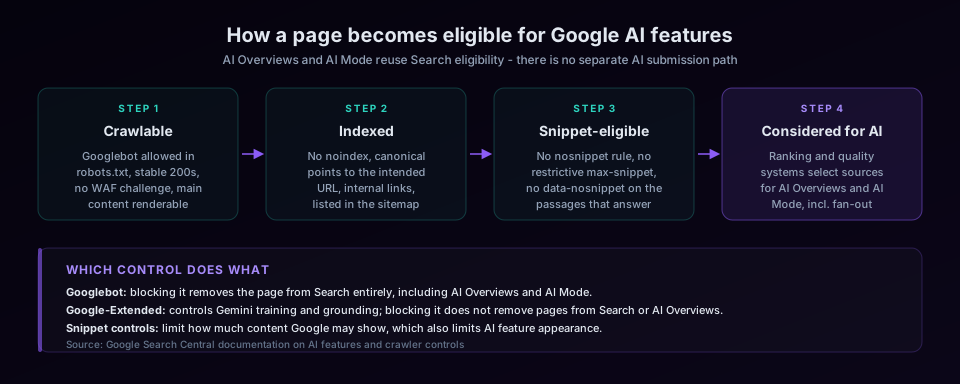
Check, in order:
- The URL returns a stable
200response and is not blocked for Googlebot in robots.txt or by WAF and bot-management rules. - The page does not carry
noindex. - The canonical tag points to the intended URL, so the version you want cited is the version in the index.
- The main content is available in crawlable HTML or JavaScript that Google can render.
- The page is snippet-eligible: no
nosnippet, no restrictivemax-snippet, and nodata-nosnippetwrapping the passages that actually answer the question. Google’s preview controls limit what it may show, which also limits how the page can appear in AI features. - The sitemap reflects meaningful updates and internal links help Google discover and prioritize the page.
Since there are no additional technical requirements for AI Overviews and AI Mode beyond Search eligibility, the enterprise-grade move is not to invent special AI markup. It is to remove ordinary technical SEO defects at scale, using something like our technical SEO checklist as the working list.
Googlebot, Google-Extended, And Which Switch Does What
Robots.txt decisions made for “AI policy” reasons regularly break Search visibility by accident, so it is worth being precise about Google’s documented crawler controls (reference: Google’s crawler overview):
| Control | What it governs | Effect on AI Overviews and AI Mode |
|---|---|---|
| Blocking Googlebot | Crawling for Google Search | Removes pages from Search entirely, including all AI features |
| Blocking Google-Extended | Use of content for Gemini model training and grounding | None; Google-Extended does not affect Search inclusion or ranking |
| nosnippet / max-snippet / data-nosnippet | How much page content Google may show as a preview | Restricts how the page can appear in AI features |
The practical takeaway: if legal or leadership wants to opt out of AI training, blocking Google-Extended does that without touching Search. If someone blocked Googlebot to “keep AI out,” they removed the site from Google, full stop. Audit what your robots.txt actually says rather than what the policy memo intended, and re-audit after CDN or security changes, because bot-management rules are a common silent blocker.
Content Quality For Google Generative AI Search
Google’s guidance puts the weight on unique, valuable, people-first content. In a fan-out world, that translates into pages that survive being read one passage at a time.
Strong pages include:
- A direct answer near the top, before any preamble
- Definitions for ambiguous terms, so the passage stands alone when extracted
- First-party examples, data, screenshots, or methodology that no competitor can copy
- Expert review where claims are consequential
- Clear separation of facts, recommendations, and opinions
- Descriptive headings that name the concept, so each section maps to a sub-query
- Relevant internal links to supporting pages
- Fresh dates when the topic changes over time
- Schema that matches visible content
Weak pages look like generic templates: five interchangeable sections, no unique evidence, no real decisions, and no reason for a ranking system to select them over a stronger source. Rewriting the top ten results in a different order does not create a citable page; it creates the eleventh version of the same page.
What Not To Chase
Google’s generative AI guidance also addresses several common myths.
| Tactic | Google’s Practical Position |
|---|---|
| Special AI files such as llms.txt | Google Search does not use them for generative AI features |
| Chunking every page into tiny sections | Not required; write for the user and use a clear structure |
| Rewriting purely for AI systems | Not necessary; Google can understand synonyms and meaning |
| Inauthentic mentions | Not a sustainable path; quality and anti-spam systems still matter |
| Over-focusing on structured data | Schema can help normal SEO, but there is no special schema requirement for AI features |
| Mass-producing query-variation pages | Google warns against pages created mainly to manipulate rankings or AI responses; consolidate instead |
That does not make llms.txt, structured data, or short summaries useless everywhere. Other answer engines have their own retrieval behavior, and schema still earns rich results in classic Search. The point is narrower: for Google’s AI features specifically, none of these substitutes for crawlability, indexing, snippet eligibility, and content that deserves to be cited.
A Practical Google Generative AI SEO Workflow
Use this workflow for a page that should earn visibility in Google AI answers.
- Consolidate the intent. Merge thin variants into one stronger canonical page when the user need overlaps. Redirect the losers.
- Strengthen the opening answer. Make the first section answer the primary question in two or three sentences without a warm-up paragraph.
- Add the missing angles. Cover definition, process, examples, caveats, comparisons, and measurement, because fan-out will probe each of them.
- Use descriptive internal links. Link from glossary, product, comparison, and resource pages with anchors that name the topic.
- Add original proof. Include proprietary observations, field-tested frameworks, or customer-safe examples. This is the part competitors cannot template.
- Review technical eligibility. Confirm indexing, snippet eligibility, canonicals, renderability, and page experience against the pipeline above.
- Monitor prompt visibility. Track whether Google’s AI surfaces and the other answer engines cite your page or a competitor’s, per prompt, over time.
Measurement: Where Search Console Stops
Google Search Console remains necessary: it confirms indexing, shows queries and pages, and includes traffic from AI features in its performance data. But it reports that traffic as part of overall Search totals rather than as a separate AI Overviews breakdown, and it cannot tell you which prompts cite you, which URLs the answers used, or how you compare to competitors inside the answer itself.
So combine two layers:
- Search Console: indexed coverage, queries, pages, and click trends.
- Prompt-level monitoring: run the questions your buyers actually ask against the answer engines and record whether you are mentioned, which URL is cited, at what position, and with what sentiment. These signals are defined in our glossary entries on AI citation and AI visibility, and the repeatable approach is documented in our AI visibility tracking methodology.
Track cited URLs across target prompts, competitor URLs used as supporting sources, brand mentions and framing, and organic clicks after citation changes. The interesting failures show up only at this layer: a page that ranks fourth but is never cited, or a competitor’s comparison page that wins every “best X for Y” fan-out sub-query you never wrote a page for.
Finding The Gap And Shipping The Fix
This measurement layer is exactly where AEO Goal operates, and it goes one step further than tracking. AI visibility tracking runs your prompt set against Gemini alongside ChatGPT, Claude, and Perplexity on a schedule, and AI citation tracking records which URLs each engine cited and how your brand was framed. When a prompt shows a competitor cited where you are absent, the finding does not stop at a chart: it ships with the cause and a concrete fix, whether that is an answer-first content brief via AEO content generation, a schema correction, or a crawler-access fix surfaced by the free scan, which checks robots.txt rules across AI crawlers along with structured data and metadata. The next scan re-checks the same prompt, so you know whether the fix moved the citation instead of guessing.
Because Google’s AI features and Google’s classic rankings share one foundation, the same workspace tracks your rankings and technical audit findings, and the fixes land on one backlog. That is the practical meaning of treating this as one program.
One Program, Not An AEO Hack
The enterprise recommendation is to treat Google generative AI SEO as part of the same governed program as technical SEO, content strategy, and analytics. Do not ship a separate “AEO hack” workflow with special files and AI-only pages. Ship better canonical pages, keep crawl health clean, verify claims, and measure whether Google and the other answer engines are selecting the right source for the right question. For the broader landscape beyond Google, see what answer engine optimization is and how generative engine optimization relates to it.