Quick Answer
AI search engines combine search indexes, retrieval systems, ranking signals, and generative summaries to answer complex questions with supporting links. Brands earn AI search visibility by publishing crawlable, original, well-structured content with clear entity signals and measurable proof, not by spinning separate pages for every query variant.
Google AI Overviews and AI Mode, ChatGPT Search, Perplexity, Bing Copilot, and Claude’s web search all follow the same broad pattern - retrieve, synthesize, cite - but they run different indexes, different crawlers, and different citation interfaces. For SEO teams, the practical goal is not to “rank in the model.” The goal is to make the right public pages easy for these systems to discover, understand, retrieve, trust, and cite when a user asks a question your brand can legitimately answer.
What Makes AI Search Different
Classic search results send a user to a list of links. AI search answers the question first, then may show supporting links, citation cards, product references, or follow-up paths. That shift changes how visibility is earned and measured.
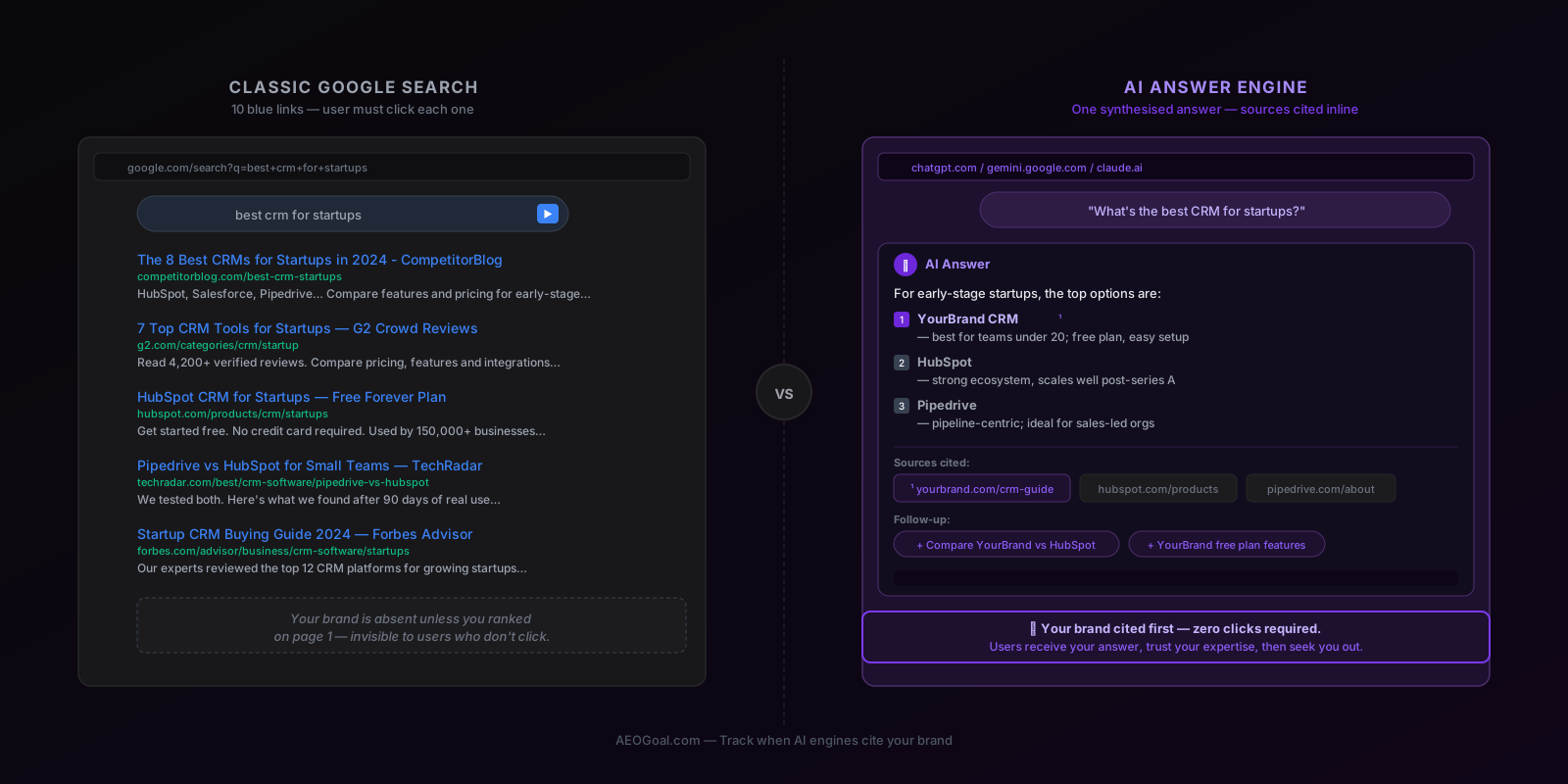
The important differences are:
- Queries are more conversational. A buyer may ask “Which AI visibility tools can track citations across ChatGPT and Google?” instead of searching a two-word keyword. Longer, multi-constraint questions reach the engine directly instead of being decomposed into several searches by the user.
- Retrieval happens across subtopics. Google describes “query fan-out” for its AI features, where related searches are issued behind the scenes to answer a complex question across multiple angles. One prompt can trigger retrieval for definitions, comparisons, pricing, and reviews simultaneously - and a different site can win each slot.
- A page may be cited for one passage, not the whole article. Clear sections, definitions, examples, and evidence blocks matter because the system may retrieve a specific part of the page. This is why answer-first structure beats essay structure in AI search.
- Zero-click visibility still has business value. A brand mention or source citation can shape evaluation before the user ever visits the site. The two are worth tracking separately: see AI citation and the brand-presence metric of share of model.
- Measurement needs prompt-level data. Ranking for a keyword is not the same thing as being cited for a procurement question, comparison prompt, or category recommendation - a page can hold position three in Google and be absent from every generated answer on the same topic.
Google’s official guidance says its generative AI features are still rooted in core Search ranking and quality systems, and that foundational SEO remains relevant for AI Overviews and AI Mode. See Google’s guide to generative AI search optimization and AI features and your website.
The Major AI Search Engines and Their Crawlers
Each platform has its own index, retrieval stack, crawler policies, and answer interface. Knowing which agent feeds which surface is the difference between a deliberate crawler policy and an accidental one.
| Engine | How pages get in | Key crawlers and controls |
|---|---|---|
| Google AI Overviews and AI Mode | Ordinary Google crawling and indexing; AI features are rooted in core Search systems | Googlebot; Google-Extended is a separate control for Gemini model training, not the path into AI Overviews |
| ChatGPT Search | OpenAI’s search index plus live fetches during a conversation | OAI-SearchBot builds the search index; ChatGPT-User fetches pages when a user asks; GPTBot governs model training |
| Perplexity | Perplexity’s own index, with sources cited inline by default | PerplexityBot crawls for the search index |
| Bing Copilot | Bing’s search index and ranking systems feed the generative answers | Bingbot, governed by standard Bing Webmaster guidelines |
| Claude web search | Live retrieval with cited sources when search is invoked | ClaudeBot is Anthropic’s crawler |
Three practical consequences follow. First, training controls and search controls are different levers: blocking GPTBot stops OpenAI training on your content but does not remove you from ChatGPT Search, while blocking OAI-SearchBot does - OpenAI documents each bot’s purpose and user-agent string in its crawler documentation, and describes the search product itself in its ChatGPT Search overview. Second, blocking Google-Extended does not take you out of AI Overviews, because those features draw on ordinary Google indexing; conversely, you cannot stay in classic Google Search while opting out of AI Overviews specifically. Third, an old “block all unknown bots” WAF rule written before these crawlers existed can silently remove a site from every AI search surface at once - audit robots.txt and firewall rules against the current agent lists, including Perplexity’s crawler documentation and Bing’s webmaster guidelines.
How AI Search Engines Choose Sources
Across platforms, most AI search visibility work reduces to five layers.
1. Technical Eligibility
The page must be accessible. That means the URL is not blocked by robots.txt, noindex, authentication, broken canonicals, or rendering problems. Public pages should return stable 200 responses, expose the main content in crawlable HTML, and be listed in current sitemaps.
For enterprise sites, this is often the first failure point. Security controls, WAF rules, geo routing, cookie banners, JavaScript rendering, and accidental noindex tags can quietly hide otherwise strong content from AI retrieval systems - and because generated answers fail silently, nobody notices until a competitor owns the citation.
2. Entity Clarity
AI systems need to understand what the page is about and how entities relate to each other. A page about AI search engines should make the relationships explicit: AI search, answer engine optimization, AI citations, retrieval-augmented generation, query fan-out, search indexes, and source attribution.
Strong entity clarity comes from consistent naming, descriptive headings, internal links, structured data that matches visible content, and clear author or organization attribution. Ambiguity is expensive here: an engine that cannot confidently resolve what your brand is will cite a source that leaves no doubt.
3. Answer-Ready Structure
AI search favors pages that answer specific questions cleanly. That does not mean writing robotic “question and answer” content everywhere. It means the page should include:
- A direct answer near the top
- Definitions where terms may be ambiguous
- Comparison tables where choices are involved
- Steps where the user needs implementation guidance
- Caveats where the answer depends on context
- Evidence and sources where claims need support
Because retrieval is passage-level, each of these elements is a candidate citation on its own. A single well-built page can be cited for its definition by one prompt and its comparison table by another.
4. Original Evidence
Generic summaries rarely deserve citations. A strong AI-search page adds something a model cannot infer from common web consensus: proprietary data, a field-tested framework, examples, benchmark methodology, expert commentary, customer-safe observations, or original definitions.
This is the enterprise-grade path. Thin pages may create short-term index coverage, but they dilute trust, waste crawl budget, and create governance debt. A mature SEO program consolidates weak variants into canonical resources and uses supporting pages only when they add a distinct angle.
5. Freshness and Maintenance
AI search surfaces change quickly. Pages that mention platform behavior, crawlers, analytics reports, or product interfaces need review cadences. Update the page when the facts change, reflect the modified date in the sitemap, and remove stale recommendations that could mislead a reader - engines answering “current state” questions favor recently maintained sources, and a stale page loses its citation slot to whoever updated last.
Optimization Framework
Use this workflow when building or repairing an AI search page.
- Choose the canonical intent. Decide what one question the page should be the best source for.
- Map related prompts. Include the natural-language prompts a buyer or evaluator would ask across ChatGPT, Google, Bing, Perplexity, Gemini, and other relevant surfaces.
- Audit retrieval blockers. Check robots.txt against the current crawler lists, plus noindex, canonicals, redirects, renderability, response codes, and sitemap freshness.
- Add the direct answer. Put the clearest answer within the opening section, then expand with context.
- Create source-worthy sections. Add definitions, frameworks, trade-offs, tables, examples, limitations, and dated observations.
- Strengthen internal links. Link from product pages, glossary entries, comparison pages, and methodology pages using descriptive anchors.
- Validate schema. Use
Article,FAQPage,Organization,BreadcrumbList, or other schema only when it matches visible content. - Measure AI visibility. Re-run prompts, record citations, compare competitors, and track whether fixes changed citation frequency or answer framing.
AI Search and Classic SEO Are One Program
The framework above should look familiar, because most of it is disciplined SEO. That is the point: AI search does not need a separate content strategy, it needs an extra measurement layer on top of the existing one.
The overlap is structural. AI Overviews and Bing Copilot draw directly on the classic search indexes, so a page that cannot rank is also handicapped in generated answers on those surfaces. Authority signals compound across both: the well-linked, consistently cited domains that classic search rewards are the same domains retrieval systems treat as safe sources. And the on-page work is shared - the direct answer that earns a snippet is the passage an engine extracts, the schema that clarifies a page for Google clarifies it for every parser.
What is genuinely new is the scoreboard. Rankings measure position for keywords; AI search requires tracking prompts, mentions, cited URLs, and framing per engine, because each engine retrieves differently. Teams that run one backlog with two scoreboards - rank tracking and citation tracking side by side - avoid both failure modes: treating AI search as magic that ignores SEO fundamentals, and assuming good rankings automatically produce citations. The full comparison is in AEO vs traditional SEO.
What To Avoid
Do not create a separate thin page for every prompt variation. Google’s generative AI guidance explicitly warns against over-producing pages just to manipulate rankings or AI responses, and it says there is no special schema or llms.txt requirement for Google Search’s generative AI features.
Avoid:
- Keyword-stuffed AI SEO pages with no original insight
- Duplicate pages that only swap the platform name
- Fake statistics, fake awards, or unsupported “best” claims
- Hidden text or schema that does not match visible content
- Auto-generated pages published without expert review
- Crawling policies that allow public blog pages but accidentally block source assets, CSS, or rendered content
How To Measure AI Search Visibility
AI search performance needs its own reporting layer. Track:
| Metric | Why It Is Important |
|---|---|
| Prompt coverage | Shows which buyer questions are tested regularly |
| Citation rate | Shows how often owned URLs are used as sources |
| Cited URL | Reveals whether the right page is being retrieved |
| Competitor overlap | Shows which competitors own adjacent answers |
| Mention quality | Captures whether the brand is described accurately |
| Source diversity | Shows whether AI systems cite owned, third-party, or review sites |
| Assisted conversion | Connects AI visibility to pipeline or revenue signals |
Doing this by hand means asking the same questions across four or five engines on a schedule and logging every answer - workable for ten prompts, impossible for a real prompt set. This is the job AEO Goal automates, and it goes one step further than tracking: its AI citation tracking runs your prompts across up to nine AI answer engines (ChatGPT, Claude, Gemini, Perplexity, Google AI Overviews, Microsoft Copilot, Grok, Meta AI, and DeepSeek) and logs mentions, cited URLs, and sentiment per engine, and then the agent layer attaches a fix to every gap it finds - a crawler-access correction when a bot is blocked, an answer-first content brief when no owned page fits the prompt, a schema change when entity signals are weak - and re-checks the same prompts on the next scan to show whether the fix earned the citation. The scoring rules are public in the AI citation tracking methodology, and AI visibility tracking rolls the results into the share-of-model trend a stakeholder can act on.
Enterprise teams should treat AI search as an owned knowledge distribution channel. The safest path is a governed content system: canonical topic maps, reviewed source claims, crawler observability, prompt monitoring, and rollback plans for pages that produce inaccurate or risky answers.
For implementation depth, see What Is AEO, Generative Engine Optimization, and AI citation tracking.