What A Keyword Competitor Tracker Actually Does
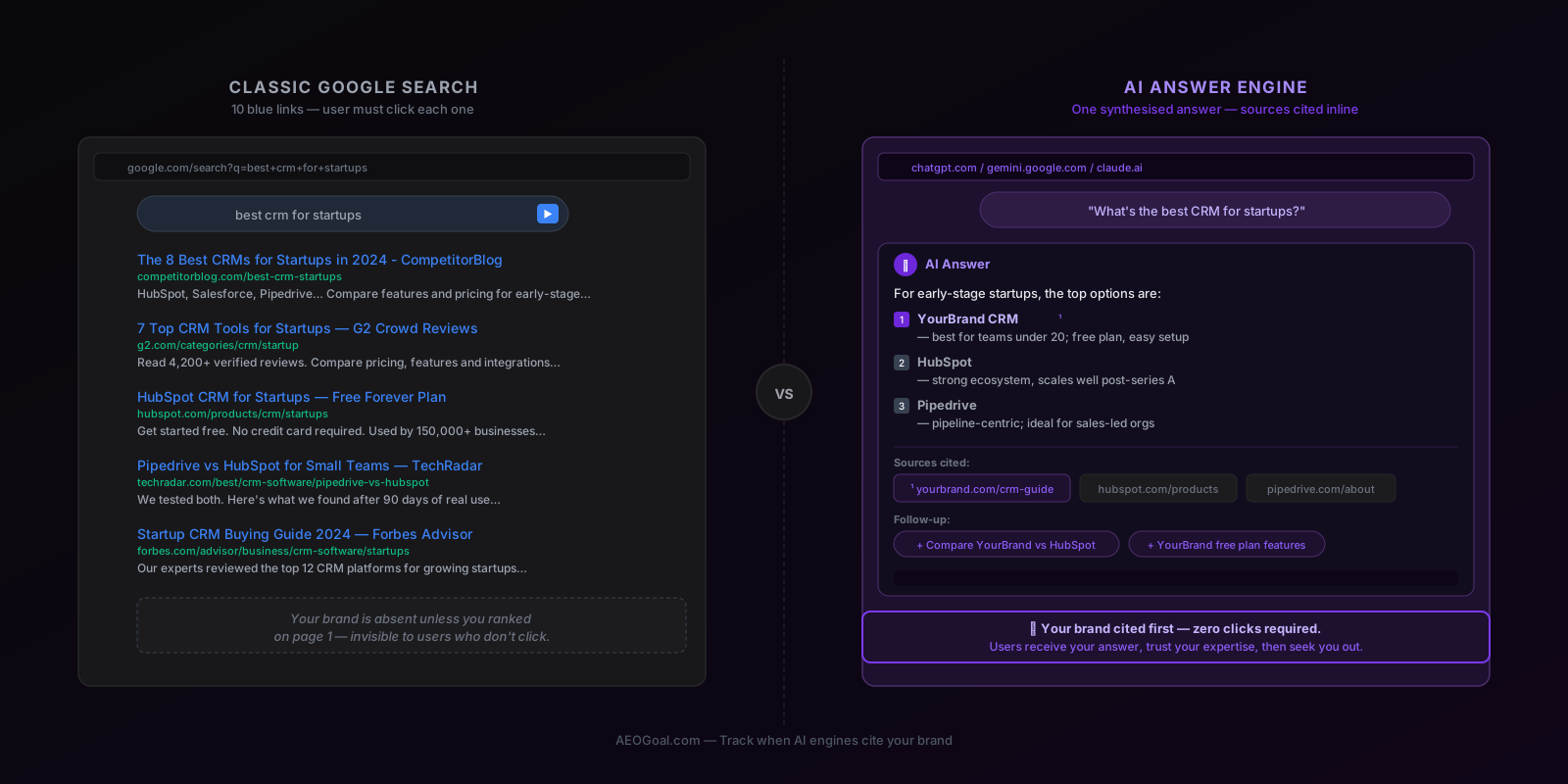
A keyword competitor tracker monitors which brands win the keywords, prompts, and buyer questions you compete for, and how that picture changes over time. Ten years ago that meant one number: your Google position versus theirs. Today the same query gets answered twice, once as a ranked results page and once as a generated answer inside ChatGPT, Claude, Gemini, Perplexity, or Google’s AI results, and the winner of one layer is frequently the loser of the other.
That split is the whole reason this page exists. A tracker that only watches rankings will tell you that you hold position three for a commercial keyword while quietly missing that an AI engine recommends your competitor by name every time a buyer asks the equivalent question. For Answer Engine Optimization, tracking has to cover both layers or it is measuring the wrong war.
Before going further, an honest note about what is on this page: this is a working guide to the tracking workflow, not an embedded tracker widget. The interactive pieces are the free AI visibility scan, which checks any domain live with no signup, and the tracking features inside the AEO Goal app, which require an account. Everything below describes what those actually do and how to read what they produce.
The Three Signals Worth Tracking Per Topic
For every keyword or prompt that counts for revenue, a complete tracker separates three signals. Each one supports a different decision, and conflating them is the most common way teams misread their competitive position.
1. Classic search position. Where you and each competitor rank in Google or Bing for the keyword, which URL is doing the ranking, and how that position trends. In AEO Goal’s rank tracking, each keyword shows current position, movement since the last check, the ranking URL, estimated search volume, and a 30 day trend sparkline, and you can overlay competitor positions on any keyword’s history chart once you have added their domains.
2. Presence in AI answers. Whether each brand gets mentioned when an answer engine responds to the related buyer prompt. This is measured per engine, because the engines disagree: it is normal to be recommended by Perplexity and absent from ChatGPT on the same prompt. Aggregated across your prompt set, this becomes Share of Model: the percentage of tracked answers that mention your brand versus each competitor.
3. Which URLs get cited. Mentions and citations are different events. An engine can name your brand while linking a third party review site, or cite your documentation without recommending you. AI citation tracking records the actual source URLs behind each answer, which tells you which pages engines treat as trustworthy, yours and theirs.
Read together, the three signals diagnose the problem type. Strong position but no AI presence points to an extractability or entity problem on a page that already has authority. AI presence but weak position points to classic SEO work. Absence from both points to a missing or inadequate canonical page.
How To Read A Head-To-Head
Once you add competitor domains in AEO Goal, the Competitors view scores every tracked prompt as a head-to-head with four possible outcomes. Each cell of that table maps to a specific decision:
| Outcome | What it means | What to do |
|---|---|---|
| You win | Your brand appears, the competitor does not | Defend: keep the cited page fresh, dated, and structurally stable |
| Competitor wins | They appear, you do not | Your highest value targets. Diagnose why: no source page, weak structure, or thin proof |
| Both appear | Both brands are mentioned | Check position and framing within the answer, and monitor sentiment |
| Neither | No brand is recommended | The engine answers generically. Often the cheapest win, because no incumbent must be displaced |
Two readings of this table matter more than any single cell. The first is the win/loss ratio across the whole prompt set, which is your overall competitive posture. The second is the trend: whether the gap is narrowing or widening month over month, which tells you if your shipped work is compounding or if a competitor is out-executing you.
The “Neither” row deserves more attention than it usually gets. Prompts where no brand is recommended are open territory, and a well structured answer-first page frequently earns the first citation faster than it can displace an entrenched competitor elsewhere.
From Keywords To Prompts
Keyword lists and prompt lists overlap but are not the same thing. Buyers type “keyword competitor tracker” into Google, but they ask an assistant “what tool shows me which competitors AI engines recommend?” Tracking the keyword without the question means monitoring half the demand.
The practical workflow: start from your commercial keyword list, then expand each keyword into the question forms buyers actually ask. AEO Goal’s keyword research supports this directly with a Questions tab that surfaces question-format variations of a seed keyword, plus an AI answer frequency metric showing how often engines produce a definitive answer for a term rather than deferring to links. Keywords with high AI answer frequency are the ones where the answer layer is actively deciding winners, so they should be first onto your tracked prompt list.
Reading Trends Without Overreacting
Two properties of this data trip up new users. First, AI answers are not deterministic: the same engine can answer the same prompt differently on consecutive runs, so a single missing mention is not a loss and a single appearance is not a win. Second, classic positions oscillate daily within a band for most competitive keywords.
The discipline that works: review weekly, decide monthly, and treat any signal that has not persisted across several consecutive checks as noise. When you ship a fix for a specific gap, note the ship date against the trend line and judge the fix on the following weeks of data, not the next day’s answer. This is the loop AEO Goal is built around as an agent rather than a dashboard: find the gap, ship the concrete fix, then re-check on the next scan whether citations, Share of Model, or position actually moved. AI visibility tracking keeps that re-check running on a schedule so verification is automatic instead of a task someone forgets.
Common Mistakes
Tracking only the competitors you think about. Engines regularly recommend brands outside your internal shortlist. Review who actually appears in tracked answers and add unexpected names to the tracker rather than assuming your known rivals are the whole field.
Treating a mention as a citation. A brand name in an answer and a link to your URL are different achievements with different causes. Measure both, separately.
Copying the winner’s content. The gap analysis tells you where a competitor wins, not that their page is the template. Imitations rarely displace the original because they add nothing the engine does not already have. Close gaps with pages that contribute something the competitor’s page lacks: your data, clearer structure, or more direct answers.
Reacting to single-day movements. Covered above, and still the most common failure. Volatility is a property of the system, not a signal.
Tracking without a fix queue. A tracker that feeds a spreadsheet nobody acts on is a cost. Every persistent gap should become a ticket: which owned page closes it, what change ships, and when the re-check happens.
What Is Free And What Is Not
The free AI visibility scan checks any domain live with no signup: AI crawler access in robots.txt, llms.txt, JSON-LD structured data including the Organization entity and its sameAs links, canonical and metadata health, and entity salience. Because it accepts any domain, you can scan a competitor and compare their technical readiness against yours today, for free.
Ongoing tracking is app functionality: scheduled prompt runs across engines, citation history, Share of Model trends, competitor head-to-heads, and scheduled rank tracking live behind a paid plan, because each scheduled check consumes real engine queries. The free scan tells you where you start; the tracker tells you whether you are moving. For how the two layers relate strategically, see AEO vs traditional SEO.
Frequently Asked Questions
Can I track competitors whose brand name I do not know? Yes. In AEO Goal you add a competitor by domain, and the system looks for both the domain and the associated brand name across all tracked prompt results.
How many keywords and prompts should I track? Enough to cover the topics that drive revenue, and few enough that someone reviews every head-to-head monthly. A focused set of buyer-intent prompts you act on beats a thousand-keyword list nobody reads.
Do the AI engines disagree with each other often? Yes, and that is useful information. Engine-level breakdowns tell you where each fix will have the most effect, and which engine your market actually uses determines which gaps matter most.