Quick Answer
Enterprise AI search is the discipline of managing how a large organization appears in AI-generated answers across public search and answer engines. This page covers public AI search visibility, not an internal employee search deployment.
For an enterprise brand, AI search is not only an SEO channel. It is a governance problem. The organization needs accurate public knowledge, crawlable canonical pages, monitored citations, competitor visibility, claim controls, and a response process for when an AI system describes the company incorrectly. The mature program combines crawl access, canonical content, source-quality review, prompt monitoring, citation tracking, legal and compliance controls, and executive reporting across markets and product lines.
What Changes At Enterprise Scale
A ten-page startup site and a fifty-thousand-URL enterprise estate face the same answer engines, but not the same problem.
When someone asks ChatGPT, Claude, Gemini, or Perplexity a question your company should own, the engine retrieves sources, synthesizes one answer, and cites a handful of URLs. For a small brand, the question is “are we cited at all?” For an enterprise, the questions multiply:
- Which of our forty domains did the engine cite, and is it the one legal approved?
- Did it describe the current product or the version we retired two years ago?
- Did the answer for a German compliance query cite a US page with the wrong regulatory framing?
- Did it attribute a capability of Product A to Product B because both share a brand prefix?
- Did it recommend a competitor because our canonical page is buried under twelve near-duplicates?
Classic SEO tolerates some of this because users click through and read context. AI search compresses fragmented, stale, or contradictory sources into a single confident paragraph. The ambiguity you have been carrying for years becomes visible in the answer itself.
Why Enterprise AI Search Needs Governance
Large sites have more ways to confuse AI systems:
- Multiple domains and subdomains
- Regional or language variants
- Product pages owned by different teams
- Legacy microsites
- Partner and reseller pages
- PDF-heavy documentation
- JavaScript-rendered content
- Legal or compliance restrictions
- Conflicting claims across old pages
- Support content that is accurate for one product version but wrong for another
Each of these is a potential source an answer engine can retrieve. Without an owner, a policy, and a monitoring loop, the organization is effectively letting its oldest, least-maintained pages speak for the brand in front of buyers.
The Enterprise AI Search Operating Model
The enterprise-grade path is a cross-functional operating model with clear ownership.
1. Governance
Define who owns AI search visibility. In mature organizations, this usually involves SEO, content strategy, digital analytics, product marketing, legal, security, and demand generation.
Governance should answer:
- Which domains are in scope?
- Which AI engines are monitored?
- Which prompts matter by market and product line?
- Which claims require legal or compliance review?
- Which pages are canonical sources of truth?
- How are inaccuracies escalated, and within what SLA?
- What metrics are reported to executives, and on what cadence?
Write these decisions down. The single most common failure mode in enterprise AI visibility is not a technical defect. It is that nobody owns the answer when an engine gets the brand wrong.
2. Technical Access And Crawler Policy
Public content cannot be cited if AI systems cannot access it. Audit robots.txt, noindex directives, canonicals, WAF and bot-management rules, CDN challenges, server errors, redirect chains, language routing, and sitemap coverage on every in-scope domain.
Each engine reaches your content through its own documented user agents, and they do different jobs. Verify current names and behavior against each vendor’s own documentation, because these change, but the pattern looks like this:
| Crawler | Operator | What it feeds |
|---|---|---|
| Googlebot | Google Search, including AI Overviews and AI Mode | |
| Google-Extended | A robots.txt control for Gemini model training and grounding; blocking it does not remove you from Google Search | |
| GPTBot | OpenAI | Model training corpus |
| OAI-SearchBot | OpenAI | ChatGPT search features and link citations |
| ClaudeBot | Anthropic | Anthropic’s crawler for model training |
| PerplexityBot | Perplexity | Perplexity’s search index |
The enterprise recommendation is least-privilege access, applied deliberately: allow public marketing, documentation, resources, and glossary paths where citation is desirable; block app, admin, customer, billing, API, staging, and personal-data paths everywhere. A blanket “block all AI bots” rule set by the security team two years ago is one of the most common reasons an enterprise brand is invisible in AI answers today, and nobody in marketing knows it happened. Audit the actual robots.txt files, not the policy document.
3. Canonical Knowledge Layer
AI search works best when there is a clean source of truth. Enterprises should maintain canonical pages for:
- Company description
- Product categories and naming
- Product capabilities
- Pricing or packaging policy
- Security and compliance posture
- Integrations
- Supported markets and languages
- Competitive positioning
- Methodology and measurement
- Customer-safe proof points
Thin variants should be merged or canonicalized. A strong canonical page with clear sections is safer than five weak pages competing for the same answer, because the engine chooses one source and you do not control which. Structured data should mirror what the page visibly says: Organization, Product, and FAQ markup that matches on-page claims, never markup that invents them.
4. Prompt And Citation Monitoring
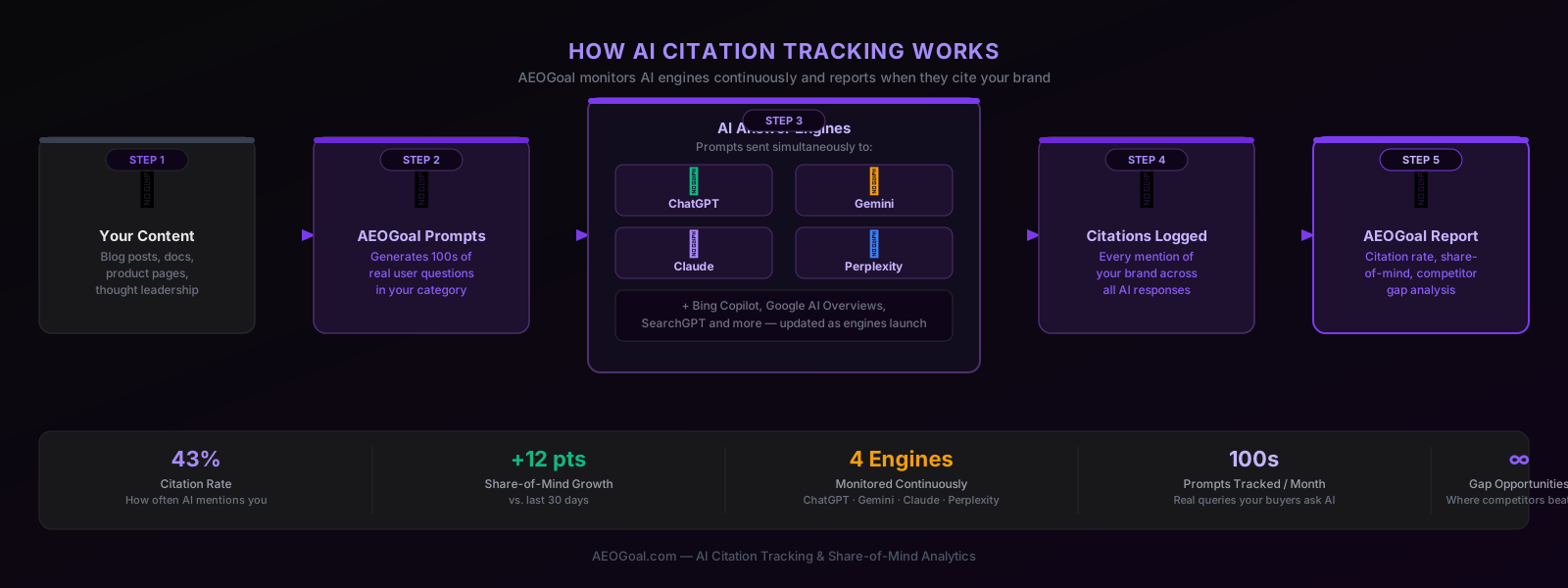
AI visibility must be measured at the prompt level. Build prompt sets around real buying and research tasks:
- “Best platforms for AI citation tracking”
- “How does [brand] compare to [competitor]?”
- “Which vendors support enterprise AI visibility reporting?”
- “What are the security risks of AI SEO tools?”
- “Which tools track citations in ChatGPT and Google AI Overviews?”
Then segment those prompts the way the business is segmented: by product line, market, language, and funnel stage. A prompt set that only covers the flagship product in English will produce a comfortable dashboard and miss the regions where the brand is actually losing.
For each prompt and engine, track whether the brand is mentioned, which URLs are cited, how competitors are framed, whether the answer is accurate, and whether the cited page is the right source. These signals are defined in our glossary entries on AI citation and share of model, the repeatable measurement approach is documented in the AI citation tracking methodology, and the competitive view is what competitor AI visibility is built to surface.
5. Content Remediation
When a prompt exposes a gap, do not immediately create a new page. First decide whether an existing page should be improved.
Common remediation work includes:
- Add a direct answer to the canonical page
- Clarify product naming and category language
- Add evidence, methodology, or examples
- Update stale claims and dates
- Improve internal links to the canonical page
- Consolidate duplicate pages
- Add or correct schema so it matches visible content
- Publish a comparison or methodology page only when the intent is distinct
At enterprise scale, remediation needs a queue, an owner per item, a review path for regulated claims, and a re-check step that confirms whether the fix changed the answer. Otherwise findings pile up in a spreadsheet and the dashboard never moves.
Enterprise Risk Areas
AI search introduces risks that normal rank tracking does not fully capture.
| Risk | Example | Mitigation |
|---|---|---|
| Incorrect brand framing | AI answer says the product lacks a capability it supports | Maintain current capability pages and monitor high-value prompts |
| Competitor substitution | A competitor is cited for a query your product should answer | Build stronger canonical content and track competitor overlap |
| Compliance exposure | AI cites outdated claims from an old PDF | Audit legacy files, redirects, noindex policy, and source-of-truth pages |
| Regional mismatch | A US page is cited for an EU compliance question | Improve hreflang, market pages, and localized content ownership |
| PII leakage | Private or semi-private pages become crawlable | Enforce access controls and crawler policies for sensitive paths |
| Measurement blind spots | SEO reports look stable while AI citations decline | Add prompt-level AI visibility reporting |
Metrics That Matter
Enterprise AI search reporting should include:
- Owned citation rate by prompt group
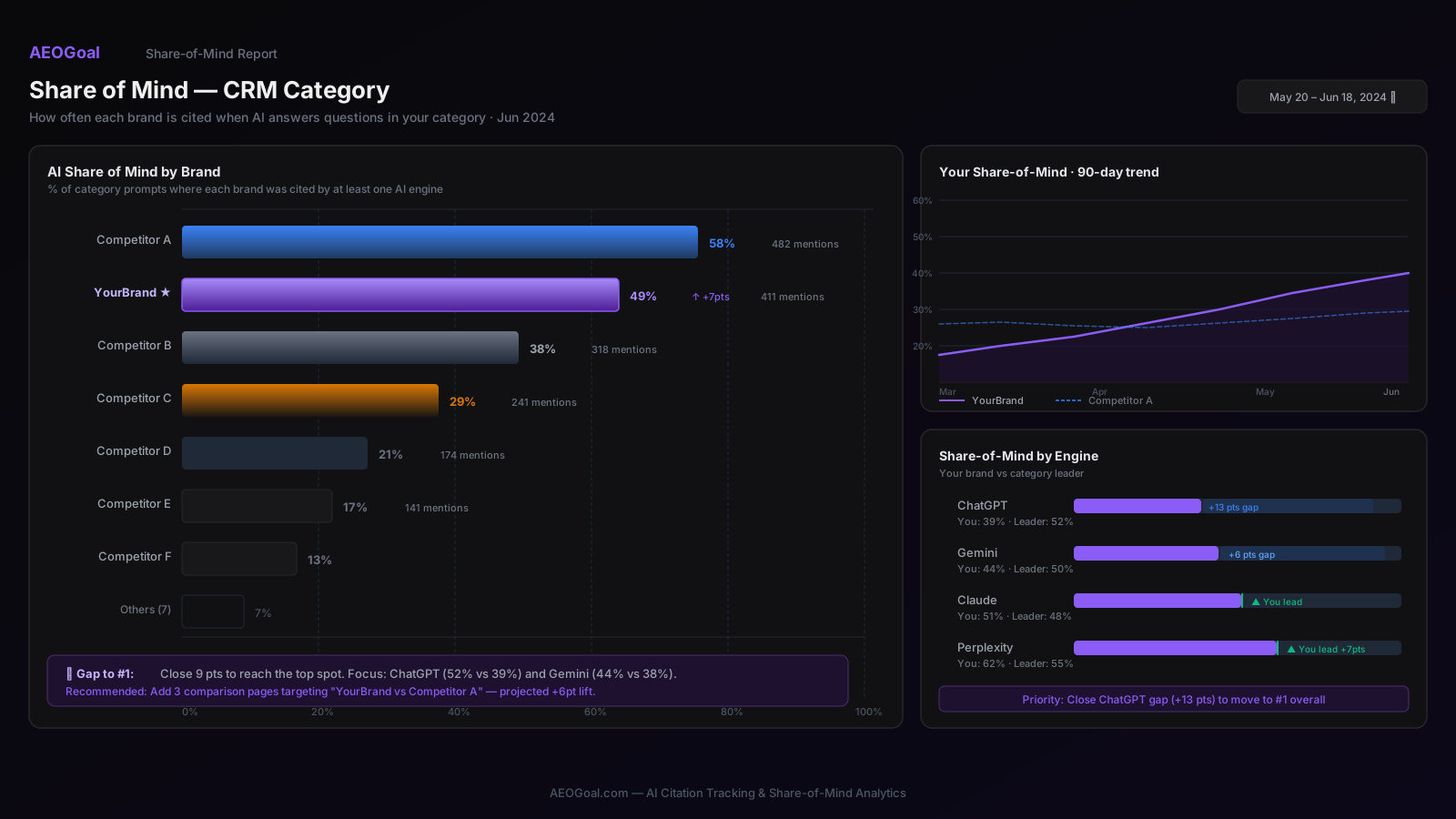
- Share of model against named competitors
- Cited URL distribution
- Citation quality and answer sentiment
- Unsupported or inaccurate claims
- Market and language coverage
- Crawl accessibility by domain and section
- Content freshness by canonical topic
- Remediation backlog and SLA
- Assisted conversions or influenced pipeline where measurable
Report per engine, not as one blended number. A brand can be strong in Gemini and absent from Perplexity for the same prompts, and the fixes for each differ. Report per brand and per market for the same reason: a portfolio-wide average hides exactly the acquired product line or regional site that needs the work.
Closing The Loop: From Finding To Fix
Most tools in this category stop at the dashboard: they tell you the citation rate dropped and hand the hard part back to a committee. The reason we built AEO Goal as an agent rather than a tracker is that at enterprise scale the gap between “we saw it” and “we fixed it” is where programs die.
The working loop looks like this. AI citation tracking runs the governed prompt set against up to nine AI answer engines (ChatGPT, Claude, Gemini, Perplexity, Google AI Overviews, Microsoft Copilot, Grok, Meta AI, and DeepSeek) on a schedule and records mentions, cited URLs, position, and sentiment per engine. When a prompt group shows a competitor cited where you are absent, the finding arrives with a cause and a concrete fix: an answer-first content brief for the canonical page, a schema correction, a crawler-access fix such as a robots.txt rule blocking the relevant bot, or a distinct page to publish. The next scheduled scan re-checks the same prompts, so the remediation queue empties against evidence instead of opinion.
The enterprise-specific layer is just as important. AI visibility tracking data can be scoped per brand and per market so each product team sees its own slice, and governance controls such as role-based access, SSO, and audit trails are available on the Enterprise plan (confirm current availability with sales during procurement). Agencies and in-house teams that report upward can deliver white-label share-of-model reports rather than raw exports. The requirements checklist for evaluating this category is covered in the enterprise SEO platform overview and the enterprise brands use case.
A First-Quarter Rollout Plan
A realistic sequence for standing up the program:
- Weeks 1-2: Scope and access. Inventory in-scope domains, audit robots.txt and bot-management rules against the crawler table above, and fix unintentional blocks. This is often the highest-leverage work of the whole quarter.
- Weeks 3-4: Prompt set and baseline. Draft prompt groups per product line and market with product marketing, then capture a baseline of citation rate, share of model, and cited URLs per engine.
- Weeks 5-8: Canonical layer. Pick the ten highest-value topics, consolidate duplicates, add direct answers and current claims to each canonical page, and align schema with visible content. Route regulated claims through legal once, as a template, rather than per page.
- Weeks 9-12: Remediation cadence. Stand up the queue, assign owners, ship the top fixes, and re-measure. Present the first executive report as trend versus baseline, per engine and per brand.
Nothing in this plan requires new headcount. It requires ownership, measurement, and a fix path for every finding.
Enterprise Recommendation
The shortcut is to publish more AI SEO content and hope answer engines find it. The enterprise-grade recommendation is a governed AI search program: source-of-truth content, deliberate crawler controls, prompt-level citation monitoring, compliance review, executive reporting, and a remediation workflow tied to business-critical prompts.
This is the same reason enterprise SEO programs invest in technical audits, structured content models, and analytics governance. AI search increases the cost of ambiguity, which is the broader shift explained in AEO versus traditional SEO. The two disciplines share one foundation: the crawl health, canonical structure, and content quality that earn Google rankings are the same inputs answer engines retrieve and cite. Run them as one program with one backlog. The brands that win citations will be the brands whose public knowledge is clear, current, accessible, and trustworthy.