What An Organic Traffic Estimate Really Is
An organic traffic estimate answers one question: if we improve our position for these keywords, how many additional clicks per month is that plausibly worth? It exists to rank opportunities before you commit effort, and that is all it can do. Treated as a forecast of what will happen, every traffic calculator ever built is wrong; treated as a consistent way to compare bets, the simple model below is genuinely useful.
Full transparency about this page: the model is documented here completely rather than hidden behind an input form, because the calculation is four spreadsheet columns and the value is in understanding the assumptions, not in the multiplication. Every number the model needs comes from sources you control, chiefly Google Search Console, and the two genuinely uncertain inputs, click-through rate and the AI answer effect, get their own sections because they are where estimates go to die.
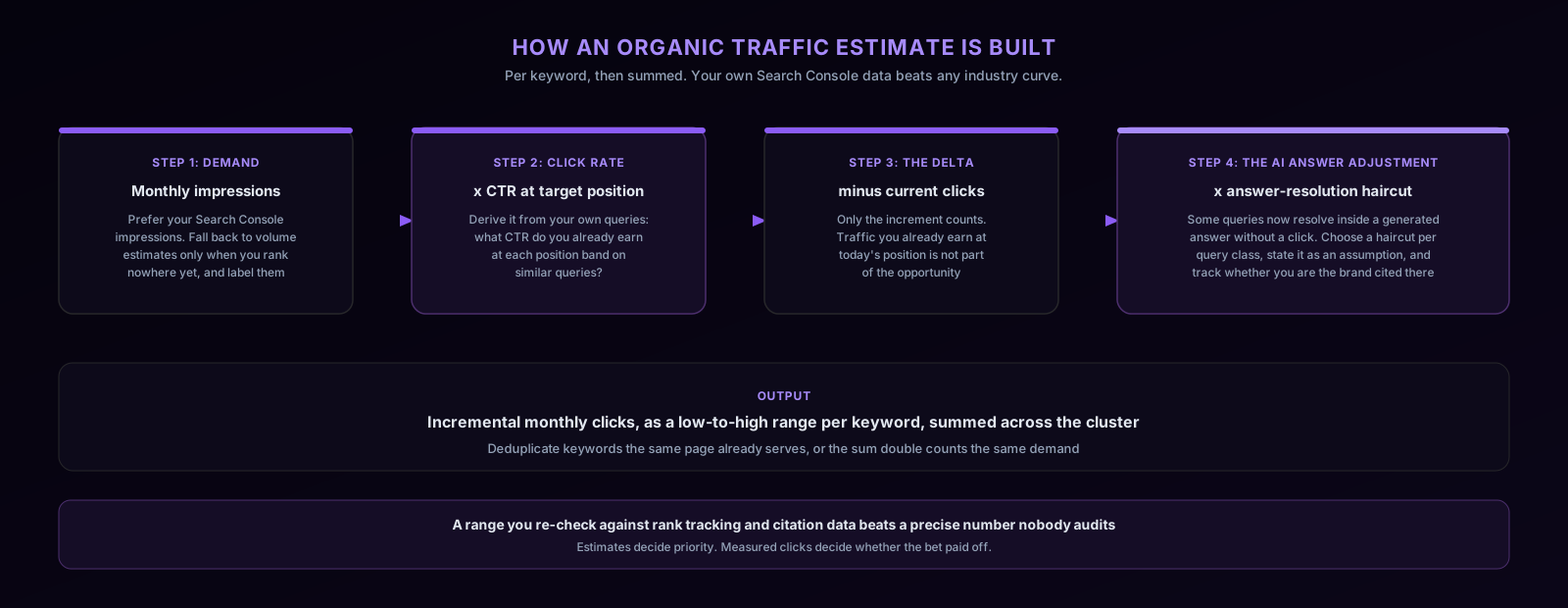
The Model, Step By Step
Per keyword:
expected clicks    = monthly impressions x CTR at target position
incremental clicks = expected clicks - current monthly clicks
cluster total      = sum of incremental clicks across deduplicated keywords
adjusted total     = cluster total x (1 - AI answer haircut)
Step 1: demand. Prefer your own Search Console impressions over third-party search volume wherever you have any footprint, because impressions are measured on your actual market, device mix, and seasonality. Fall back to volume estimates only for keywords where you rank nowhere, and label those rows as estimates, since volume figures are themselves modeled numbers that vary between data providers.
Step 2: click rate at the target position. Covered in depth below; this is the input most calculators fake.
Step 3: subtract what you already earn. Only the increment is the opportunity. A page moving from position four to two keeps its existing clicks; counting them again inflates the case for work on pages that are already fine.
Step 4: the AI answer haircut. Some fraction of queries now resolves inside a generated answer with no click to anyone. That fraction varies by query class and cannot be looked up anywhere reliable, so it enters the model as your stated assumption, visible and adjustable, rather than as silent optimism.
Run the whole chain twice, with pessimistic and optimistic values for the two soft inputs, and carry the resulting range forward. A range survives contact with reality; a point estimate just gets falsified.
Build Your CTR Curve From Your Own Data
The standard shortcut is to grab a published industry CTR-by-position curve and multiply. The problem: those curves average across brands, countries, intents, and SERP layouts. Your CTR at position three depends on whether the SERP shows an AI overview, shopping units, or three ads, whether the query is branded, and whether your title earns the click, none of which an aggregate curve knows.
The better source is sitting in your Search Console: export query-level data, group queries by average position band (1 to 3, 4 to 10, 11 to 20), and compute the CTR you actually earn in each band, ideally split by query type, since informational and commercial queries behave differently. That gives you a curve calibrated to your own snippets and your own SERPs. Where you have no footprint at all, borrow the curve from the most similar query class you do have data for, and only reach for a published industry curve as a last resort, labeled as such in the model.
This is also the honest answer to “what CTR does this calculator assume?”: it assumes nothing. The CTR is an input you derive, and the quality of the estimate tracks the quality of that derivation.
A Worked Example
Illustrative placeholders only, to show the mechanics; every figure below should be replaced with your own data.
Say a product page averages position eight for a commercial keyword with 12,000 monthly impressions and currently earns 240 clicks. Your own Search Console curve says similar commercial queries earn around 2% CTR in the 4 to 10 band and around 12% in the 1 to 3 band. Targeting position three: expected clicks = 12,000 x 12% = 1,440; incremental = 1,440 - 240 = 1,200 clicks per month before adjustment. If you judge that a quarter of this query class now resolves inside AI answers, the adjusted increment is 1,200 x 0.75 = 900, and the honest range once you vary CTR and the haircut pessimistically might run from roughly 500 to 1,200.
The number that counts in that example is not 900; it is the range, and the fact that every assumption producing it is written down and arguable. To convert the click range into a funding decision, hand it to the SEO ROI calculator, which chains it through conversion rate, deal value, and margin.
Aggregating Across A Cluster Without Double Counting
Keyword-level sums overstate cluster opportunity in two standard ways. First, duplication: “organic traffic calculator” and “calculate organic traffic” are one demand stream served by one page, and adding their volumes counts the same searchers twice. Deduplicate to the page level: the unit of estimation is the URL and its query cluster, not the keyword row. Second, cannibalization: if two of your pages trade positions for the same query, an improvement estimate for one is partly a transfer from the other, not net new traffic.
Search Console again resolves both, since it reports impressions and clicks per page as well as per query. Build the model at the page level, use queries only to understand what the page could additionally serve, and check which URL actually ranks per target query with rank tracking before crediting anyone with a gain. For discovering the cluster in the first place, keyword research supplies volume, difficulty, and question variants per seed term.
Where AI Visibility Fits The Estimate
The haircut in step 4 treats AI answers purely as traffic loss, which is only half the truth. When a query resolves inside a generated answer, somebody’s brand is usually named and somebody’s URL cited, and being that brand has value the click model cannot see: the buyer arrives later as branded search or direct, or shortlists you without visiting at all.
So pair the model with measurement on the answer layer. AEO Goal’s keyword research reports AI answer frequency per keyword, which tells you which rows of your model deserve a heavy haircut, and AI citation tracking shows whether you or a competitor is the source those answers cite. A keyword with a large haircut and a competitor holding the citation is not a dead opportunity; it is a different opportunity, pursued through answer-first content rather than position gains, and tracked through Share of Model instead of sessions. This is the AEO Goal loop end to end: the estimate flags the gap, the fix ships, and the next scan shows whether citations or clicks moved. Your technical readiness for any of it is checkable now with the free AI visibility scan, no signup.
Common Mistakes
Summing search volumes and calling it opportunity. Volume is impressions at best; opportunity is incremental clicks after CTR, current traffic, and deduplication. The two differ by an order of magnitude routinely.
Assuming position one. Modeling every target at the top position produces fantasy totals. Model the position you can defend given the competition, which competitor SEO analysis makes concrete.
Borrowed CTR curves presented as fact. The single most common corruption. Your own Search Console curve is measured; anything else is a labeled fallback.
Ignoring the AI answer layer. Estimates built on pre-AI click behavior quietly overstate informational-query opportunity. State the haircut, even if it is a guess; a visible guess can be argued with and improved.
Never reconciling. Six months later, compare actual incremental clicks against the range you wrote down. Estimation skill only improves through that loop, and unreconciled models repeat their optimism forever.
Frequently Asked Questions
Is this calculator free? The model is fully documented on this page and runs in any spreadsheet with your own Search Console export. AEO Goal’s free scan checks any domain’s technical AI readiness with no signup; volume, difficulty, and AI answer frequency data plus ongoing rank and citation tracking are app features.
How accurate are organic traffic estimates? Accurate enough to rank opportunities against each other on consistent assumptions, and not accurate enough to promise a number to a stakeholder. Present ranges, reconcile against actuals, and the model earns whatever trust it deserves.
Can I estimate a competitor’s organic traffic with this? Not credibly at the absolute level: you lack their Search Console, and third-party estimates carry large error bars on individual sites. Their observable positions on your shared keywords, via rank tracking and competitor analysis, are more decision-useful than a modeled sessions figure.