Quick Answer
Ranktracker is a rank-tracking-centered SEO toolset: position tracking anchors the product, with supporting research and audit tools built around that core. AEO Goal starts from a different premise - that “tracking” in 2026 has to include the AI answers buyers actually read - and then goes one step further than tracking altogether: it is an AEO agent that measures how ChatGPT, Claude, Gemini, and Perplexity mention and cite your brand, diagnoses each gap, ships the fix, and re-checks the result on the next scan, while also covering keyword research, daily Google rank tracking, and backlinks in the same workspace. If what you want is a tracking-first toolset for the classic search surface, Ranktracker is squarely that category. If what you want is one prioritized backlog across both surfaces, with the acting done for you instead of handed back to you, that is AEO Goal. Some teams run both.
What are you actually shopping for?
If Ranktracker is on your shortlist, you are probably not an enterprise SERP-data specialist. You are more likely a founder, a solo marketer, or a small team picking one affordable toolset to cover the SEO job end to end: track the keywords, check the site, watch the competitors. That is a sensible way to buy, and this page is written for that decision - not as a feature-by-feature scoreboard (we make no claims about Ranktracker’s current pricing, packaging, or feature matrix; verify those with the vendor), but as a question the shortlist itself hides:
Is “a tracking toolset” still the right shape of product to buy?
Two things changed. First, what needs tracking grew: a serious share of buyer research now ends inside a generated answer from ChatGPT, Perplexity, or Google AI Overviews, a surface no rank-centered tool reads. Second, tracking was never the expensive part. The expensive part is the work between seeing a number and shipping a change - deciding what the number means, what to fix, and whether the fix worked. A tracking-first product leaves all of that with you. An action-first product does it for you. That is the real AEO Goal vs Ranktracker comparison.
What is Ranktracker built for, honestly?
By its broadly known category role: Ranktracker is an SEO toolset with rank tracking at its center - positions over time, plus the supporting tools a small team expects around that core, such as keyword and competitor research and site checks. The appeal of the category is genuine: one login, one bill, the classic surface watched without enterprise-suite pricing. For a team whose buyers still demonstrably search and click, and whose main deliverable is “are our keywords moving,” a tracking-first toolset does that job.
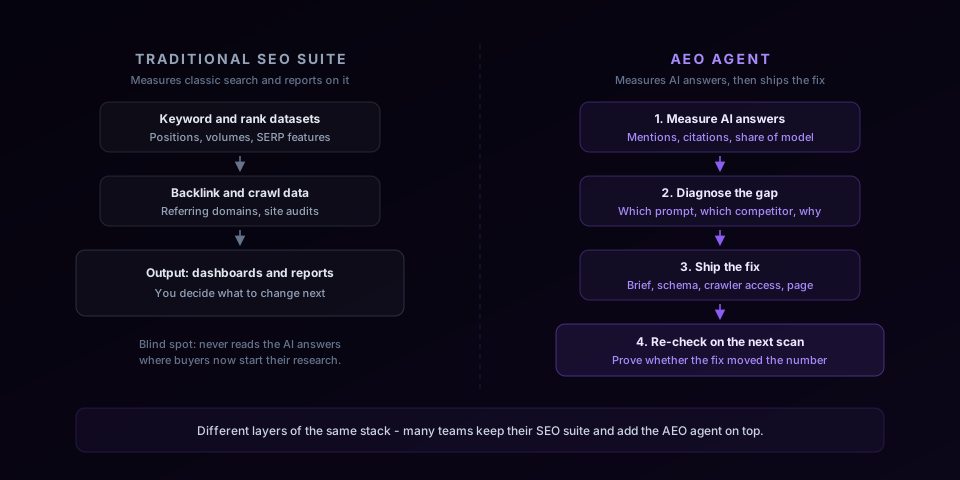
What the category does not do - by design, not by defect - is read the answer layer or close the loop. The output of a tracking-first tool is a dashboard; the input to your week is still “so what do we change?” You remain the agent.
What is AEO Goal built for?
AEO Goal is built as the agent, not the dashboard - the full positioning is laid out in AI SEO software. The loop looks like this:
- Scan. A free, no-signup scan of your domain checks what being cited mechanically requires: robots.txt access across 16 AI agents, llms.txt, sitemap, JSON-LD structured data, metadata, and entity salience.
- Measure. Your buyer prompts run across ChatGPT, Claude, Gemini, and Perplexity on a schedule. Each answer is parsed for mentions and cited source URLs, producing citation rate, share of model, competitor overlap per engine, and sentiment - the method is public in the AI citation tracking methodology.
- Fix. Every gap ships with a concrete action: an answer-first brief via AEO content generation, a schema recommendation, a crawler-access fix, or a page to publish - one backlog, ranked by impact.
- Re-check. The next scan reports whether the fix moved citations, share of model, or rankings.
And because small teams cannot stitch two products together, AEO Goal carries the classic layer too: keyword research, daily Google rank tracking for priority keywords, and backlinks with a DR-weighted Domain Score and AEO Rank. Findings on both AEO and SEO, one queue.
Rank tracked vs answer cited
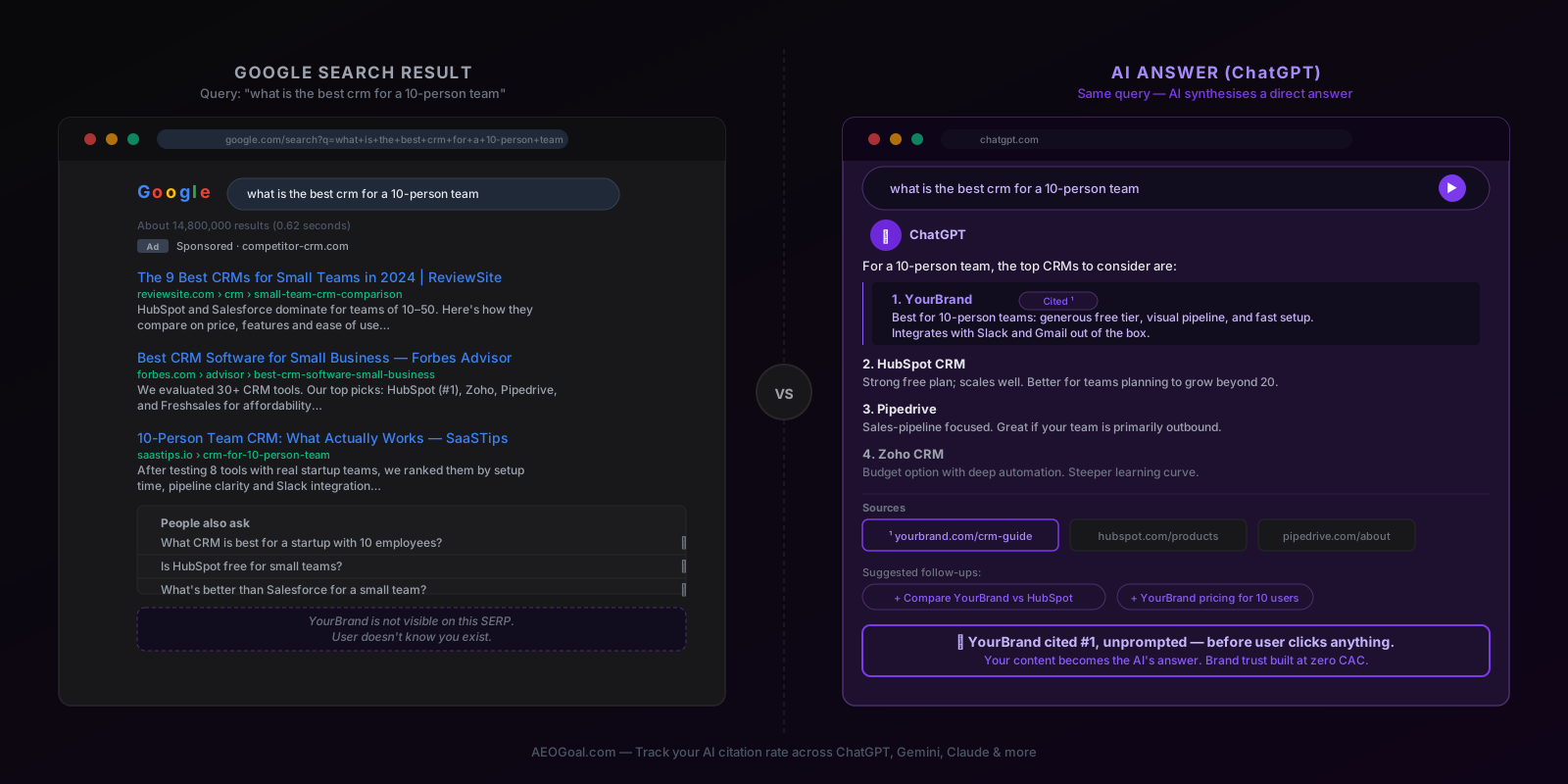
Here is the trap in buying tracking-first in 2026. Your tracker can show a keyword climbing to position 1 while the buyer’s journey never touches the ranked list at all - they asked ChatGPT, got a composed answer naming two of your competitors, and made a shortlist before any click happened. Your dashboard is green. Your pipeline is not.
That is not a rank tracking failure; positions are being measured correctly. It is a coverage failure: the generated answer is a second surface with its own mechanics. Engines select sources, cite a few URLs, and name a few brands, and ranking well makes that more likely without making it happen. You can hold position 1 and still be absent from the answer that intercepted the click. Measuring that surface means parsing answers for mentions, citations, share of model, and sentiment - which is AI citation tracking, a different instrument, not a longer keyword list.
AEO Goal vs Ranktracker: the decision table
| What your week actually needs | Tracking-first toolset | AEO Goal |
|---|---|---|
| Watch keyword positions over time | Core of the product | Daily Google tracking for priority keywords |
| Know if ChatGPT or Perplexity mentions you | Not what the category reads | Core job: per prompt, per engine, as a trend |
| Know which URLs the engines cite as sources | Not measured | Measured and verified per the public methodology |
| See which competitor wins each lost prompt | Position overlays at best | Competitor overlap per engine, prompt by prompt |
| Turn a gap into this week’s task | You interpret the dashboard | Each gap ships with a concrete fix, ranked by impact |
| Prove the fix worked | Watch the line and infer | Re-checked automatically on the next scan |
| Cover both surfaces on one bill | Classic surface only | AEO and SEO findings in one backlog |
The first row is where a tracking-first toolset earns its keep. Every row after that is either a surface it does not read or labor it hands back to you.
When to keep or choose Ranktracker
- Your buyers demonstrably search and click, and AI answers are still marginal in your niche - measure this rather than assume it.
- Your deliverable is the position report itself, and your current workflow around it already fits.
- You genuinely only need the watching, because you have the analyst time to do the interpreting and the fixing yourself.
If that is you, a tracking-first toolset is the economical choice today, and the honest move is to say so. The broader category landscape, including the dedicated specialists, is mapped in our rank tracking tools comparison.
When to run both
Running both is a legitimate stack, not a failure to decide: keep the tracking-first toolset as the classic-surface watcher your reporting is already built on, and add AEO Goal for the layer it cannot read plus the fix-and-recheck loop neither surface gets from a tracker. Because AEO Goal also carries rank tracking, keyword research, and backlinks, the common trajectory is both first, consolidation later - after you have verified its tracking depth covers your keyword set. The conceptual background for splitting the two surfaces is in AEO vs traditional SEO.
A worked example for the one-toolset buyer
You run marketing alone at a bootstrapped project-management app. Your toolset says you rank top five for “project management software for agencies” - months of work, honestly reported. Yet trial signups from organic are flat. You ask Perplexity the same question your buyers ask: it names three competitors, cites a listicle and a competitor’s comparison page, and never mentions you.
Nothing on your dashboard could have shown you this. AEO Goal’s free scan and first measurement pass would: the lost prompt, the competitor URL that got cited, and the diagnosis - say, your comparison page opens with a hero paragraph instead of a direct answer, and your robots.txt blocks two AI crawlers. It hands you the answer-first brief and the two-line crawler fix, and after you ship them, the next scan tells you whether Perplexity now cites you. Total interpretation labor on your side: reading the task, not deriving it. For a team of one, that difference is the product.
What to verify with each vendor before buying
Comparison pages, including this one, are shortlist inputs, not procurement. Before paying anyone:
- With Ranktracker: current pricing and plan limits, exactly which tools are included at your tier, position-update frequency, competitor and market coverage, and whether any AI-answer capability actually parses generated answers rather than tracking positions around them.
- With AEO Goal: which engines and how many prompts your plan covers, how citations are verified (the methodology is published), what the fix workflow looks like on your own domain, and current pricing.
- With both: data retention, API limits, export paths, and cancellation terms.
The bottom line
Ranktracker represents a category that watches the classic search surface competently. AEO Goal represents what that category leaves out in 2026: the AI answer surface where more of your buyers now decide, and the agent loop that turns every finding - on either surface - into a shipped, verified fix. If you are picking one tool to actually move your visibility rather than chart it, start where the gap is measurable: run the free AI visibility scan and see, in minutes, which AI engines cite you, which skip you, and what to fix first. For the wider field, see best AI SEO tools, and if the category is new to you, start with what is AEO.