Quick Answer
NLP and semantic search SEO is the work of helping search engines and AI answer systems understand what your content means. Instead of optimizing only for exact-match keywords, semantic SEO clarifies entities, relationships, user intent, topical scope, and the passages that answer specific questions.
The goal is simple: when a user asks a natural-language question, the search system should be able to retrieve the right page, identify the right section, and understand why your brand is a relevant source. That same property is what earns citations in AI answers, which is why semantic SEO has quietly become the technical core of answer engine optimization.
NLP vs Semantic Search
Natural language processing, or NLP, is the broad set of techniques used to process human language. In search, NLP helps systems identify entities, classify intent, parse questions, understand synonyms, extract facts, and compare passages.
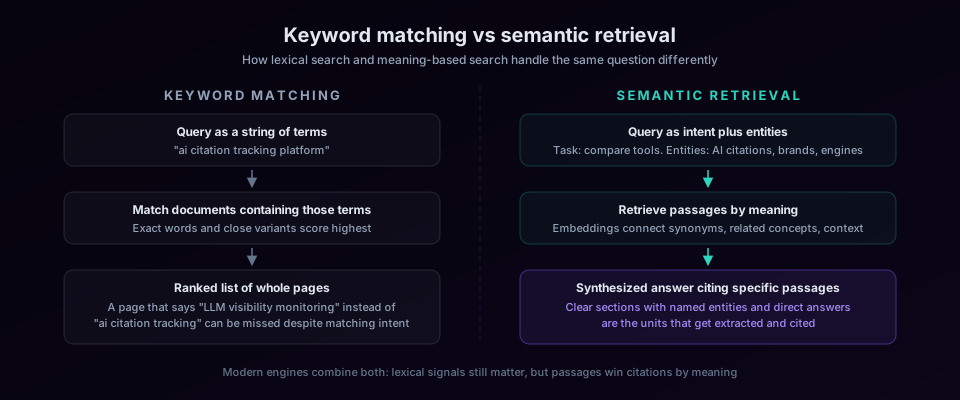
Semantic search is the search behavior that comes from understanding meaning. A semantic search system can connect “AI citation tracking platform” with related concepts like LLM visibility, answer engine optimization, source monitoring, and share of model even if the page does not repeat every phrase exactly.
This is not speculative. Google has publicly described the shift over more than a decade: the Knowledge Graph (introduced in 2012) models entities and their relationships rather than strings, BERT (announced for Search in 2019) improved interpretation of conversational queries, and passage ranking lets Google surface a specific section of a page rather than judging only the whole document. AI answer engines like ChatGPT, Claude, Gemini, and Perplexity push the same direction further: they retrieve passages by meaning and synthesize an answer that cites a handful of sources. The full landscape is mapped in our overview of AI search engines.
For SEO teams, the consequence is direct: the page should not read like a keyword list. It should read like a clear explanation of a topic, with the right entities connected in a way that a person and a retrieval system can both follow.
How Meaning-Based Retrieval Actually Works
You do not need to build these systems, but knowing the moving parts explains why certain writing habits win citations:
- Entity recognition. The system identifies the people, products, companies, and concepts a passage is about, and links them to known entities where it can. Consistent, unambiguous naming makes this easier; three different names for the same product across your site makes it harder.
- Embeddings and vector search. Text is converted into numerical representations where similar meanings sit close together. This is how “tool for monitoring ChatGPT mentions” retrieves a page that says “AI citation tracking,” with no shared keywords required.
- Intent classification. The system infers the task behind the query: define, compare, implement, troubleshoot, buy. Pages that visibly serve one task per section are easier to match.
- Passage-level scoring. Retrieval increasingly operates on sections, not whole pages. A buried two-sentence answer inside an unrelated section competes worse than the same answer under a heading that names it.
- Answer extraction and synthesis. AI answer engines assemble retrieved passages into one response and cite sources. The passages that get cited tend to be self-contained: they name the subject explicitly instead of leaning on pronouns, and they state the answer rather than alluding to it.
Every practical recommendation in the rest of this guide is downstream of these five mechanics.
From NLP Concept To Practical SEO Work
| NLP concept | What the system does | What you should do |
|---|---|---|
| Entity recognition | Identifies who and what the passage is about | Name the brand, product, and category consistently; define terms on first use |
| Entity salience | Weighs how central an entity is to the text | Put the target entity in the title, opening sentences, and headings, not only in a footer mention |
| Intent classification | Infers the user’s task | Structure sections around tasks: definition, comparison, steps, measurement |
| Embedding similarity | Matches meaning across different wording | Cover the concept and its natural synonyms; stop counting exact-match repetitions |
| Passage retrieval | Scores sections independently | Make each section self-contained with a descriptive heading and a direct answer |
| Knowledge graph linking | Connects entities to known records | Use accurate Organization and Product structured data with sameAs links to authoritative profiles |
Entity Salience: The Metric Behind “Is This Page About Us?”
Entity salience measures how central an entity is within a piece of text, as opposed to merely present. A page can mention your product twelve times and still treat it as background noise if the sentences are actually about something else. Salience is worth singling out because it is measurable and fixable:
- Lead with the entity. The subject of the first sentence carries more weight than a mention in paragraph nine.
- Make the entity the grammatical subject. “AEO Goal tracks citations across four engines” is stronger than “citations can be tracked across four engines using various tools.”
- Reduce competing entities. A page that gives equal airtime to eight tools has no salient one. Comparison pages are the deliberate exception.
- Keep naming consistent. Aliases, abbreviations, and rebranded names split the signal.
We cover the technique in depth in the certification module on entity salience and brand authority.
Build A Semantic Content Brief
A semantic brief is more useful than a generic SEO outline. It should define the topic as a knowledge object.
Include:
- Primary entity: The main topic, product, concept, or category.
- Related entities: Tools, platforms, concepts, standards, competitors, and metrics.
- Audience: Who is asking the question and what decision they need to make.
- Core intents: Definition, comparison, implementation, risk, cost, measurement, and alternatives.
- Required distinctions: Terms that are often confused and need clear boundaries.
- Evidence requirements: Data, screenshots, methodology, examples, or expert review.
- Internal links: Existing pages that support the topic and pages that should link back.
For example, a page about “AI citation tracking” should connect citation rate, cited URL, prompt set, AI visibility, share of model, ChatGPT, Google AI Overviews, Perplexity, competitor overlap, and methodology. A page that only repeats “AI citation tracking” will underperform, because the retrieval system is looking for the concept neighborhood, not the phrase count.
Keyword research still starts this process; it tells you the demand and the vocabulary buyers actually use. The keyword research guide covers that layer, and the semantic brief builds on top of it.
Page Structure That Supports Semantic Search
Use structure to make meaning explicit.
Start With A Direct Definition
Define the topic in plain language before expanding. The first answer should be short enough for a reader to understand immediately and specific enough for an AI system to extract accurately. This single habit does more for answer extraction than any markup.
Use Descriptive Headings
Headings like “Overview” and “Why This Is Important” are easy to write but weak semantically. Prefer headings that name the actual concept:
- “How AI Citation Tracking Works”
- “Semantic SEO vs Keyword SEO”
- “When To Use Structured Data”
- “How To Measure Passage Retrieval”
Because passages are scored per section, a heading is effectively the label the retrieval system uses to decide whether the section is a candidate answer.
Cover Related Intents
Semantic search rewards complete coverage of the user’s task. A strong page usually includes definition, use cases, steps, examples, mistakes, and measurement. Do not add filler; add sections that answer adjacent questions a real user would ask next.
Connect Internal Pages
Internal links are semantic signals. Use anchors that name the relationship: AI citation tracking, structured data, semantic SEO guide, and answer engine optimization are stronger than vague anchors like “learn more.” The link graph tells retrieval systems which page is your canonical treatment of each topic.
Add Schema Carefully
Schema can clarify page type, organization identity, FAQs, products, breadcrumbs, and articles, and sameAs properties help systems connect your organization to its authoritative profiles. It should never invent facts that are not visible on the page. Structured data is a clarification layer, not a substitute for useful content.
Semantic SEO Quality Checks
Before publishing, test the page against these questions:
- Can a reader explain the topic after the first section?
- Are the important entities named consistently?
- Does the page distinguish similar terms?
- Are examples specific to the audience?
- Are claims supported by visible evidence or links?
- Do internal links point to authoritative supporting pages?
- Would this page still be useful if every keyword variation were removed?
- Can each major section stand alone as an extracted passage?
If the answer is no, the page probably needs more editorial work before it can contribute to AI citations.
Measurement
Semantic SEO performance should be measured beyond keyword rank.
Track:
| Signal | What It Shows |
|---|---|
| Prompt coverage | Whether the page answers real natural-language questions |
| Cited passages | Whether AI systems retrieve the correct section |
| Entity consistency | Whether the brand and topic are described accurately |
| Cannibalization | Whether multiple pages compete for the same intent |
| Internal link depth | Whether the page is supported by the topic cluster |
| Conversion path | Whether semantic traffic or citations contribute to business outcomes |
The prompt-level signals are the same ones defined in the AI citation tracking methodology: per prompt and per engine, was the brand mentioned, which URL was cited, at what position, and with what sentiment.
Where This Meets Practice: Measuring And Fixing Semantic Gaps
Most of this work fails in the same place: teams agree the theory, then have no way to see whether engines actually understand their pages, so nothing changes. This is the gap AEO Goal was built to close, and it closes both halves.
On the measurement side, the free scan runs a live pass over a domain and scores target-entity salience directly, alongside structured data, metadata, and AI-crawler access, so “is our brand actually salient on our own product page” becomes a checked finding instead of a debate. AI citation tracking then runs your real buyer prompts against up to nine AI answer engines (ChatGPT, Claude, Gemini, Perplexity, Google AI Overviews, Microsoft Copilot, Grok, Meta AI, and DeepSeek) on a schedule and records which passages and URLs each engine cites.
On the fix side, every gap ships with an action rather than a chart. If a competitor’s page is retrieved for a prompt you should own, AEO content generation turns that gap into an answer-first brief: the direct definition up top, the entity named as the subject, self-contained sections per intent, and schema that matches the visible claims. The next scan re-checks the same prompt, so you see whether the semantic work changed the retrieval instead of assuming it did.
Enterprise Recommendation
The shortcut is to add more related keywords to a page. The enterprise-grade recommendation is to maintain a shared entity and intent map for the site. That map should define canonical topics, approved terminology, related product pages, schema patterns, content owners, review cadence, and AI visibility metrics.
This prevents duplicate thin pages and makes content easier to govern as AI search evolves. It also keeps traditional SEO and AEO on one backlog: the entity clarity and passage structure that win featured snippets and passage rankings in Google are the same properties that win citations in AI answers. Semantic SEO is not a writing trick. It is information architecture for search systems that understand meaning.