Quick Answer
AEO Goal and Serpstat both pitch consolidation, but they consolidate different eras of search. Serpstat is broadly positioned as a value-oriented all-in-one SEO platform for the classic stack. AEO Goal redefines what all-in-one has to include in 2026: it measures how ChatGPT, Claude, Gemini, Perplexity, and Google AI Overviews mention and cite your brand, ships the specific fix and re-checks it, and covers keyword research, daily rank tracking, and backlinks with a DR-weighted Domain Score, all on one prioritized backlog. An all-in-one that cannot read AI answers no longer covers all of search.
What does “all-in-one” actually have to include now?
If you are comparing AEO Goal and Serpstat, you are almost certainly a value maximizer. You consolidate subscriptions on principle, you compare what you get against what you pay, and you have little patience for paying twice for overlapping tools. Good. This page is written for exactly that discipline, and it starts by interrogating the phrase doing all the work in this decision: all-in-one.
“All-in-one SEO” earned its meaning when search had one surface. Keywords, rankings, backlinks, site audits: cover those four and you covered the game. But the game grew a second board. A meaningful and growing share of buying questions now get answered by ChatGPT, Perplexity, Gemini, Claude, and Google AI Overviews before any results page is seen. Those engines compose one answer, name a few brands, cite a few sources, and render everyone else invisible for that question.
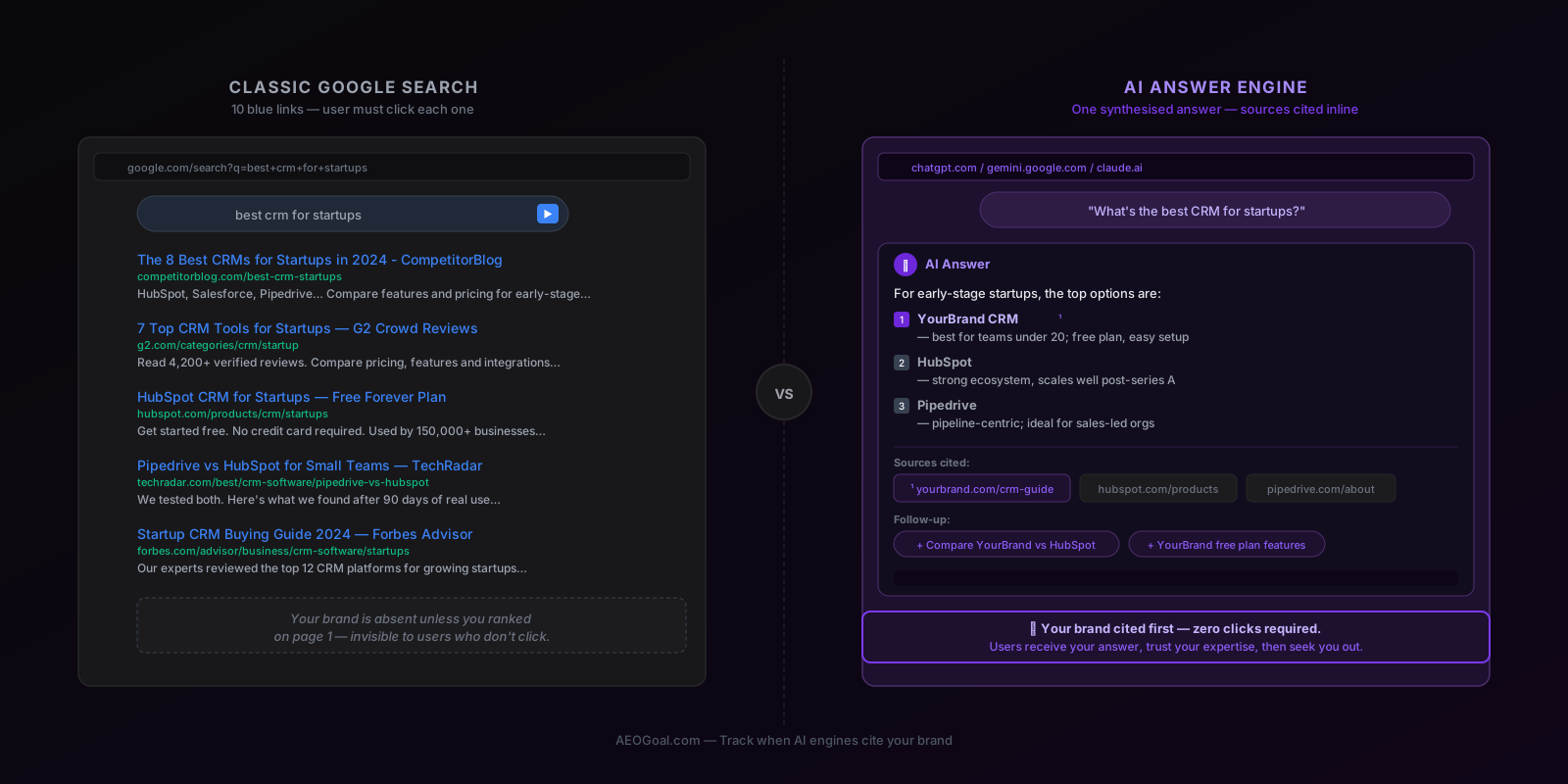
A value maximizer should draw the obvious conclusion: an all-in-one that covers four fifths of the old game and none of the new one is not all-in-one anymore. It is a very complete tool for a shrinking share of the decisions you care about. The rest of this page tests both products against the full 2026 definition, honestly.
What is Serpstat built for?
Serpstat is broadly positioned as a value-oriented all-in-one SEO platform: the category that bundles the classic workflows (keyword research, rank tracking, backlink analysis, site audits) into one subscription at a price meant to undercut the premium suites. For teams that want the classic stack consolidated without an enterprise contract, that is a sensible category, and value-oriented all-in-ones have saved plenty of budgets from tool sprawl.
House policy: this page makes no claims about Serpstat’s current pricing, plan contents, database sizes, or feature matrix. Those change, and you should verify every one of them with the vendor before buying. What can be said fairly is the category boundary: classic all-in-one platforms are instruments for the rankings game. They do not run prompts against AI answer engines, do not parse generated answers for brand mentions and cited source URLs, and cannot tell you your share of the answers your buyers actually read. If the platform you consolidate onto cannot see a surface, consolidating onto it makes that surface’s blind spot total.
What is AEO Goal built for?
AEO Goal is an AEO agent built to cover both surfaces and, crucially, to act on what it finds rather than adding to your reading list:
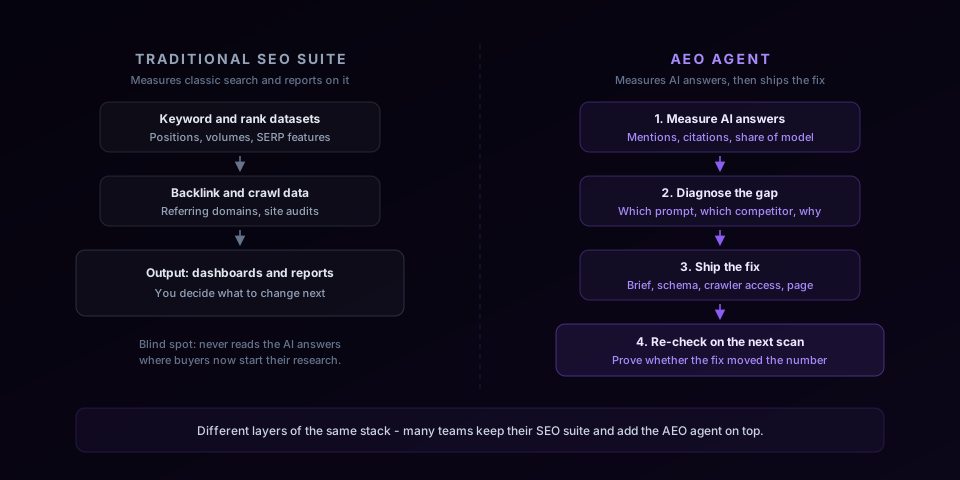
- It reads the answers. Your priority prompts run against ChatGPT, Claude, Gemini, and Perplexity on a schedule; each generated answer is parsed for mentions, cited source URLs, position, and sentiment, reported as citation rate, share of model, sentiment, and competitor overlap per engine. The competitor AI visibility view shows the exact prompts where a rival wins and you are absent.
- It ships the fix. Every gap maps to a concrete action: an answer-first content brief, a schema change, a robots.txt or llms.txt correction, a specific page to publish, ranked by impact.
- It proves the outcome. The next scan re-checks whether the fix moved citations, share of model, or rankings. For a value buyer this is the decisive property: you can see cost per shipped improvement, not just cost per feature.
- It carries the classic stack. Keyword research with volume and difficulty, daily Google rank tracking, technical audits, and backlink analysis scored with a DR-weighted Domain Score plus AEO Rank, which measures authority among the domains AI engines actually cite. Findings from both surfaces land on one prioritized backlog, one report.
That last point is important for the consolidation math: AEO Goal is not “an extra tool on top of your all-in-one.” For most small and mid-sized teams it is the all-in-one, covering the classic basics and the surface the classic category cannot see. The full capability map is on the AI SEO software page.
How do the two compare on the surfaces that matter?
A value comparison should be a coverage audit. Here are the surfaces and jobs a consolidator actually needs covered, and where each category stands:
| Surface or job | Value all-in-one SEO platform (Serpstat’s category) | AEO Goal |
|---|---|---|
| Keyword research | Core category territory; verify plan specifics with the vendor | Yes: volume, difficulty, and SERP features built in |
| Rank tracking | Core category territory | Yes: daily positions for priority keywords and competitors |
| Backlinks and authority | Core category territory; dataset depth varies, verify | Yes: referring domains and anchors, DR-weighted Domain Score, plus AEO Rank for AI-cited authority |
| Technical site audits | Core category territory | Yes: crawlability, structured data, metadata, answer-extractability, plus AI-crawler access checks |
| AI answer visibility (ChatGPT, Claude, Gemini, Perplexity, AI Overviews) | Outside the category | Yes: citation rate, share of model, sentiment, competitor overlap per engine |
| Why an AI answer skipped you, and the fix | Outside the category | Yes: diagnosed cause plus a concrete fix, prioritized by impact |
| Proof that work moved the numbers | Rank movement only | Yes: fix-and-recheck across citations, share of model, and rankings |
| One backlog across all of the above | One backlog for the classic surface | Yes: both surfaces, one prioritized backlog |
The classic rows are comparable across both columns, and you should verify the left column’s specifics with the vendor. The AI-answer rows have one column. For a buyer whose whole thesis is coverage per dollar, rows with one column decide the comparison.
When is Serpstat enough?
If your operation genuinely lives on the classic surface, a value all-in-one is a rational purchase, and this page will say so plainly. That is true when your traffic and revenue demonstrably come from classic rankings, when you have measured (not assumed) that AI assistants are not answering your category’s buying questions yet, and when your team’s workflows are built around classic reporting. Inexpensive classic coverage done well is real value.
But a value maximizer should price the blind spot, not just the subscription. If engines are already recommending competitors for your category’s questions, every month of blindness has a cost that never appears on an invoice: it appears in pipeline you never saw. The question is not whether the classic all-in-one is a good deal on classic data. It is whether you can afford to be invisible on the surface where your buyers increasingly get their shortlist, and no classic tool can even tell you whether that is happening.
Should you run both, or consolidate?
- Run both if you depend on large-scale crawl or backlink datasets that specialist suites do best. Keep the classic platform for that layer and add AEO Goal as the answer-engine layer; the AEO vs traditional SEO breakdown covers how the disciplines divide the work. Teams evaluating heavier stacks should also see enterprise SEO platforms.
- Consolidate onto AEO Goal if your classic needs are the standard set: keyword research, daily rank tracking, backlinks, audits. You get those plus the AI-answer surface plus the agent loop, on one subscription and one backlog. For a consolidator, one tool that covers both games beats two tools that each cover one.
The only indefensible option is the default one: consolidating onto a classic-only platform and calling search “covered” while the answer layer goes unmeasured.
A worked example: a bootstrapped B2B SaaS consolidating its stack
Say you run marketing at a 15-person bootstrapped SaaS selling field-service scheduling software, and you are consolidating a messy stack down to one search tool. The classic checklist is easy: you need keyword research for “field service management software” clusters, daily rank tracking, and a backlink view. Both categories claim that ground; AEO Goal covers it natively.
Now the 2026 checklist. Your actual buyer, an operations manager, asks ChatGPT “best field service scheduling software for a small HVAC company” and gets three named vendors with citations. AEO Goal’s free scan first verifies the fundamentals: whether your robots.txt blocks any of the 16 AI crawlers it checks, whether llms.txt exists, and whether your JSON-LD and entity signals actually identify what you sell. Tracked prompts then show which competitors each engine names for your money questions, which pages get cited (often a comparison page or review site, not the vendor’s own site), and your share of model per engine. The backlog might rank an answer-first brief targeting one losing prompt above every classic task, because the competitor’s cited source is weak. You ship it, and the next scan tells you whether the engines picked you up. Cost per shipped, verified improvement: that is the value metric the invoice comparison misses.
What should you verify with each vendor before buying?
No pricing, packaging, or feature claims about Serpstat appear on this page by design; verify all of it at the source, and distrust review roundups and AI answers that assert current numbers. Before committing:
- Current pricing, plan limits, seat and project caps, and dataset depth, from the vendor’s own materials.
- Whether the platform measures AI answers directly (which engines, prompt sampling, refresh cadence) or classic search only.
- Whether findings become owned actions with a re-check, or exports you must turn into tasks; the best AI SEO tools framework has the complete checklist.
- Governance basics: data handling, retention, access controls, API limits, cancellation terms.
- In a trial, ask each tool one question: “which prompt am I losing, to which competitor, and what exactly should I change?” Then buy the tool that answers it.
Audit the surface your all-in-one cannot see
You are good at extracting value from tools; start by extracting some for free. AEO Goal’s AI visibility scan runs with no signup and shows whether AI engines can read your site, where they cite you, where they skip you, and the first fix to ship. If the scan comes back clean and the prompts show no competitor winning your category’s answers, you have lost nothing. If it does not, you just found the gap your current all-in-one was never going to report.