Quick Answer
Enterprise SEO platforms such as BrightEdge, Conductor, seoClarity, and Botify help large teams manage rankings, content operations, technical crawling, and reporting at scale. AI search adds a requirement none of them was originally built for: knowing whether ChatGPT, Claude, Gemini, and Perplexity mention, cite, and accurately describe the brand. Most enterprises now run an AI-answer measurement layer such as AEO Goal beside the incumbent suite, because the two layers answer different questions.
What “enterprise SEO platform” means now
For fifteen years the category had a settled definition: a sales-led platform that consolidates rank tracking, keyword datasets, content workflows, technical crawling, and executive reporting for organizations with thousands of pages and many stakeholders. That definition still holds, but it now covers only one of the two surfaces where buyers meet a brand. The other surface is the generated answer, where an engine synthesizes a response from sources it chooses to cite, and where a page can rank first and still be absent.
So an enterprise stack review in 2026 has two questions, not one: does the platform cover classic search at the scale and governance standard the organization needs, and does something in the stack measure the AI answer layer directly? A platform that answers only the first question is not wrong, it is incomplete.
The incumbent platforms, honestly summarized
These are the vendors most enterprise shortlists start from. The notes below are limited to well-known public positioning as of early 2026; feature depth and packaging change often, so verify everything in a live demo and current documentation before buying.
- BrightEdge. One of the longest-established enterprise SEO platforms, founded in 2007, known for its large Data Cube keyword dataset, content recommendations, and enterprise reporting. Sales-led, custom-priced contracts. It has been adding AI-search-related features; verify their current depth directly.
- Conductor. An enterprise SEO and content platform that expanded through acquisition, adding ContentKing’s real-time site monitoring in 2022 and Searchmetrics in 2023. Strong positioning around content workflows and organic marketing reporting. Sales-led, custom-priced.
- seoClarity. An enterprise platform built on its own large crawl and keyword dataset, with an AI assistant and emphasis on unlimited-style data access within contracts. Sales-led.
- Botify. Focused on enterprise technical SEO for very large sites: crawling at scale, log-file analysis, and prioritizing what search engines actually fetch and render. Sales-led.
None of these is a weak product, and this page does not rank them. The relevant question is different: each was architected around search engine results, and the AI answer layer is a bolt-on to that architecture, not its center of gravity.
| Requirement | Incumbent enterprise suites | AEO Goal |
|---|---|---|
| Rank tracking, keyword datasets | Core strength, at enterprise scale | Included: keyword research and daily rank tracking, at self-serve scale |
| Large-site crawling, log-file analysis | Core strength (especially Botify) | Technical audits included; not a log-file or ten-million-page crawl specialist |
| AI answer measurement | Varies by vendor; verify depth in a demo | Core product: mentions, verified citations, sentiment, Share of Model per engine |
| Citation evidence at source-URL level | Verify per vendor | Yes, with two-stage URL verification before a citation counts |
| Gap-to-fix workflow | Typically recommendations and workflows for classic SEO | Agent loop: every AI-answer gap ships a concrete fix and is re-checked next scan |
| Buying motion | Sales-led, custom pricing | Self-serve plans with published pricing, free scan first |
The question incumbents were not built to answer
When an executive asks “why does ChatGPT recommend our competitor,” the answer requires data an SERP-centric platform does not naturally hold: the exact prompt, the engine, the generated answer text, whether the brand was mentioned, which source URLs the engine cited, and how that has trended since the content team shipped its fixes. That is a different collection pipeline, run against the engines themselves, with its own exclusion and verification rules - the kind documented in our AI citation tracking methodology.
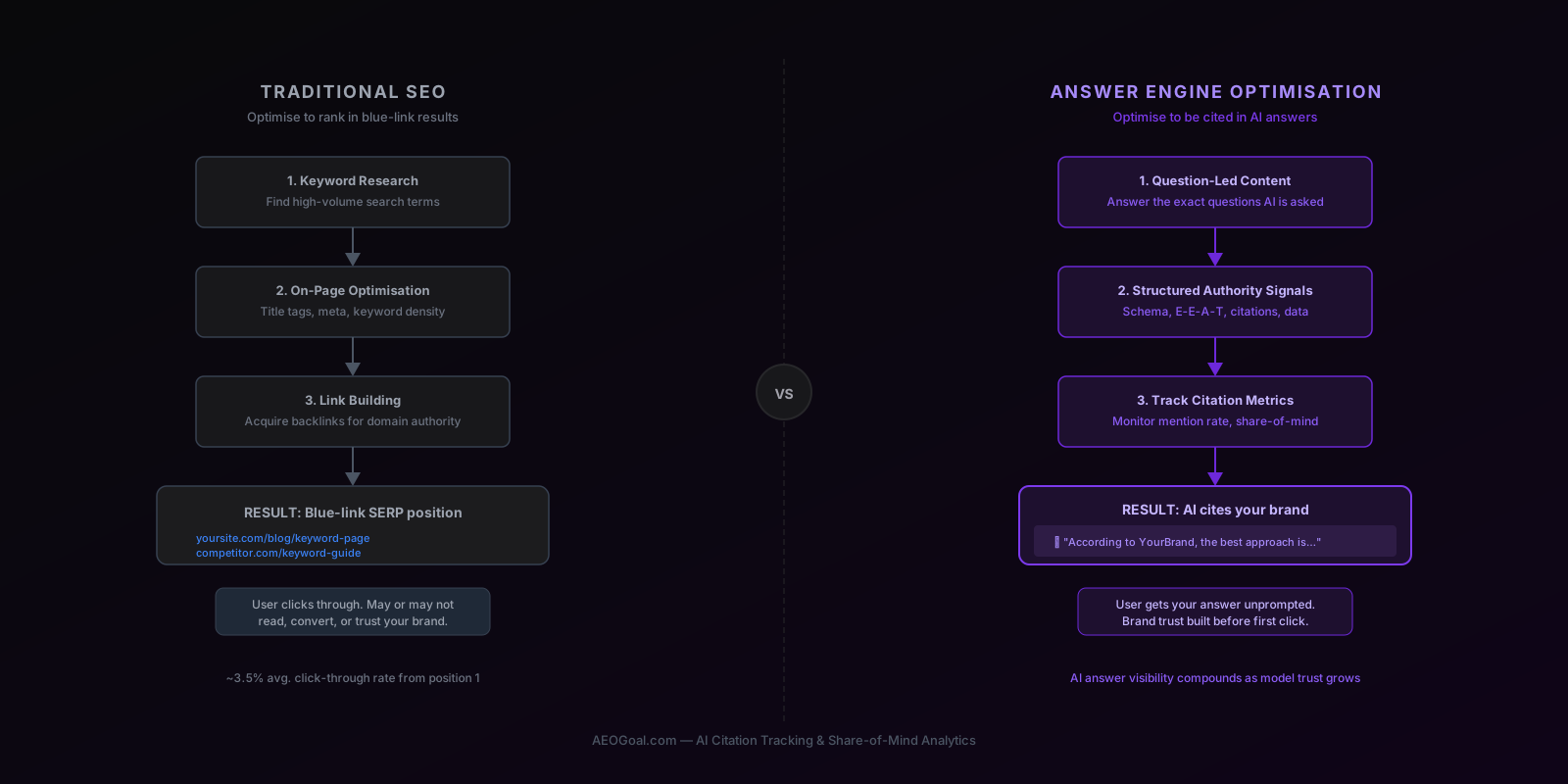
This is why the practical enterprise pattern is layered: keep the incumbent suite as the system of record for rankings, crawling, and legacy reporting, and add a purpose-built answer engine optimization layer for generated answers. The full reasoning is in AEO vs traditional SEO.
Where AEO Goal fits
AEO Goal is the AI-answer layer, built as an agent rather than a dashboard. It runs your prompt set across ChatGPT, Claude, Gemini, and Perplexity on a schedule, measures mentions, verified citations, sentiment, and Share of Model per engine, and benchmarks competitor visibility prompt by prompt. Then it does the part enterprise reporting usually leaves to a steering committee: each gap ships with a concrete fix - an answer-first brief, a schema change, a crawler-access fix - and the next scan re-checks whether the fix moved the number.
Two honest boundaries. First, AEO Goal carries its own traditional stack - keyword research, daily rank tracking, backlinks with a DR-weighted Domain Score and an AI-citation AEO Rank, and technical audits - which is enough for many teams to consolidate, but it is not a log-file-analysis or ten-million-page crawl specialist; organizations that depend on that keep a suite like Botify for it. Second, AEO Goal is self-serve with published pricing rather than a sales-led enterprise contract, which some procurement teams will read as a benefit and others as a gap. Evaluate it as the AI visibility layer of the stack, on evidence: AI visibility tracking and AI citation tracking are the two workflows to test in a trial.
What should enterprises verify before choosing?
Verify both the AI-answer coverage and the enterprise controls, because a strong measurement layer with weak governance fails procurement, and strong governance around a bolted-on AI report fails the business question. Concretely:
- Which AI engines and prompt sets are monitored, at what cadence, with what historical retention, and whether the measurement method is published and auditable.
- Whether mention and citation data exists at source-URL granularity, and whether cited URLs are verified rather than taken at face value.
- Whether findings become owner-assigned remediation work with a re-check, or remain a report.
- SSO, role-based access, audit logging, DPA terms, subprocessor lists, encryption, retention, and incident processes - requested as documentation, not gathered from marketing pages. Our own current posture is stated plainly on the security page.
- Total cost against usage: sales-led platforms price by contract; self-serve platforms publish plans. Model both against your actual prompt, market, and seat counts.
When AEO coverage becomes mandatory
- AI answers influence buyer research before a website visit in your category.
- Executives ask why competitors appear in generated answers and nobody has prompt-level evidence.
- Content teams need source-backed briefs tied to real answer gaps, not generic keyword recommendations.
- Legal and brand teams need to monitor inaccurate AI descriptions of the company.
- SEO reporting has to explain visibility even where search clicks decline.
An honest closing note
Do not choose an enterprise platform from comparison copy, including this page. Shortlist against the two-layer question, demand a live demo on your own brand and prompts, and put the governance documentation next to the feature claims. If the AI-answer layer is the gap in your stack, start with a free AI visibility scan from the homepage and the broader landscape in best AI SEO tools; if large-scale classic datasets are the gap, the incumbents above are the right shortlist for that job.