Quick Answer
Search Atlas is an all-in-one AI SEO platform best known for OTTO, an automation layer that deploys technical, on-page, content, and off-page changes to your site after a pixel install, spanning keyword research, audits, content, backlinks, and even ads. AEO Goal is an AEO agent whose first-class metric is AI answer-engine visibility: it runs your prompts across ChatGPT, Claude, Gemini, Perplexity, and Google AI Overviews, measures citation rate and share of model per engine, diagnoses why you were skipped, ships that fix, and re-checks it on the next scan - and it also carries the classic search stack. The choice is between a broad automate-the-SEO-workflow suite and an agent built around measuring and improving AI citations specifically.
Breadth of automation, or depth on AI citations
These two tools are both AI-era SEO platforms, but they are organized around different center points, and naming that center is how you choose between them.
Search Atlas is organized around breadth and automation. Its signature, OTTO, is positioned as an autopilot that touches a wide range of SEO work - meta tags and schema, headings and internal links, content and topical maps, link building, even Google Ads - and deploys many of those changes to your site directly after a one-time pixel install. For a team that wants one platform to automate as much of the SEO workflow as possible across many areas, that breadth is the appeal.
AEO Goal is organized around a single question and the loop that answers it: are AI answer engines citing you, and if not, exactly why, and did the fix work. It is not trying to automate every corner of SEO. It is trying to be the best tool for making ChatGPT, Perplexity, Gemini, and Google AI Overviews cite you, and to prove when they start.
What AEO Goal is built for: AI citations as the first-class metric
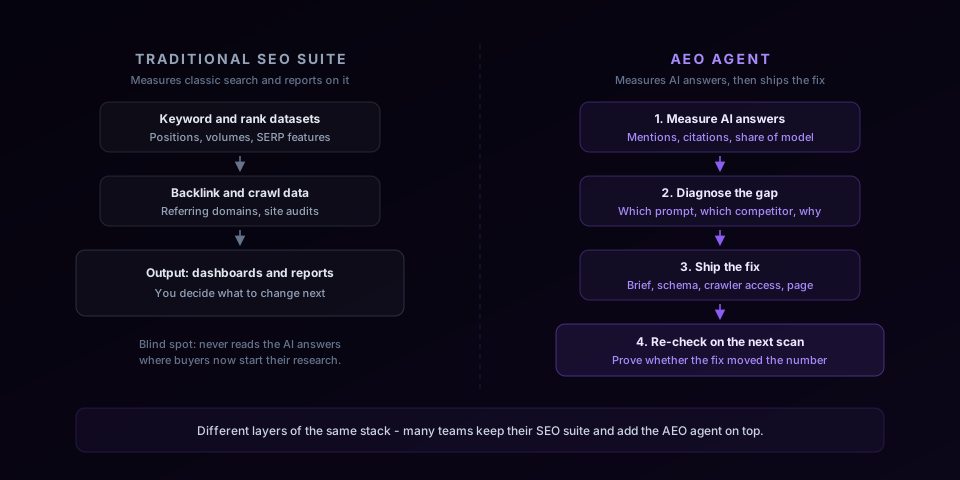
AEO Goal is an agent, not a dashboard, and its loop is deliberately narrow and deep.
- It reads the answers. Your priority prompts run against ChatGPT, Claude, Gemini, Perplexity, and Google AI Overviews on a schedule; every generated answer is parsed for brand mentions, cited source URLs, position, and sentiment.
- It attributes the loss. Per engine, you see which prompts cite a competitor and skip you, and which competitor page won the citation.
- It ships the fix. Blocked AI crawler, missing llms.txt, absent JSON-LD, weak entity salience, no extractable answer page: each finding becomes a concrete action in one prioritized backlog.
- It re-checks. The next scan shows whether citations and share of model moved. Proof, not vibes.
A broad suite will automate many site changes and report rankings and traffic. AEO Goal measures the one surface a rankings-and-traffic view does not read - the generated answer itself - and treats a missed citation as the problem to solve, not a side metric.
On auto-deploy: control versus hands-off
The honest tradeoff to name is auto-deployment. A pixel-driven autopilot that pushes changes to your live site is powerful and fast, and for some teams that hands-off model is exactly the point. It also means changes are applied broadly and automatically, which some teams want and others would rather review. AEO Goal generates the specific fix and content for each citation gap, tracks whether it was applied, and then verifies the result on the next scan, which favors targeted, checkable change over wide auto-deployment. Neither is wrong; they suit different appetites for automation. Confirm the exact auto-apply and publishing behavior with each vendor, because that is the detail that decides it.
The classic SEO stack, included
AEO Goal is not an AI-only layer. It carries the core search stack in the same workspace - keyword research with volume and difficulty, daily Google rank tracking, backlink analysis with a DR-weighted Domain Score, and technical site audits including measured Core Web Vitals - plus AEO Rank, which scores your authority among the domains AI engines actually cite. Where it deliberately does not compete is channel breadth beyond organic: it is not an ads platform, and a suite that spans paid campaigns covers more ground there.
The jobs, side by side
| The job to be done | Broad AI automation suite | AEO Goal |
|---|---|---|
| Auto-deploy a wide range of SEO changes to the site | A defining strength | Generates fixes; verify auto-apply scope |
| Measure AI citation rate and share of model per engine | Varies by product | Core strength, first-class metric |
| See which competitor page won a citation you lost | Varies | Yes, with the fix attached |
| Re-check that a fix moved AI citations | Not the focus | Built in |
| Keyword research, daily rank tracking, backlinks, audits | Yes | Included |
| Ads and multi-channel workflows | Often included | Out of scope |
| Score authority among domains AI engines cite | Varies | AEO Rank, with DR-weighted Domain Score |
When Search Atlas is the better fit
Choose the broad suite, without hedging, when wide workflow automation is the goal: when you want one platform to auto-deploy technical, on-page, content, and link changes across many sites, when ads and multi-channel work are part of the brief, or when a hands-off autopilot is exactly the model your team wants. Confirm the current feature matrix, auto-deploy behavior, channel coverage, and pricing with the vendor before committing.
When AEO Goal is the better fit
Choose the agent when appearing in AI answers is the priority and you want it measured, fixed, and verified. If the metric that matters is citation rate and share of model, not breadth of automation, the focused loop is the product. If you want targeted, reviewable fixes over wide auto-deployment, that is the design. And if you want to start by measuring your own domain, the free scan is the entry point.
What to verify with each vendor
A comparison page is a shortlist input, not diligence. Before buying:
- With Search Atlas: current pricing and plan limits, exactly which changes OTTO auto-deploys and how reversible they are, channel coverage including ads, AI-visibility features and how they measure, and enterprise terms.
- With AEO Goal: engines and prompt counts per plan, scan cadence, how AEO Rank and Domain Score are computed, how fixes are generated, applied, and re-checked, pricing, and data handling. Then test against your own domain, not a demo.
- With both: SSO, access control, data retention, subprocessors, rate limits, and cancellation terms.
For the broader landscape, see best AI SEO tools and AEO vs traditional SEO.
Baseline your AI visibility in five minutes
Measure your own domain before you decide anything. The free AI visibility scan checks AI-crawler access across 16 agents, llms.txt, sitemap, JSON-LD, metadata, and entity salience against your live site, and your first prompt runs show citation rate and share of model per engine. If the gaps are real, you will get the exact list of what is in the way - and AI citation tracking will prove whether each fix worked.