Quick Answer
Profound is a purpose-built answer engine optimization platform known for large prompt-volume datasets, per-engine citation and sentiment tracking, AI-crawler analytics, and in-platform content agents, with enterprise controls and a hands-on strategist model. AEO Goal is an AEO agent built around a tighter loop: it runs your prompts across ChatGPT, Claude, Gemini, Perplexity, and Google AI Overviews, measures citation rate and share of model per engine, diagnoses why you were skipped, ships that fix, and re-checks it on the next scan. It also carries the classic search stack - keyword research, daily rank tracking, backlink analysis with a DR-weighted Domain Score, and technical site audits - so most teams do not need an SEO suite underneath it.
Same category, different stopping point
This is not a links-versus-answers comparison. Profound and AEO Goal are in the same category: both exist because AI answer engines now sit between your buyers and your site, and both read the generated answers to tell you whether those engines mention and cite you. If you are evaluating these two, you already believe in measuring AI visibility. The real question is what the tool does after it has measured.
Profound’s reputation is as a measurement-and-insights platform, and a serious one. Its strength is the data layer: a very large base of real user prompts segmented by intent, per-engine tracking of citation share, accuracy, and sentiment, visibility into how an engine fans a single prompt into many retrieval searches, and analytics on AI-crawler activity against your site. Alongside that it runs in-platform content agents that generate briefs and drafts. For a team that wants a deep, category-scale view of the answer-engine landscape with hands-on support, that is a strong offering.
AEO Goal is built around a narrower, more operational promise: not just see the gap, close it and prove it closed.
What AEO Goal is built for: the measure-fix-recheck loop
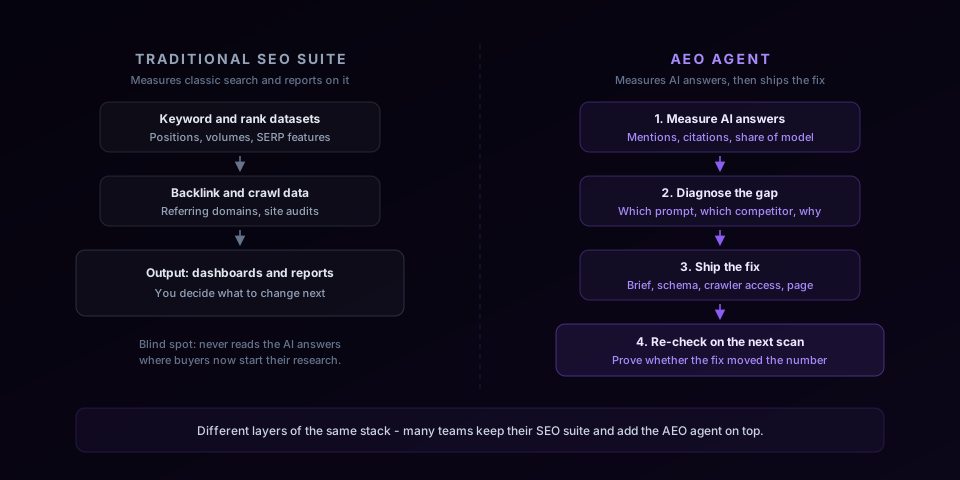
AEO Goal is an agent, not a dashboard. The loop is the product.
- It reads the answers. Your priority prompts run against ChatGPT, Claude, Gemini, Perplexity, and Google AI Overviews on a schedule; every generated answer is parsed for brand mentions, cited source URLs, position, and sentiment.
- It attributes the loss. Per engine, you see which prompts cite a competitor and skip you, and which competitor page won the citation.
- It ships the fix. Blocked AI crawler, missing llms.txt, absent JSON-LD, weak entity salience, no extractable answer page: each finding maps to a concrete action in one prioritized backlog, from a robots.txt change to an answer-first brief.
- It re-checks. The next scan shows whether citations and share of model moved. Proof, not vibes.
That loop is the whole point of comparing a measurement platform against an agent. A platform tells you share of model dropped on a set of prompts; the agent tells you it dropped because two AI crawlers are blocked and the answer is buried below a 400-word intro, opens the crawlers, rewrites the opening, and shows you the citation return on the next run.
The classic SEO stack, included
The second real difference is scope beneath the AI layer. A page that AI engines decline to cite is usually a page with an ordinary SEO problem: it is slow, it is not cleanly crawlable, its structure hides the answer, or it has no authority behind it. AEO Goal carries the tools to fix that in the same workspace - keyword research with volume and difficulty, daily Google rank tracking, backlink analysis with a DR-weighted Domain Score, and technical site audits including measured Core Web Vitals - plus AEO Rank, which scores your authority among the domains AI engines actually cite.
If you pair a pure AI-visibility platform with your existing SEO suite, that is two tools and two workflows. If the classic stack lives next to the answer-engine layer, the fix for a citation gap and the fix for the underlying page are the same ticket.
The jobs, side by side
| The job to be done | Measurement-led AEO platform | AEO Goal |
|---|---|---|
| Track citation share and sentiment per engine | Core strength | Yes, per engine, as a trend |
| Mine category demand from very large prompt datasets | A defining strength | Focused on your priority prompts |
| See which competitor page won a citation you lost | Varies by product | Yes, with the fix attached |
| Turn a citation gap into a shipped technical or content fix | You act on the insight | Fix-and-recheck loop, one backlog |
| Score authority among domains AI engines cite | Varies | AEO Rank, with DR-weighted Domain Score |
| Keyword research, daily rank tracking, backlinks, site audits | Typically out of scope | Included |
| Hands-on strategist / managed engagement | Often included | Self-serve agent; verify support tiers |
When Profound is the better fit
Choose the measurement-led platform, without hedging, when category-scale prompt intelligence is itself the deliverable: when you need to mine demand across a very large prompt base, when a dedicated strategist and managed engagement are part of what you are buying, or when your workflow is built around deep answer-engine analytics that a smaller, loop-focused agent is not trying to replicate. Confirm the current dataset size, feature matrix, and enterprise terms with the vendor, because those are exactly the claims a comparison page should not freeze in time.
When AEO Goal is the better fit
Choose the agent when the bottleneck is acting, not seeing. If your team already suspects where it is losing citations and needs the diagnosis, the fix, and the proof it worked, the loop is the product. If you would otherwise run a separate SEO suite for keyword, rank, backlink, and audit work, folding that into the same workspace removes a tool and a handoff. And if you want to start by measuring your own domain rather than a demo, the free scan is the entry point.
What to verify with each vendor
A comparison page is a shortlist input, not diligence. Before buying:
- With Profound: current pricing and plan limits, prompt-dataset size and methodology, exact engines and update cadence, how its content agents generate and deploy, support and strategist model, and enterprise controls (SSO, RBAC, retention, subprocessors, security certifications).
- With AEO Goal: engines and prompt counts per plan, scan cadence, how AEO Rank and Domain Score are computed, how fixes are generated and re-checked, pricing, and data handling. Then test against your own domain, not a demo.
- With both: SSO, access control, data retention, subprocessors, rate limits, and cancellation terms.
For the broader landscape, see best AI SEO tools and AEO vs traditional SEO.
Baseline your AI visibility in five minutes
Measure your own domain before you decide anything. The free AI visibility scan checks AI-crawler access across 16 agents, llms.txt, sitemap, JSON-LD, metadata, and entity salience against your live site, and your first prompt runs show citation rate and share of model per engine. If the gaps are real, you will get the exact list of what is in the way - and AI citation tracking will prove whether each fix worked.