Quick Answer
AEO Goal and Ubersuggest solve different definitions of search. Ubersuggest is broadly positioned as a budget-friendly way into classic SEO: keyword research and site-audit basics. AEO Goal is an AEO agent: it measures whether ChatGPT, Claude, Gemini, Perplexity, and Google AI Overviews mention and cite your business, hands you the specific fix, re-checks the result, and still covers keyword research, daily rank tracking, and backlinks. If your first SEO tool should reflect where buyers actually ask questions in 2026, start with the one that can read an AI answer.
What are you actually buying when you buy your “first SEO tool”?
If you are comparing AEO Goal and Ubersuggest, you are probably a small business owner or a first marketing hire buying your first serious search tool. So before comparing features, settle a more basic question: what does “SEO” mean for your business in 2026?
For twenty years it meant one thing: rank higher in a list of blue links so people click you. That game still exists, and it still counts. But a second game now runs on top of it. When someone asks ChatGPT “what’s a good CRM for a five-person landscaping company” or asks Perplexity “who makes the best beginner espresso machine under $500,” they do not get ten links. They get one composed answer that names two or three businesses and cites a handful of sources. Everyone else is invisible, no matter how well they rank.
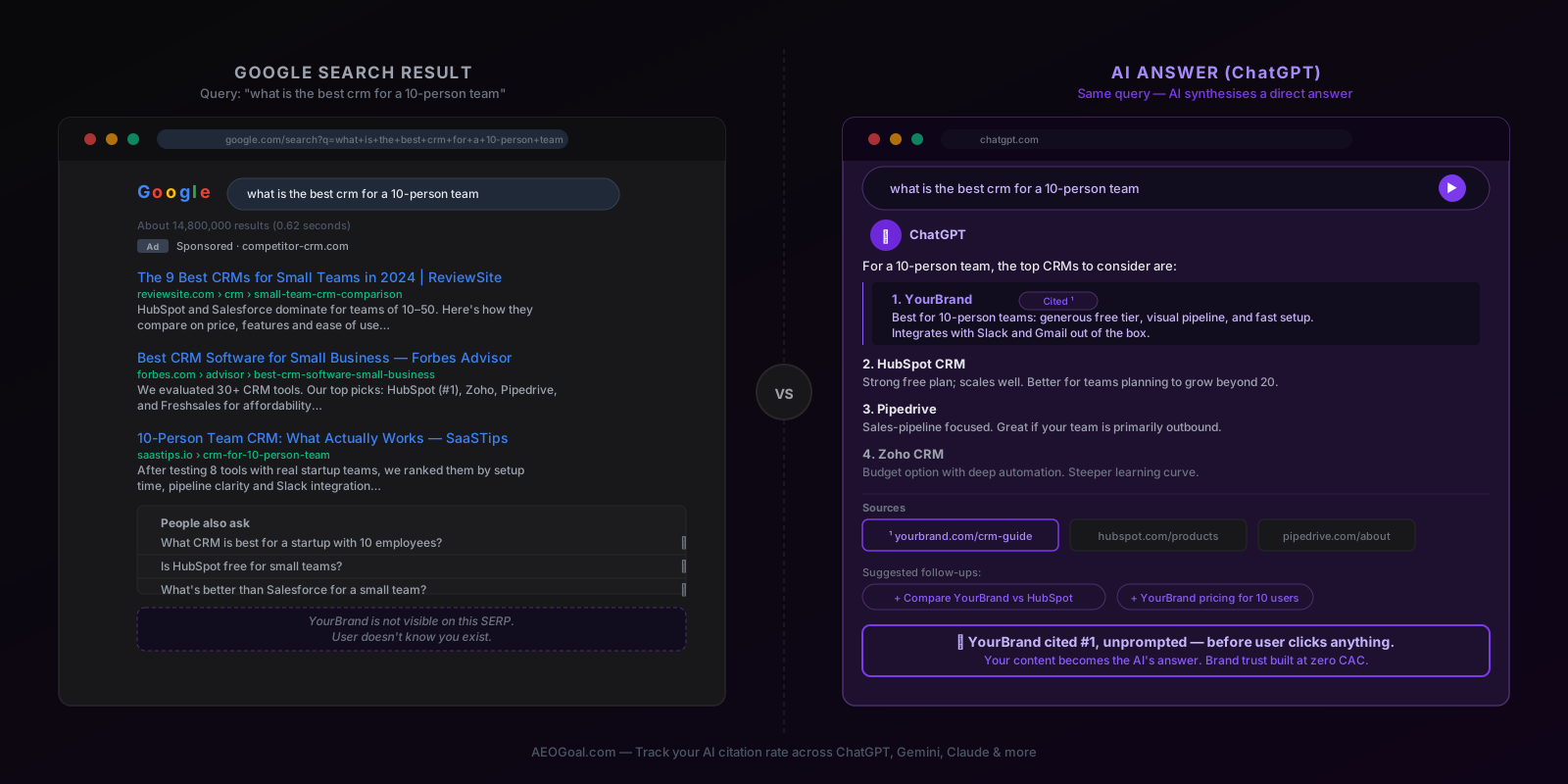
That is the real fork in this comparison. One path buys you tooling for the rankings game. The other buys you tooling for both games at once. This page walks through the decision honestly, including the cases where the budget classic tool is genuinely the right call. For the category background, start with what is AEO.
What is Ubersuggest built for?
Ubersuggest sits in a well-understood category: budget-friendly SEO software covering keyword research and site-audit basics. Tools in this category earn their place by making rankings-era SEO approachable for people who are not SEO professionals: find keywords people search, get a sense of competition, surface obvious technical problems on your site, and do it without an enterprise contract.
That is a legitimate and useful job. If you have never done keyword research, a tool like this teaches you the vocabulary of classic search, and for plenty of small businesses that education alone pays for itself. We will not tell you what Ubersuggest currently costs, what its plans include, or how big its databases are; that information changes and you should verify it with the vendor (see the checklist below). What we can say fairly is what the category does not do: tools built for keyword data and rankings do not run prompts against AI answer engines, parse the generated answers, or tell you why an assistant recommended your competitor instead of you.
What is AEO Goal built for?
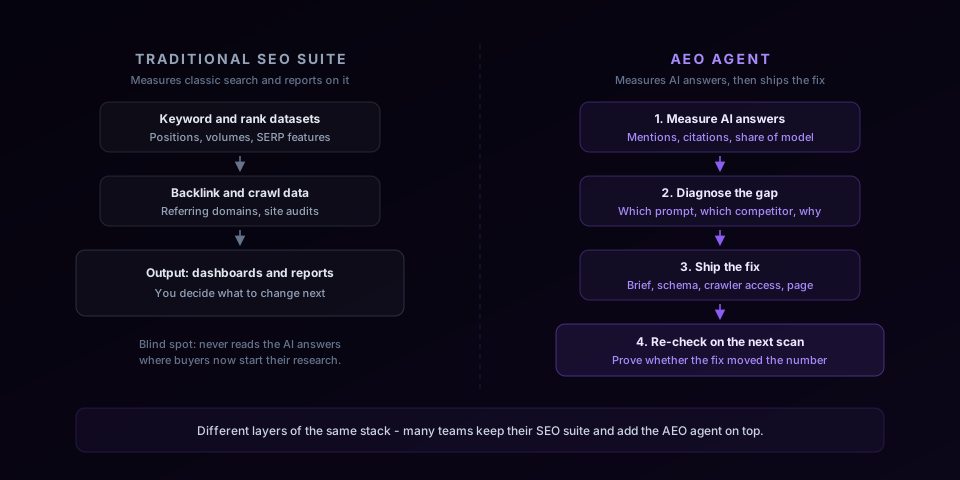
AEO Goal is built as an agent for the answer era, not a dashboard for the rankings era. The distinction is more important than any feature list. A dashboard reports numbers and hands the hard part back to you. An agent closes the loop:
- It measures the answers directly. AEO Goal runs your priority prompts against ChatGPT, Claude, Gemini, and Perplexity on a schedule and parses each generated answer for brand mentions, cited source URLs, position, and sentiment, then reports citation rate, share of model, and competitor overlap per engine.
- It diagnoses the gap. Not “your visibility is 12%,” but which prompt cites a competitor and skips you, on which engine, and the likely cause: a blocked AI crawler, missing entity signals, weak answer structure, or no citable source page.
- It ships the fix. Every finding maps to a concrete action: an answer-first content brief, a schema change, a robots.txt or llms.txt fix, or a specific page to publish, prioritized by impact on one backlog.
- It re-checks. On the next scan, it shows whether the fix moved citations, share of model, or rankings. You get proof, not hope.
And because a small business should not need two subscriptions to cover two search surfaces, AEO Goal carries the classic stack too: keyword research, daily Google rank tracking, and backlink analysis with a DR-weighted Domain Score plus AEO Rank, which measures authority among the domains AI engines actually cite. Findings from both surfaces land in the same prioritized backlog. That combination is the whole pitch of AEO Goal as AI SEO software: one tool, both games, and it acts instead of just watching.
Which jobs does a first SEO tool need to do in 2026?
Ignore feature counts. List the jobs you actually need done and see which category covers them. These are the ones small-business buyers weigh in this comparison:
| The job you need done | Budget classic SEO tool (Ubersuggest’s category) | AEO Goal |
|---|---|---|
| Find keywords customers search on Google | Core territory for the category; verify specifics with the vendor | Yes: keyword research with volume, difficulty, and SERP features |
| Spot basic technical problems on your site | Site-audit basics are the category’s second pillar | Yes: technical audits feeding the same fix queue, plus AI-crawler checks classic audits skip |
| Know whether ChatGPT or Perplexity recommends you or a competitor | Outside the category: these tools read rankings, not generated answers | Yes: prompts run across ChatGPT, Claude, Gemini, and Perplexity, with citation rate and sentiment per engine |
| Learn why an AI answer skipped your business | Outside the category | Yes: the prompt, the competitor URL the engine cited, and the diagnosed cause |
| Get the exact next fix, then confirm it worked | Category tools report; acting is your job | Yes: the fix-and-recheck loop is the product |
| Track Google rankings over time | Common in the category; verify plan specifics | Yes: daily rank tracking for priority keywords and competitors |
| Try before paying | Varies by vendor; verify | Yes: the free scan runs with no signup |
Read the table honestly and the pattern is clear: the left column is a subset of the right column, and the rows the left column cannot touch are the rows where buying decisions increasingly happen.
When is Ubersuggest enough?
Sometimes the budget tool is the right tool, and pretending otherwise would be the kind of copy this site refuses to write. A tool in Ubersuggest’s category is likely enough if all of these are true:
- Your customers still find you almost entirely through classic Google results, and you have checked that assumption rather than assumed it.
- Your only near-term goal is learning keyword research and cleaning up basic on-site issues.
- Nobody asks an AI assistant questions your business should be the answer to, which is rare in 2026 but not impossible for some local or niche categories.
The problem is that the third condition quietly stopped being true for most businesses. The question is not whether classic keyword research is worth doing cheaply; it is whether you can afford to be invisible on the surface where a growing share of buyers get their shortlist. A great rank on a results page nobody scrolls past the AI answer to see is a trophy, not a channel.
Should you run both, or consolidate?
Two honest paths:
- Run both. Keep a budget classic tool for keyword exploration if you already know and like it, and add AEO Goal as the answer-engine layer that measures AI visibility and ships fixes. The AEO vs traditional SEO breakdown explains why the two disciplines complement rather than replace each other.
- Consolidate. For most small teams, AEO Goal’s built-in keyword research, daily rank tracking, and backlink analysis cover the classic basics well enough that a second subscription becomes redundant. One login, one backlog, one report.
The wrong path is the common one: buying only the classic tool and concluding that “SEO is handled” while AI assistants recommend your competitors every day, unmeasured.
A worked example: a local HVAC company
Say you run a 12-person HVAC company in Austin. The rankings game: you want to rank for “AC repair Austin,” so a classic tool helps you pick keywords and flag site issues. Necessary, and AEO Goal’s keyword research and rank tracking handle it.
Now the answer game. A homeowner asks their assistant, “my AC is blowing warm air, who should I call in Austin?” The engine composes an answer naming two or three companies. AEO Goal’s free scan first checks whether your site is even readable by the 16 AI crawlers it tests in robots.txt, whether llms.txt exists, and whether your structured data and entity signals identify you as an HVAC service in Austin at all. Then tracked prompts reveal which competitors the engines actually name for repair-intent questions, which sources they cite (often a directory or review page, not the competitor’s own site), and where you are absent. Each gap arrives with a fix: an answer-first page brief for “AC blowing warm air” questions, a schema correction, a crawler-access fix. Next scan, you see whether the engines picked it up. No classic-category tool can even see this battlefield, let alone fight on it.
What should you verify with each vendor before buying?
This page deliberately makes no claims about Ubersuggest’s current pricing, plan limits, feature matrix, or data sizes. Before buying either tool, verify directly with each vendor:
- Current pricing, plan contents, and usage limits, from the vendor’s own site, not review roundups or AI answers.
- Whether the tool measures AI answers directly (which engines, how prompts are sampled, how often results refresh) or only classic rankings.
- Whether findings become specific actions with a re-check, or reports you must translate into tasks yourself.
- Data handling, cancellation terms, and support: the best AI SEO tools framework has the full checklist.
- In a trial, one test question: “which prompt am I losing, to whom, and what exactly should I change?” A tracker shows a chart; an agent answers the question.
Start where the answer starts
Your first SEO tool decides which game you learn to play. The classic basics are worth having, and AEO Goal includes them. What only an AEO agent gives you is sight of the surface where buyers increasingly make decisions, plus the fix, plus the proof it worked. Run the free AI visibility scan now: no signup, and in a few minutes you will know whether AI engines can even read your site, and what to fix first.