Quick Answer
Moz is a long-standing SEO suite known for Domain Authority and for teaching much of the industry how SEO works. AEO Goal is an AEO agent for the question DA was never built to answer: whether AI engines cite you. Domain authority predicts rankings; what predicts AI citations is retrievability, entity clarity, and citable source pages. AEO Goal measures your prompts across ChatGPT, Claude, Gemini, Perplexity, and Google AI Overviews, explains each gap, ships the fix, and re-checks it, while carrying keyword research, daily rank tracking, and backlinks with a DR-weighted Domain Score and AEO Rank. Many teams run both; leaner teams consolidate.
Where these two tools come from
This comparison attracts a specific kind of buyer: someone who learned SEO properly. You know what a domain-authority-style score is and, more importantly, what it is not - a prediction of ranking ability, not a grade from Google. You probably learned that distinction from the kind of patient, honest SEO education Moz is known for. That education is exactly why this page can be short on hype: you already have the mental model for evaluating a metric by what it predicts.
So here is the claim this page stands on, stated the way a good SEO course would: domain authority predicts rankings. It does not predict AI citations. Those are two different outcomes with two different causal chains, and a team that measures only the first will systematically misread its position in the second. Everything below is the supporting argument, plus an honest account of when the classic suite remains the right tool.
What Moz is built for
By its broadly known category role: Moz is one of the longest-standing SEO suites, known above all for Domain Authority - the metric that became shorthand for site strength across the entire industry - and for SEO education that taught a generation of marketers the craft. Around that sit classic suite workflows: keyword research, rank tracking, site auditing, link analysis. For a team that wants dependable classic-search fundamentals with a gentle learning curve and a trusted authority metric, that is a coherent, respectable offer. Verify its current packaging and features with the vendor; the category role is not in question.
Does Domain Authority predict AI citations?
No, and the reason is structural, not a knock on the metric. DA-style scores are trained to predict one outcome: how well a domain competes in ranked results. AI answers are not ranked results. When ChatGPT or Perplexity answers “what is the best [your category] for a small team,” it retrieves a handful of pages, extracts claims, and cites the sources it used. Three different gates decide who gets cited, and none of them is a ranking prediction:
- Retrievability. Can the engine’s crawlers reach your pages at all? A robots.txt rule written years ago for a different web can silently block AI agents; a missing llms.txt leaves engines without the map you could have given them.
- Entity clarity. Does the engine know what your brand is, what it does, and how it relates to the category? Weak entity salience and missing structured data make you hard to place in an answer even when your pages are reachable.
- Citable sources. Is there a page that answers the question directly, near the top, with proof - something an engine can quote? A high-authority page that buries its answer loses citations to a modest page that leads with one.
This is why the field data keeps surprising authority-minded teams in both directions: strong-DA brands invisible in answers because they fail gate one or three, and modest domains consistently cited because they pass all three. If you internalize one thing from this page, make it this: your authority score is not evidence about your AI visibility, in either direction. You have to measure the answers themselves. For the fuller conceptual picture, see what is AEO.
What AEO Goal is built for: measure, explain, fix, re-check
AEO Goal is an AEO agent, and the education-minded buyer is the one who will most appreciate what that means: it does not just report a number, it shows its reasoning.
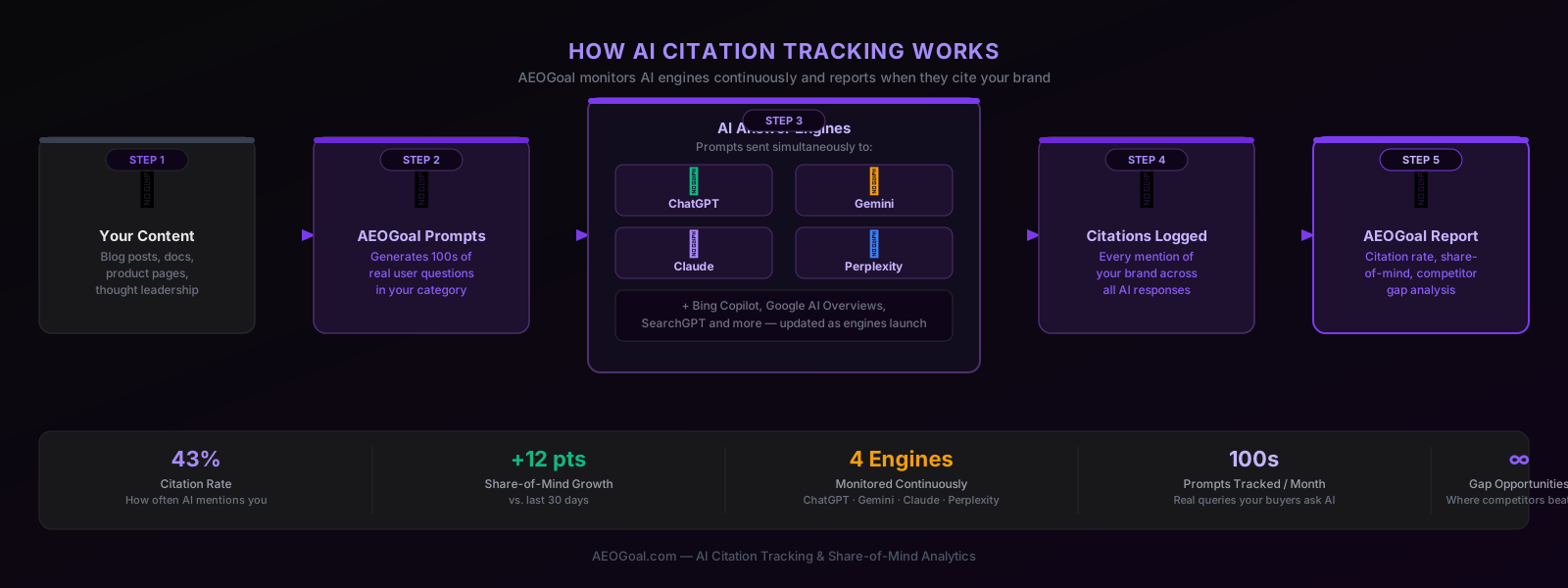
- Measure. Your priority prompts run on a schedule across ChatGPT, Claude, Gemini, Perplexity, and Google AI Overviews. Each generated answer is parsed for mentions, cited source URLs, position, and sentiment, rolling up into citation rate, share of model, and competitor overlap per engine.
- Explain. Every gap names its cause: a blocked AI crawler, missing JSON-LD, weak entity salience, no citable answer page. Not “your score is low” but “here is the gate you are failing and why.”
- Fix. Each finding ships as a concrete action - an answer-first content brief, a schema change, a crawler-access fix, a page to publish - in one prioritized backlog, free fixes surfaced first.
- Re-check. The next scan shows whether the fix moved citations, share of model, or rankings. Action, then measured result: the same feedback loop good SEO education has always taught, now built into the tool.
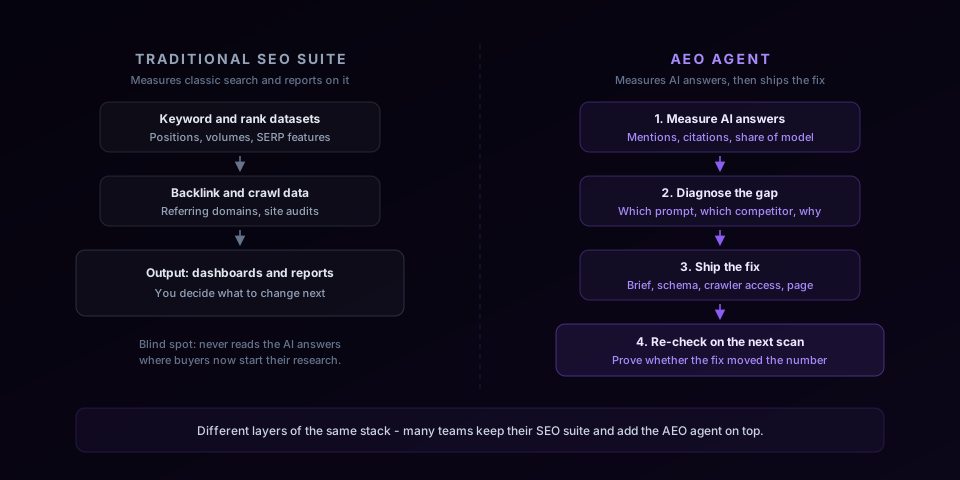
On authority specifically, AEO Goal deliberately gives you both lenses: a DR-weighted Domain Score for the classic link-authority view, and AEO Rank, which measures your standing among the domains AI engines actually cite for your prompts. When Domain Score is healthy and AEO Rank is not, the divergence itself is the diagnosis - your authority exists but is not registering where answers are assembled - and the backlog tells you which gate to fix first. The classic core (keyword research, daily rank tracking, backlink monitoring) lives in the same workspace, so both disciplines land in one queue.
Job by job: which tool answers which question?
| The question you are actually asking | Classic authority-led suite | AEO Goal |
|---|---|---|
| How strong is my domain for ranking in classic search? | Its signature metric | DR-weighted Domain Score |
| How strong am I among domains AI engines actually cite? | Not measured | AEO Rank |
| Do AI answers mention or cite my brand for buyer prompts? | Not designed to read answers | Yes, per engine, as a trend |
| Which competitor page won the citation I lost, and why? | No | Yes, with the cause named |
| Can AI crawlers even reach my pages? | Classic crawl audits target search bots | Free scan: robots.txt across 16 AI agents, llms.txt |
| Is my brand entity clear enough to be placed in answers? | Not measured | Entity salience, JSON-LD, metadata checks |
| What do I fix first, and did it work? | You interpret the reports | Fix-and-recheck loop, one prioritized backlog |
| Keyword research and daily rank tracking | Yes | Yes |
When Moz is the right choice
Plainly: if your work is classic search and you value a suite with a long track record, a widely understood authority metric your stakeholders already speak, and education that levels up a junior team, the classic suite is a sound home for that work. If nobody in your buying journey asks an AI engine anything - still true in some categories - the AEO layer can wait, and it would be dishonest of this page to insist otherwise. Match the tool to the job.
Running both, or consolidating
Run both when the suite carries real reporting weight in your organization - stakeholders track its metrics, workflows are built around it - and the team needs to add the AI-answer layer. There is no conflict: the suite keeps the classic lens, AEO Goal reads and fixes the answers, and the overlap in keyword and rank features is a renewal-time cost question.
Consolidate when an honest audit shows your classic usage is the core three - keyword research, rank tracking, backlink monitoring - plus reporting. AEO Goal carries that core with both authority lenses, adds the entire citation layer, and puts every finding on one backlog. Leaner in-house teams take this route because it swaps a second subscription for a surface they currently cannot see. Either way, read AEO vs traditional SEO first, so the decision is about jobs rather than logos.
A worked example: the team that learned SEO the right way
Picture an in-house marketer at a mid-sized HR-software company who has run a disciplined program for years: authority built patiently through genuinely useful content, clean site health, rankings earned rather than gamed. The authority score is the best in their bracket and the board slide says so. Then a renewal call goes sideways: the champion says their exec asked Gemini for alternatives, and the summary framed the brand with a three-year-old pricing complaint - when it appeared at all.
The first week with AEO Goal reframes the problem. The free scan shows two AI crawlers blocked and no structured data on the product pages; prompt tracking across 35 buyer prompts shows a low citation rate with sentiment skewing neutral-to-negative on the prompts that mention pricing. Cause, fix, and re-check follow in order: crawlers unblocked, JSON-LD shipped, and an answer-first page addressing the pricing question directly, from the generated brief. Over the next scans, citation rate climbs on Gemini and Perplexity and sentiment on the pricing prompts turns; the outdated complaint stops being the only citable source because a better one now exists. Nothing about the team’s authority changed. What changed is that the answers finally had something accurate to retrieve, understand, and quote.
What to verify with each vendor
Treat every public comparison, including this one, as a shortlist input. Before purchasing:
- With Moz: current pricing and plan limits, which suite modules you will actually use, any AI-visibility features it now offers and how they measure, data freshness, and contract terms.
- With AEO Goal: engines and prompt counts per plan, scan cadence, how Domain Score and AEO Rank are computed, how briefs and fixes are generated and re-checked, pricing, and data-handling terms - then test on your own domain, not a demo.
- With both: SSO and access controls, data retention, subprocessors, API and rate limits, and cancellation terms.
For evaluating the whole category, the checklist in best AI SEO tools applies to every vendor, including us.
Get the number DA cannot give you
You already know your authority score. In five minutes you can know the other number: run the free AI visibility scan and see whether AI engines can retrieve your pages (robots.txt across 16 AI agents, llms.txt), whether your structured data and entity salience hold up, and what to fix first. If your rankings and your citations turn out to be moving together, wonderful - now you have evidence. If they are not, AI visibility tracking is the discipline that closes the gap, and AEO Goal will show its work at every step.